 Over 30 years, the MOISEIKIN company based in the Ural area has become a famous jewellery brand.
The jewellery and souvenirs of this jewellery house made of precious and semi- precious stones and metals are displayed at museums and in private collections of world celebrities, representatives of the political and cultural elite - from the Queen Elizabeth of Great Britain and German Ex-Chancellor Angela Merkel to designer Paco Rabanne and movie star Catherine Deneuve.
Salons and representative offices of the company are located in Russia, Japan, the UAE, the PRC and Hong Kong, and the central representative office is based in Yekaterinburg.
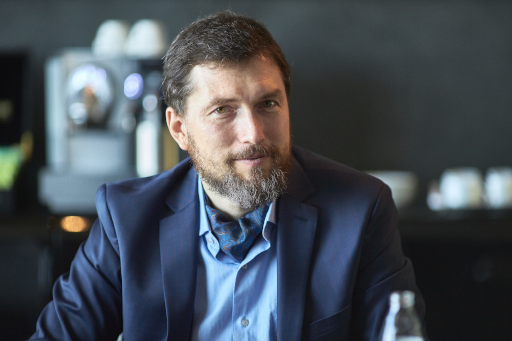
Viktor Moiseikin, the founder of the “Moiseikin” Jewellery House, the author of the proprietary technology of the unique “Waltzing Brilliance” setting for stones who has many awards for his designs, told Rough&Polished about his attitude to the Fabergé heritage, jewellery and about the philosophy of his jewellery.
Recently, the Museum of Decorative and Applied Arts presented your company’s precious lines, both genre and floral ones, reminiscent of the “imperial gifts” of Karl Fabergé’s times. You are often called his successor who ‘inherited’ his traditions. Are your roots from Fabergé or from Ural craftsmen from Bazhov’s fairy tales? What are the sources of inspiration for you?
To my mind, Fabergé is first of all an innovator. Continuing his traditions is not just to ‘blow off the dust’ from his heritage - the very spirit of his creative work should be continued. In addition to innovation, it is also the “Russianness” - in a broad sense, a certain alloy of various cultures of the East and the West. Should Fabergé live now, he would make other jewellery pieces, because the world has changed, we have changed, technologies have changed - we can express our feelings, emotions in precious materials in a different way. Fabergé studied jewellery in Russia and abroad and even tried to make Feodosia earrings, inspired by Scythian jewellery pieces – jewellery art works with the plot and skillfully made. We cannot even copy these technologies - it is not clear how the jewellery pieces were made. We seem to continue creating jewellery items that look like Faberge ones, but made in a modern and innovative way; you know, there are words in Vysotsky’s song “Follow me, don’t do as I do.”
But some of his technical and artistic solutions, for example, his courage to use unusual materials, enamels, interesting technical solutions for metal processing, settings and clasps, undoubtedly, had some influence on me. And the fact that he was able to convince everyone with his jewellery art works that the jewellery piece’s cost can exceed the cost of the materials used - probably, I also continue his traditions in this regard.
The Moiseikin Jewellery House was founded in 1993. What has changed over the years as for themes, genres, trends?
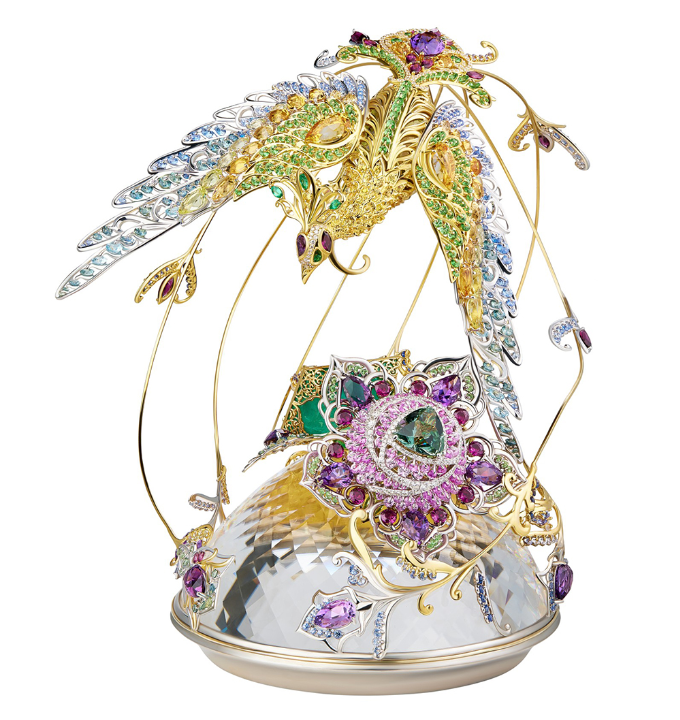
Our company will celebrate thirty years this year. A team of high-class sculptors, stonecutters, jewellers was formed, and each of us contributes to the creation of souvenirs and jewellery - from the development of an idea to its implementation. Now, we are specializing more in exclusive jewellery, precious souvenirs and interior miniatures, picturesque stone panel pictures, and premium gifts. We continue the traditions of the Russian jewellery school and try to give the jewellery we made a modern twist. In recent years, we have focused more on jewellery created using new technologies and we received a patent for the invention of an innovative Russian “Waltzing Brilliance” setting. This is a disruption in design - it is now called a “Russian setting”.
Tell us how did the idea of this technology leaped into your mind?
At some point, I realized that as a designer I did not have enough tools. That is, I wanted to express the ‘flower tremor’- how could I do this? Well, probably, I could use more diamonds to place them on different levels, put one large stone as a drop of dew and add other small ones ... But something like this has already been done repeatedly. And how to convey the admiration for a flower, its tremor, lightness and tenderness in a special way? For me, stones - and primarily diamonds - are light sources. I even have a poem about this, “Flowers seemed to be woven from the light, they are the remnants of paradise, a symbol of purity ...”, they are ‘flowers made of the light’. When a stone is ‘drowned’ in a metal setting, a lot of its charm is lost, and when it is open, it’s another thing. And the idea of this assignment arose, inter alia, due to love for the Russian ballet: I wanted a diamond look like a ballerina when she is doing fouette, I wanted the stone to make light and free movements, shine with all its sparkling facets. I wanted a diamond not to be clamped, I wanted it could be seen from all sides and the light could strike the stone’s facets and reflect. After all, a polished diamond’s pavilion looks no less beautiful than its crown, and all its facets reflect the light, not only its crown.
So, the idea of a setting arose: thanks to this technology, reliably fixed jewellery stones can move and rotate, creating a unique dynamic effect.
And an aesthetic effect, too. We can say that you have made a revolution by bringing the movement and life to static jewellery and souvenirs.
Exactly. This technology helps a jeweller convey the tremor of a flower, vibration of a bird’s wing, the movement of a wave, the murmuring of a surf...
It is very important for me that there is life in a jewellery item, some kind of movement. On the other hand, this is a technology that was inaccessible in the 20th century: it is not possible to do this manually, it can only be done on the computer because additive technologies, prototyping, and cultivation are required. This is a 0.2-mm thin metal ‘net’, into which the stones are ‘woven’. And it is beautiful on both sides, so you can make any curved surfaces. And everything will move in the jewellery piece - both the metal and the stones inside it.
I gave lectures in China on the topic “Modern Architecture of Jewellery, a Russian Setting”. Everyone is very interested in this new tool that gives a designer a possibility to look at a flower, at the sky, at the stars shining brighter - at everything.
What is more important - a shape or colour?
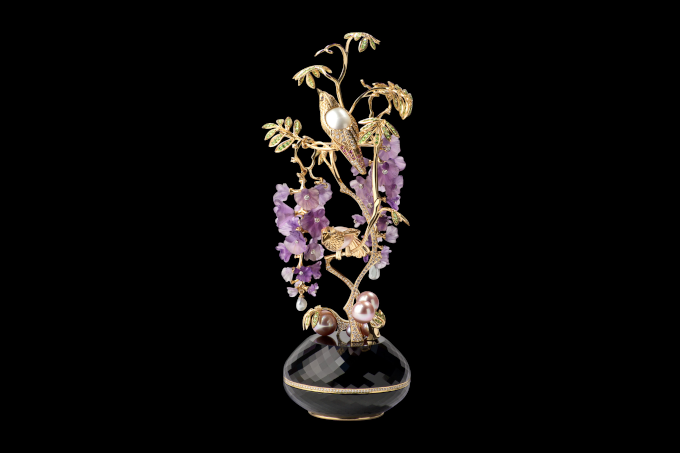
Everything is important. I determined for myself: in every jewellery item I make, there should be “4M”. The first is a Message: some idea that inspired me. Then, you begin to select Materials for a jewellery piece. Third is Manship (craftsmanship): you must make it very skillfully. And the fourth “M” is Moiseikin: I must implement the previous “3M” in my own way.
Now, many jewellers speak - and they are right - about the crisis, about difficult times, obstacles, and imperfect legislation. All of them were hit by pandemic and lockdown, then a special operation began in Ukraine, there is a chaos around and you have new collections, exhibitions, some kind of activities all the time. One day, you give some present to Catherine Deneuve, some other day, the current King of the United Kingdom came across your exhibits at the London exhibition... How can you cope financially, and save the harmony of mind and heart?
So, you said the keyword now - harmony. This year, we just presented the collection that I have worked on for two years - it is called “Harmony”.
Whether a glass is half full or half empty depends on your inner perception. From the point of view of business, some changes, both positive and negative, occur all the time. Do you remember what Tolstoy advised someone in his letter, “If you can do without writing, well, don’t write, please.” It all depends on your internal message, your own state when you are delighted with something and want to express it. Whatever happens around, your inner perception does not change, you do everything not only for others, but for yourself, too.
God be praised! The Lord arranges everything. I am doing business, which is my hobby. And I cannot do without my business because it is my life. This is an internal message.
But there are objective conditions: a difficult economic situation in the country and very expensive production. How does everything work?
If you do a good and important thing that is required by people, God helps. For example, some person at a construction site works with construction materials, some other one makes money, and the third one builds a house in which people can live happily. So, I make jewellery pieces that bring joy to people. This brings joy to me and those people who will give them as their present, wear or admire them.
And does this bring joy to everyone who works in your company? How many employees are in your company?
There are about one hundred employees in the company and most of them work in Yekaterinburg and the company has also representative offices abroad.
Do you have difficulties in obtaining materials like stones and precious metals?
Our difficulties are not great. Just somewhere, prices rose, and somewhere, logistics has become longer.
Prices rose very much.
I would say that money has fallen in price. With precious stones, the situation is normally like this: high-end goods become more expensive, and low-end goods get cheaper. We always try to buy stones of high value - and we always get money’s worth: a good natural diamond would always be appreciated and some connoisseurs would like to purchase it to add the stone to their collection, or give it as a present to someone.
After all, not so many things survived from all previous civilizations, but jewellery remained and it ‘tells’ a lot, for example, what people admired, what made their lives more beautiful. It turned out to be the same things as in our times, but looking differently. We create what, I hope, will remain for centuries, we make family jewellery, family collections - and our descendants will see our understanding of the beauty, and we will help them in this.
Do your jewellery items always find an owner or collector?
Always, as a rule. If you honestly do your work, and you like your work, sooner or later someone will appear who can appreciate it, too.
Once you met Prince Charles long ago at a jewellery exhibition in London where the current king of the United Kingdom (whom you did not recognized at that time) bought a jewellery piece as a gift to his mother. Can you call anyone else from your customers?
You know, when the number of sheikhs, kings and celebrities exceeded 30, I stopped counting them. I can say that recently, we have made jewellery items to order that were a gift to the King of Saudi Arabia.
In our jewellery pieces, we try to skillfully combine stone and metal in an interesting way. The main thing for me is a gemstone featuring colour and light. And metal is just like a canvas for a painter. We strive to make jewellery in a Fabergé way aimed at showing the beauty of a gem and making a setting that emphasizes the stone’s beauty.
Do you have a favourite gem?
I love them all. If you live in the Ural region, you can’t help but love gemstones. There are all kinds of gems in the Ural area, and from childhood, you see these stones, love, you are an expert in gems and collect them. Since childhood, I collected gemstones, they were attractive. I remember a piece of malachite, which is still in my collection - it looked like mountains and the moon. And I admired the stones very much. Each gemstone has its own mood. Coloured stones carry colour, diamonds sparkle in a special way. The diamonds are not colourless stones and there is the whole range of colours, so a diamond is the main gemstone. Light hitting the stones is reflected, it enhances the luster, radiance and colour of all the gemstones.
In Yekaterinburg, there is a galaxy of brilliant jewellers and successful companies. Are you friends or competitors?
I would not say that we are friends or competitors - just each of us does his or her own business, has his or her own way. If you have your own face, your own philosophy, then you can compete only with yourself - I like to compare myself with what I was a year ago or a few years ago.
When you see someone’s achievements, you do not lose anything and you can only enjoy the things. The only thing that can upset you is when someone steals your ideas. When we started working in China and they copied our jewellery designs, they told us, “You must be happy about this - it means that you create good jewellery”. But only you know how much time and effort you invested to create these jewellery items. And the worst situation is when someone takes your ideas and makes it pretty badly. It’s as if someone would try to copy “Starry night” by Van Gogh.
It is better to do something else, but in your own way. Indeed, in the jewellery art, we express our feelings, emotions and share them with others.
Galina Semyonova for Rough&Polished
