 Lucapa Diamond’s wholly-owned subsidiary Australian Natural Diamonds (AusND) completed the A$8.5 million acquisition of the Merlin project in the Northern Territory.
This included the 24 km2 mineral lease, the 210 km2 exploration licence encompassing the mineral lease, and all existing machinery, infrastructure, and assets on the mineral lease and exploration licence.
In this first part of a two-part exclusive interview, Lucapa managing director and chief executive Stephen Wetherall told Rough & Polished’s Mathew Nyaungwa that although Merlin, previously owned by Rio Tinto until 2003, was a low-cost acquisition, it has the potential to transform Lucapa into a mid-tier diamond producer.
He said the project is expected to be a bigger carat producer and revenue generator for Lucapa, which also has interests in the Lulo and Mothae mines in Angola and Lesotho, respectively.
Below are excerpts from the interview.
What are you currently working on at Merlin in the Northern Territory?
I am pleased to say that we are nearing the end of the large body of work needed to complete the feasibility study. Our technical teams are collating all the individual reports and working with our engaged consultant to collate them into the feasibility study for sign-off. We are hoping to have some numbers to talk to in the coming weeks. We must convey to the market the value that we see in a full-scale mine development, but I think it is important to convey to the market, given the global financial uncertainty right now, the alternate development solutions that we have to derive value from Merlin. So we should be bringing some news to the market shortly on Merlin.
It is a very important development project within our growth focus. We have grown organically with Lulo in Angola, where we've been expanding operations literally from day one, and now it is almost six times larger than the very first year it operated in 2015. We acquired Mothae, in Lesotho, into our portfolio in 2017, and we successfully developed that into our second mine. Mothae is a great mine; however we had challenges there last year, but I am very happy to convey that the diligent work our teams did there to understand the issues, come up with plausible solutions, and implement them, has paid dividends. We've seen some very good things there since those changes were implemented, and we trust there is a good future for Mothae.
So as a company wanting to continue growing, we looked at Merlin, believed there were strong prospects for a mine development under an innovative mining methodology, and therefore acquired it into the Lucapa stable. It is important to convey that Merlin is not just another acquisition that will sit alongside our existing mines. While it was certainly a low-cost acquisition, it has the potential to transform this company tremendously. In terms of scale, once Merlin is brought into production, we will become a mid-tier producer, with well over 200,000 carats per annum from the group, and importantly, it's our first mine in a tier-one jurisdiction.
With a successful mine development at Merlin, it would be the only producing diamond mine in Australia, and I believe we'll be able to derive a lot more value beyond the rough mine gate. Our aspirations at all of our mines to derive value as far along the diamond pipeline or value chain is well known, and we believe that the Merlin development will allow us to go further than where we are with Lulo and Mothae cutting and polishing, and develop a provenance driven Australian brand that will command a premium. So, we are very keen to get Merlin developed, but we are also well aware of where the world is financially and too must take that into account.
We believe that we are growing at the right time in the diamond industry - diamond supply is reducing quite substantially, and by the end of this decade, global diamond supply will be moving closer to 100 million carats per annum. This is substantially down from the 170 million carats in the early 2000s and the 150 million carats in 2018.
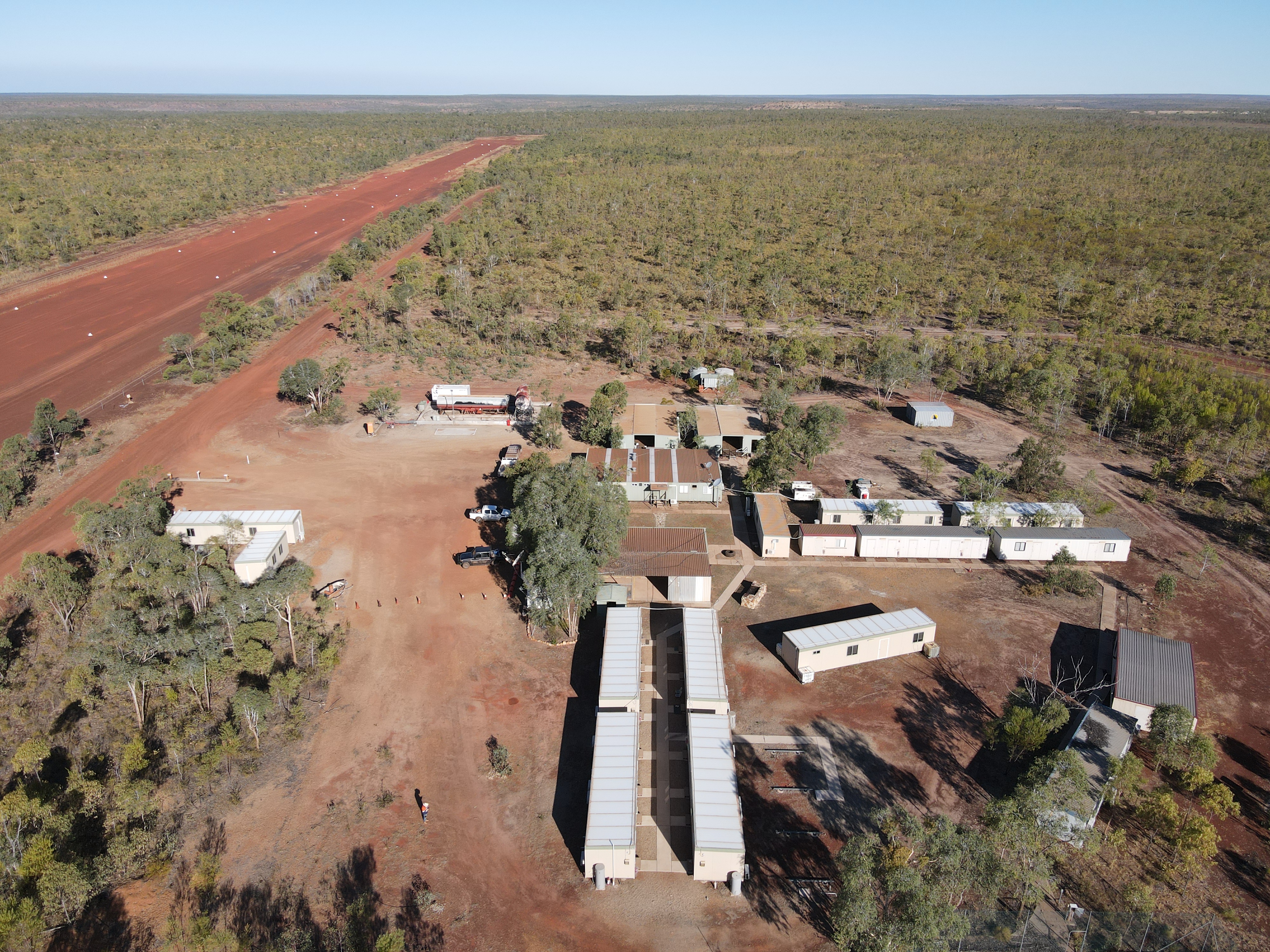
Merlin camp and airstrip. Sorrce: Lucapa Diamond. Photographer: Justin Clarke
When do you intend to notify the market of the findings of your feasibility study?
I would say within the next few weeks. We are going to give an update on our quarterly activities to the market in July, as required, and we will update the market then as to the feasibility study.
I am not sure if this is the right time to make comparisons, but I am interested in finding out, based on your projections, if Merlin would be your biggest operation compared to Mothae and Lulo?
Absolutely, it will be a much larger carat producer, because it is a much higher diamond-grade environment, which means more carats per tonne. In terms of diamond value, the overall quality of diamonds will be close to five times better than the world average. So yes, Merlin will be a bigger carat producer and revenue generator for us as a company. Our other two mines in our portfolio are very special as they are low-grade and high-value resources, however, from a production scale perspective, the potential at Merlin will be to triple our rough diamond revenues and quadruple our earnings on an attributable basis. That's the scale of how transformative the Merlin mine development could be for our company.
So given that Rio Tinto used to own Merlin and stopped mining in 2003, is the mine under care and maintenance?
Yes, the mine is currently under care and maintenance. When we acquired Merlin, it was already on care and maintenance status. Once we finalise our mine development propositions, we will approach the Northern Territory government for the respective approvals to convert to mining status.
What makes you think you will succeed where others have failed?
While we are very experienced technically, I am not going to say that it's only because of this. We are most certainly benefiting from an improved diamond pricing environment and an improved foreign exchange environment compared to previous vendors. So, while we are competent at what we do and innovative in deriving unique solutions to extract diamonds out of the ground, we are benefiting from a much better set of circumstances. We have successfully developed two mines, with four operating plants in Africa, and we have gone through the same rigour in assessing this mine development as we do all our assets and I believe Merlin is going to be a very good mine for Lucapa and its shareholders.
How expensive is it to oversee a mothballed mine?
Every jurisdiction has a different pricing environment and Australia is one of the most expensive to operate in. We have put Australian operating costs and capital requirements into the scoping and feasibility studies, and we still see good value and strong margins being derived. We believe it's going to be a very special proposition once it's developed. No doubt, it would be even more value-added if Merlin were located in Africa, as it is cheaper to operate there; however, it is here in the Northern Territory, and we have assessed it as such.
The Australian media seem to believe that Merlin will reopen soon, making it the only diamond-producing mine in the country. Are you not under pressure to deliver?
I think we put ourselves under pressure. There is certainly no pressure from any government agency pushing us to get something built as soon as possible, and yes, it will be Australia’s only mine when brought into production.
Naturally, they are all working with us and supporting us to try and get something done as soon as possible, but there is no pressure. Of course, they are all very keen to see us succeed so that we can build a mine there to assist with the creation of jobs, and population growth and contribute to the remote communities around the mine. We are all working very well together to try and achieve the same goals.
What are you doing to ensure that you mining responsibly in all the countries you have projects in?
We take our ESG initiatives seriously. From the very start, at all of our mines or operations, we have believed that creating employment opportunities is the best way to assist communities in the long term, and that has been our focus wherever we operate. If we build a successful mining operation, it will employ people from the villages and towns around us. I am proud to say that at Mothae, we only have three expatriates on the mine, and there are close to 500 Basotho nationals employed or contracted. In Angola, given the remoteness of where our operation is and the availability of key technical skills, our expatriate component there is around 10% of the 600-strong workforce and contractors. Once again you can see that the vast majority of the Lulo teams are sourced from the villages or communities around us.
We believe education is the next most important aspect to focus on, so we contribute tremendously to schools. In Lesotho, we have been assisting with the refurbishing of schools and classrooms and making donations of sporting equipment and clothing. We are proud that we sponsor several children from our local communities through their secondary and tertiary education. In Angola, we are building a local school together with our partners. It is close to the Lulo mine, and it should be completed during the second half of 2023. We also focus on agricultural initiatives and health provision. Our clinics at our operations are open to both staff and their families.
We have been actively assisting our communities for a long time, but we've just not stood on a pedestal and shouted about what we do. However, with ESG requiring measurement and separate communication we have for the very first time published a standalone ESG report this year.
What is your safety record in all your operations?
Our safety culture and record are very good and naturally, we strive for zero harm. At both mines, our safety culture is constantly improving, and the focus is always on safe practices. Every morning, the teams start with a toolbox meeting where safety is addressed. We are also proactively training our teams to operate machinery safely. We have good records at both our mining operations. Yes, we do have lost time injuries, but thankfully, they are predominantly minor injuries.
How many carats did you put through cutting and polishing in the first half of the year?
As not every carat is equal, it’s more important to understand the value that's going through the polishing partnerships and what value is being generated.
Our polishing initiatives have resulted in very good additional margins being generated and growing the overall EBITDA of both operations. If we look at the total cash margin per carat at the Lulo operation, polishing is growing the EBITDA, or cash margin, by close to 30%. And at Mothae, the contribution to EBITDA or cash margin is even greater as Mothae is a lower-margin mine when compared to Lulo. In Angola, on average we are achieving very close to a 28% additional margin on the rough diamonds that we send for cutting and polishing while we achieve a similar 25% on average at Mothae on the diamonds that we send for cutting and polishing.
We are going to be more detailed on the financial contribution of the cutting and polishing margins in our upcoming quarterly report in July.
Mathew Nyaungwa, Editor in Chief of the African Bureau, Rough&Polished
