During the St. Petersburg International Economic Forum (SPIEF) in June, one of the events was the Creative Business Forum that addressed the jewelry industry’s topical issues, including new sources of investment in creative industries, the future of the Russian fashion market, as well as an intangible asset - the art of creating a brand.
At the forum, special attention was paid to working with national cultural and visual codes in the jewelry industry.
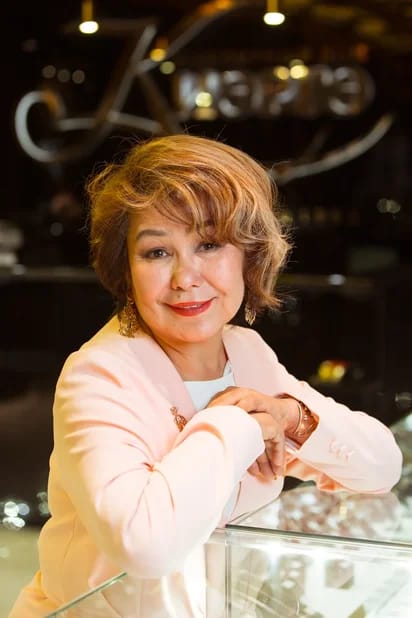
Galina Pavlova, President of the Arctic Jewelers Association, Director of the Kierge jewelry house based in Yakutia, was among the speakers at the forum.
Galina Pavlova told Rough&Polished about her impressions of the SPIEF, the problems of the creative business, as well as the specifics of the jewelry industry and the search for identity that has become relevant today - from traditional arts and crafts to innovative brands.
How useful were the meetings and discussions held at the SPIEF for its participants, the representatives of the jewelry industry?
Undoubtedly, they were useful, even from the purely practical point of view. At the forum in St. Petersburg, the representatives of public organizations of the small jewelry business had meetings with federal officials and raised awareness about many issues in the presence of the head of the Federal Tax Service and the Deputy Minister of Finance, including questions about taxation.
Alexey Sazanov from the Ministry of Finance assured the participants that the Ministry was ready to consider reducing the tax burden on silver, and the possible application of the simplified system of taxation (STS) to silver, which would greatly improve the position of entrepreneurs in our difficult times. Meanwhile, as for gold as a luxury item, it will be subject to the value added tax (VAT). It is known that in Russia’s jewelry industry, the transition of all jewelry companies from the tax regimes of the STS and patent system of taxation (PST) to the general taxation system (GTS) has been legislatively introduced since the beginning of this year. The decision to abolish the right to the STS for the jewelry industry brought about 20 thousand enterprises and entrepreneurs to the verge of survival, and many companies had to close down. In addition, it contradicts the legislation on small and medium businesses - after all, all individual entrepreneurs and small businesses operate under a simplified taxation system (in accordance with Article 145), except for jewelers whose revenues have decreased in recent years, and input costs have increased significantly.
Do the officials admit that the State Integrated Information System in the Sphere of Control over the Circulation of Precious Metals and Precious Stones (SIIS PMPS) is not yet stable and that small jewelry enterprises have not been treated fairly?
Daniil Yegorov, Head of the Federal Taxation Service, listened to the representatives of small jewelry enterprises and promised to consider the issue of a tax regime. Сhanging the tax regime for the jewelry business has a significant impact on the industry. Abolishing a 20% VAT for private customers on the purchase of gold, as well as the introduction of special tax regimes, the STS, for the jewelry business and the requirement to switch to a general taxation system (regardless of the amount of revenue) can lead to a reduction in the number of small jewelry companies on the market and the consolidation of jewelry businesses.
What was your presentation at the forum about?
The current situation in the jewelry market may lead to a loss of jewelry traditions, which are mainly maintained by small jewelry companies, such as Kierge. In my opinion, this can affect the development of culture as a whole.
Preserving the jewelry traditions is an important task that we are facing. My presentation was about this and the risks of losing jewelry traditions.
Jewelry art plays a big role in preserving the cultural legacy of the people - our national, ethnic and cultural peculiar features.
Many nations keep and develop their national traditions in the jewelry field. Our craftsmen’s jewelry art has almost completely preserved the most interesting artifacts reflecting the aesthetics and style of ancient ideas and images.
What is unique in the jewelry art of the Republic of Sakha (Yakutia)?
During their centuries-old history, the Sakha people led a nomadic lifestyle from ancient times and came into contact with tribes speaking different languages, they domesticated customs and traditions and learned a lot, choosing the best. And the Yakut jewelers created really beautiful jewelry items. Historically, the Yakut jewelry pieces have a sacral meaning. Having lost writing at one of the periods of their history, the Sakha people began to assign a deep meaning into their ornaments, so the Yakut patterns have an imprint of ancient times.
All this looks quite relevant today and is in demand. Native - indigenous - jewelry in Yakutia has always been popular, and every girl following the latest fashion trends wears them now both on holidays and in everyday life - first of all, earrings, rings, bracelets and necklaces. These items reflect the connection of generations, carry the cultural code, the energy and strength of the family and kindred. Our jewelry pieces are beautiful, and in addition, they become strong talismans for their owners and this is verified.
Human life always struggles between good and evil and trims between light and darkness, that is why our ancestors held rites and ceremonies that harmonize, balance the internal energy and state of a person. Traditional ceremonies (purification rite, as well as a travelling, maternity, wedding and other ones) are based on ancient knowledge of the laws of nature. One of the protective attributes associated with a human life is a protective amulet made by human hands, mainly from metal. The amulets were made by skilled blacksmiths. In the social hierarchy of the ancient Yakuts, blacksmiths were a special caste of the initiates, and the locals honored them and shamans who carried out the mission of keeping the world order in society. In the modern world, these traditions have been inherited by jewelry art.
Tell us about the priorities of your jewelry house. How do you adapt national jewelry traditions to the current environment? How do you manage to combine the ancient meanings with modern designs?
Preservation and development of national images and elements of the Sakha culture is one of the key priorities of the Kierge jewelry house. When creating jewelry pieces, our jewelers strive to combine the sacred meanings of traditional art and modern trends in jewelry design. We do our best to give them the strength and wisdom of our land that bring well-being and prosperity to a jewelry owner.
Many of the jewelry pieces are custom-made according to customer’s requirements.
For example, we have a “Women’s Happiness” line. Many single women have no husbands, they have not found their happiness, or they cannot have children. And after buying a jewelry piece from this line, I often get calls from different countries and get news about a wedding party or that a child is expected in the family. There are also talismans, lucky charms, for successful business. Jewels not only adorn people but make their dreams come true. It really does work.
We have a widely known collection called “Permafrost Symphony” made from the huge riches of Yakutia’s nature, including mammoth tusk, charoite, chrome diopside (Yakut emerald), diamonds, gold, and silver.
We have a “Power of the Earth” collection of jewelry with rough, uncut diamonds.
We have a “Sun of the Arctic” collection of gold jewelry pieces studded with polished diamonds.
At present, a new collection is being developed, the “Aria of the Polar Night”. It’s amazing that reindeer’s eyes are greenish in summer and they turn violet-blue in winter. And this collection will be adorned with blue stones – it's such a northern motif.
Your jewelry store in Yakutsk was recognized as the best jewelry store in Russia at the latest Junwex exhibition. How to create and promote a strong national brand?
Our stores are not only for buying and selling jewelry. In our showroom, we have a “Women’s Chest-type Jewelry” collection of jewelry items from all over the world, and you can see that they have much in common.
We contribute to the development of tourism and have a diamond and mammoth tusk cutting and manufacturing center.
We are currently planning a joint project with the Russian Ethnographic Museum - a joint exhibition in St. Petersburg to display jewelry items made in the 17th-18th centuries as well as modern jewelry. We welcome any innovation in designing and using the materials, for example, weaving horsehair into necklaces. The same applies to beads and mammoth tusks.
Snow glasses out of leather and silver with sacred patterns made on the basis of historical finds are in great demand. At the exhibition in Dubai, it turned out that they protect the eyes perfectly well from sand and wind in a desert. They are also sometimes worn as decoration on baseball caps.
Our know-how is belts with buckles and men’s bow-ties made of silver with an ethnic pattern - we gave those to many people as a gift... And as a gift to a famous orchestra conductor Yuri Bashmet, the Kierge craftsmen made a conductor’s baton from mammoth tusk decorated with silver.
We manufacture a variety of goods and gifts. Even silver New Year’s toys for a Christmas tree are made in the native ethnic style.
Kierge has become a well-known brand far beyond Yakutia. Does the use of national values help in competition with other companies in the world market?
I think it does. We promote our national culture and differ from others, so our people and jewelry attract more interest.
Recently, a presentation of our jewelry has been held at the Turkish Embassy in Moscow. The Yakutia’s jewelry was shown by models wearing Turkish ethnic style clothes, and jewelry pieces had a very organic and stylish look.
A joint Russian-Italian project - a fashion show of Kierge goods with the Zima fur salon’s goods - sparks great interest.
This summer, we made an agreement with Chinese manufacturers of pearl jewelry that should result in the manufacture of some unique items.
Jewelry is a significant part of the national culture and history. On the one hand, there is a consumer demand for “spiritual” jewelry, for jewelry with a sacred code and identity, and on the other hand, there is a great desire of small jewelry companies to take into account the cultural discourse, and this opens up new opportunities for the development of jewelry tradition and culture, which is usually not characteristic of the mass jewelry market because it focuses on other priorities.
Galina Semyonova for Rough&Polished
