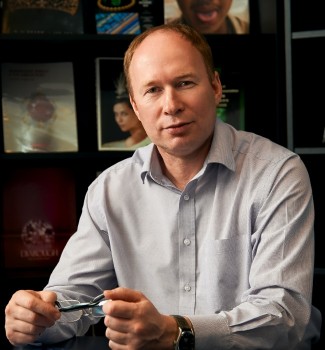
 Yuri Shelementyev is the Executive Director of the Moscow State University’s (MSU) Gemological Center, Candidate of Geological and Mineralogical Sciences, a developer of key educational programs offered by the MSU’s Gemological Center and the Academy, as well as the President of the National Gemological Association.
Yuri Shelementyev has a 20-year experience in precious stones industry.
He took part in a number of international gemological conferences.
Yuri Shelementyev told Rough&Polished about the upcoming International Conference on Gemology to be held in Moscow on October 1-2, about new challenges for the industry and how important it is today to unite the efforts of science, business and the state.
The last International Conference on Gemology was held in Moscow about five years ago. How do you evaluate its results?
The previous International Conference on Gemology aroused great interest and was attended by about three hundred participants - significantly more than at many similar events held abroad. We attracted speakers from different countries. Global issues were discussed at the conference and we were convinced that such events held in Russia could have a truly international status and combine scientific and practical aspects of the gemological industry.
We saw that it is possible to hold conferences at the confluence of science and business, because gemology exists and develops at this very confluence.
There are speakers who are used to carrying out researches, speaking at scientific conferences, writing scientific articles - they find their natural space. There are people engaged in entrepreneurship or government regulation, and we also find a natural space for them. That is, we have found a complex and combined format, in which both scientific and practical aspects of the industry and the market can be covered.
I believe, the status of the Moscow State University’s Gemological Center and the National Geological Association will greatly facilitate this.
Can I make a remark? Of course, we support the employees of our organization in their talking about their research work, too, but we are completely democratic, and people with different views, working in other institutes, organizations and countries, as well as in laboratories, can and should participate.
In recent years, new challenges have emerged and there is a need to discuss new topical issues. What has changed in the scientific field of gemology and in the market during this time?
I will start with the market, because science changes gradually and very smoothly, and there are no major breakthroughs in the scientific sphere. We have ongoing tasks, and they require ongoing research. Moreover, we also carry out fundamental research. We see that the studies, for example, on structural impurity centers in diamonds are also of interest to people today who keep their eyes on the big picture - the future - and handle the problems related, for example, to the sovereignty of our country. Or they consider a possibility that someday, a diamond-based semiconductor, a laser or a microchip can be made.
As for colored gemstones, the landscape is constantly changing: jewelers begin to use one type of gems to a greater extent and another one to a lesser extent; new deposits are discovered, new methods of treatment appear. And the interest is constantly changing. There are people who have spent their entire lives studying, for example, rubies and sapphires, and there are also people studying new minerals and gems - we invite both of them, so that the audience could listen to their presentations.
There are pressing issues, and we intentionally highlight the topics at our panel discussions at the conference, so that people having completely opposite views could express their opinions and, as they say, “cross swords”.
Experts who prefer natural diamonds can say why natural ones are better, and people who prefer synthetic diamonds can explain why lab-growns are better.
There is a dispute in the jewelry industry about what is more important in a piece of jewelry - the stone itself or its design. Some jewelers believe that the stone is of paramount importance, while others focus on the creativity and art aspects. There is also a conflict between business and the state: jewelers criticize excessive regulation, while the government believes it is necessary for ensuring the order in the market to prevent its descending into chaos. We want all parties to have a chance to give their opinions.
As for natural and synthetic diamonds: what is your Gemological Center’s stand - and, more broadly, the opinion of the National Gemological Association - in this discussion? Are there any disagreements within the Gemological Center and the National Gemological Association?
The National Gemological Association brings together people expressing different opinions. As for gemological laboratories, on the one hand, the situation is simple, because we have always been able to distinguish lab-grown diamonds. We have been able to do this, and we do it, and I hope we will keep on doing so in the future. Diagnostics is becoming more sophisticated, but the answer is the same: natural stones are clearly recognized as natural, and lab-grown ones as synthetic. This is from our Gemological Center’s point of view.
For consumers, things are more complicated: some companies promote exclusively natural stones, while others rely on synthetic ones. How a person perceives this information and what choice a person makes are the questions we are going to discuss at the conference. It is important to have an open dialogue, and both sides should have a chance to present their arguments.
What scientific topics will be covered? Who will be the speakers?
We divide the reports into ‘blocks’, including rough diamonds, polished diamonds and colored gems. Research on structural centers in diamonds, new technologies for differentiating synthetic stones, reports on rare gems, collectible mineralogy, geology and mining will be presented.
Some speakers are expected to make their presentations on the ways they use to change the color of a diamond and control diamond coloring. John Chapman, our friend from Australia, is a physicist by education who has worked with diamonds all his life and is now working on the technology of distinguishing the synthetic diamonds. As for colored stones, we expect a wide range of presentations, including a report by Dr. Pornsawat Wathanakul from Thailand, as well as the reports on new collectible diamonds featuring understudied properties and the presentations on promoting technology and laboratory equipment.
Most diamond researchers do not work with colored stones. In the field of colored diamonds, a wide range of reports of various focus will be presented, for example, on geology, including the issues of prospecting and mining, as well as studying the formation of stones and stone crystals in pegmatites, and the issues of collectible minerals.
The reports and presentations will be made by both Russian and international experts.
What foreign experts are expected to take part in the conference?
We are expecting delegates from Thailand, Australia, Sweden, India, and Turkey. Some delegates will come in person, and some will speak online. We want to show the international community how gemology is developing in Russia and attract more foreign experts to take part in our conference.
Will anyone represent the Assay Office at this conference?
We have received confirmation that the top managers from major organizations will be present, including some ministries, departments, and Gokhran (State Precious Metals and Gems Repository). We have been in dialogue with them for a long time and want all parties to be represented.
The program of the International Conference on Gemology includes the participation of ALROSA. What will they talk about?
The company has a project “Investment Diamonds” focusing on large and rare diamonds, especially pink and yellow ones. We expect them to share their development results and plans for the future development of the project.
Will jewelry companies be represented?
Sure, the program includes the participation of famous national brands. These will be the stories about the life journey of the companies rather than advertising presentations. It will be interesting to listen to the stories of those who have managed to win international recognition.
The creators of a brands can talk about the brand’s philosophy best of all. The conference will give a chance to see different companies and compare their approaches.
Have there been any major gemstone deposit discoveries in recent years? To what extent are they related to the fashion for stones?
Some gemstone deposits were discovered decades ago but there are no talks about them because they are not given attention in media outlets. That’s how the market works: without marketing, even a rare gem can remain unnoticed.
For example, in the 1990s, a gemstone called ‘dianite’ was discovered in Siberia; it is a richterite mineral, a blue variety of nephrite, so to speak. As far as I know, no blogger has yet told anything about dianite, so no one knows about the gemstone. There is also an interesting rare stone called ‘hauyne’, used in very small quantities; this mineral has been supplied to the global market from Afghanistan’s deposits since 2023. The participants in our conference will talk about it, too, and those who come to our conference will learn more about hauyne than others.
Often, fashion for stones is set by bloggers. For example, if a blogger learned that, for example, teal sapphire has appeared - a sapphire that has blue and green colors at the same time - and if the blogger got interested in this gemstone, he or she would tell their audience about the new stone, for example, about teal sapphire or cobalt-blue spinel.
Your conference program includes bloggers and influencers. In recent years, their influence has become really noticeable. How adequate and objective are they, how important is their activity for the gemstone market?
Today, they are the ones who build consumer preferences. They start talking about new gemstones and brands much earlier than professional publications appear. Indeed, their content is not always fully correct, but it is bloggers who help Russian companies that have taken the place of international brands exited from the Russian market to find their consumers. Their role in the culture of consumption is enormous today.
The “Magic of Brilliance” exhibition has already opened at the Historical Museum. The pieces of jewelry art displayed are made not from precious stones and metals, but from faceted steel and strasses. What is your attitude to the use of non-precious materials in jewelry art?
Hierarchy in precious stones and metals is not always justified. Craftsmen can create works of art from non-precious materials, too. The main thing is a creative idea and self-expression. There are many examples in history when artists worked with non-precious materials and created masterpieces.
For example, it’s possible to place gold above silver, because theoretically, an ounce of gold costs more than an ounce of silver, but where can we place titanium, for example, or rhodium?
In the Urals, where I come from, in the 1970s and 1980s (under socialism), there were jewelers who worked as artists. By the way, there is an exhibition now in Tsaritsyno about the Ural jewelry art. The craftsmen were not focused on the mass production of jewelry items, but they had the right to create and received their salaries from the state. They were not allowed to use precious metals and gemstones, and could work, for example, with cupronickel (melchior) and agate. But nevertheless, without gold and diamonds in their workshop, they could create and express themselves. There is a creative component in a piece of jewelry and an artist’s desire to express himself or herself.
But I am not an expert in this field and not ready to judge where the line between craft and art lies.
We have not yet touched on the topic of the development and formation of a professional community.
Right, this is important. The conference is not only about reports, but it’s also a platform for networking. Participants will be able to meet like-minded people, find partners and feel themselves as part of a professional community. We encourage colleagues to take an active part in professional events.
The upcoming International Conference on Gemology promises to be an important event and a milestone for the entire gemological sector. It is designed to unite scientists, jewelers, entrepreneurs and government officials. Such meetings help find a common language, strengthen the professional community and open up new horizons for further development.
Galina Semyonova, Editor in Chief of the Russian Bureau, Rough&Polished
