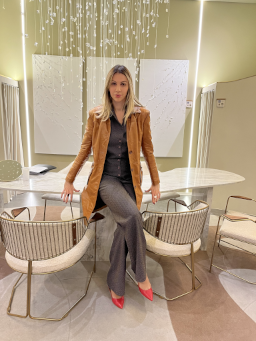
 Ali Pastorini, co-owner of the DEL LIMA JEWERLY and president of the Mubri International Association, which unites more than 2,500 wholesalers, retailers, and designers from 18 countries.
The mission of Mubri is to help the members of the association consolidate their business in order to share professional skills and experience.
In this interview with Rough&Polished Ali Pastorini talks about the situation in the global diamond market, the main trends and problems of the jewelry business in Latin America.
How would you describe the current conditions inthe global diamond market?
The moment is delicate, but I also see the industry, as usual, exploring and approaching new markets that it hadn't previously reached for various reasons. While this doesn't solve the problem in a short term, it opens doors to new business and opportunities for medium and long term.
Our sector, especially diamonds and gold, was already suffering from wars and declining consumption, now with tariffs, the challenge has become greater, but not impossible. I'm seeing companies contacting me more frequently to enter new markets.
Despite the situation, they haven't slowed down but are seeking new alliances and I see this as positive because the industry, instead of waiting, is moving towards new alternatives and creating bridges that until now were only on paper.
In your opinion, what steps should be taken to improve the situation? Tariff wars are sending ripples over the global jewellery industry. How did it affect businesses in your region? Is it now harder to export jewellery items to the U.S.?
Yes, it's more difficult, but South America has always faced economic and social challenges, so one more wall doesn't discourage the region's entrepreneurs. Many South Americans are simply adapting their businesses and not focusing solely on the US.
Today, I see many allowing themselves to do business with countries in Asia, North Africa, and the Middle East, something that wasn't even imagined until recently, as the focus and energy were always on the US.
Of course, there's some apprehension and doubt at first, since the North American market has always been the main purchasing power, but there's also never been the time or energy to study and work in other markets, as many Latin American entrepreneurs are able to do. Personally, I hope the countries can reach a consensus with the US government, but until then, it's completely understandable to seek new allies.
Do lab-grown diamonds pose an existential threat to natural diamonds? How did LGDs influence the jewellery market?
I've never seen lab-grown diamonds as a threat to natural diamonds. In my interviews and conversations, when asked, I've always stated that both could coexist precisely because they reach different audiences.
The mistake is that, from the beginning, the natural diamond industry tried to demonize lab-grown diamonds instead of showcasing the advantages and benefits of investing in natural diamonds.
More recently, the natural diamond industry has done this through marketing, but I believe it took too long to take action, and this cost the interest and curiosity in lab-grown diamonds among customers who were previously uninterested.
This is what I've always said and strived to do in my companies and at Mubri: to focus on delivering excellent work rather than badmouthing my opponent. I was an athlete for twelve years of my life and brought to business what I learned in sports. You have to deliver your best and what people expect of you. Complaining or rooting for your opponent's failure won't make you a winner.
I repeat what I've always said: both can coexist. You just have to play a transparent game and each do their best to attract customers.
How are things going with the Del Lima Jewelry Company, of which you are a co–owner?
Very good. The jewelry sector has been the least affected so far, and sales continue to be strong in South America. It's no coincidence that many foreign companies are participating in our events in the region precisely because they see the positive numbers.
In the case of Del Lima, due to the consistent sales and profits, some foreign groups are interested in partially or fully acquiring the brand. Since 2024, we've been evaluating and negotiating to launch this new phase of the brand and allow the group to expand its business, as our name has become strongly associated with high-quality products.
We know this is crucial for customer loyalty and, consequently, brand growth in our industry.
Spring is about to arrive in your country. What precious and semi-precious stones will be in fashion in the Southern Hemisphere at this time of the year?
Lately, due to global circumstances, many South American customers are preferring to purchase more classic models in yellow gold and white gold with diamonds, emeralds and rubies.
Mubri and India's Gem and Jewellery Export Promotion Council (GJEPC) hosted the Buyer-Seller Meet (BSM) in São Paulo this year. How did it go?
Our agreement with GJEPC extends to cities such as Dubai, Barcelona, Jaipur, Mumbai, and Surat, and there is a possibility of extending to London soon.
BSM Brazil is an event organized by Mubri with exclusive support from GJEPC India, DMCC Dubai, and DDC New York. Most of the exhibitors are members of GJEPC thanks to our mutual and fruitful collaboration over the years.
The event is B2B and exclusive, meaning we select the exhibitors and attendees ourselves. We create a safe and profitable business environment for everyone by bringing together major players from the South American region with companies from other continents, thus building credibility and loyalty to the event.
The event lasts two days, but exhibitors often report that they are able to meet serious clients and not waste their time, especially considering that Brazil is more remote for travel, so we need to deliver real results.
Each year, the results have been better, as we've consistently brought in regional leaders not only from Brazil but also from Argentina, Bolivia, Colombia, Chile, Paraguay, and Peru.
I'm very excited about the 2026 edition, as exhibitors are already requesting to reserve space, and I hope to have companies from other countries present to exhibit.
We've already had companies from Belgium, India, Turkey, Hong Kong, the United Arab Emirates, and the United States exhibiting. We hope other countries will also participate and showcase their products.
Do you have any other plans for collaboration with leading industry organizations? Any upcoming events to look out for?
We constantly collaborate with leading industry organizations. We're discerning about who we partner with, as many companies trust us and follow us wherever we go.
Over the years, I've learned that earning trust is all about transparency and making informed choices. This is why we have such a large membership, making us one of the largest associations in the world, as the care we take in selecting partnerships and events is evident.
We've already had significant collaborations with the Italian Exhibition Group and the Turkish Association, and more frequently with GJEPC India and DMCC Dubai.
However, everyone is welcome to join and forge new partnerships that will add to our more than 2,500 members spread across 18 countries worldwide.
Our next event will be BSM USA, focusing on bringing visiting companies from the Caribbean and Mexico.
Alex Shishlo, Editor in Chief of the European Bureau, Rough&Polished
