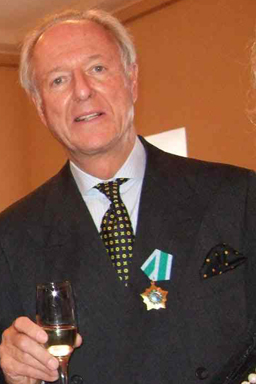
 The Russian International Konstantinovsky Charitable Fund recently purchased a significant part of the legendary collection of theater costume and stage designs belonging to Prince Nikita D. Lobanov-Rostovsky. A large part of the collection is composed of masterpieces of Russian avant-garde. The purchase was first exhibited on September 24th of 2008 at the St. Petersburg Theatre Museum. The collection will be kept in Saint Petersburg. Vladimir Kozhin, the head of the Department of Property of the President of Russian Federation, has officially announced that in 2-3 years time the collection will be permanently housed in the “Star Way” Congress Center near the presidential residence of the Konstantinovsky Palace in Strelna. However, not so many people know that among other things Nikita Lobanov-Rostovsky was a geologist and had to do with the diamond business for two decades. He talked about this side of his activities to our correspondent Vladimir Teslenko.
Nikita, tell me please how did you come to the diamond business?
My first contacts were in 1967 and were with diamond traders from West Africa, who were mostly Lebanese. I was introduced to this group of diamond middlemen by Paul Berne, a Frenchman, who was once a secretary to my grandfather Vasily V. Vyrubov. At the time I was engaged in buying up gold in Monrovia. Liberia was an islet of hard currency (its national currency is U.S. dollar) and many dealers from neighboring countries used Monrovia as transit point to export diamonds and gold from West Africa. Later, the bank where I worked obtained a concession for a diamond pipe in the Kalahari Desert and I supervised this project.
How did you start working with De Beers?
Before 1987, the De Beers management used to deal only with select functionaries from the Glavalmazzoloto of the USSR and the Soviet Ministry of Finance. De Beers needed access to those senior officials who were making strategic decisions in the diamond business (from the Presidium of the Central Committee of the CPSU and KGB). In 1986, Teddy Dow, one of the top executives of De Beers, started to look for a Russian speaking person with contacts at senior levels of the Russian nomenclature to whom he could introduce De Beers management with the view of enhancing the image of De Beers in Russia as that of a reliable and trustworthy partner. Daphne Dormer, Teddy Dow’s girlfriend at the time, suggested me as a candidate. It took six months for De Beers to get me cleared by the security services of the United Kingdom and United States. After that I was introduced to Sir Philip Oppenheimer, the head of the Central Selling Organization of De Beers, who offered me the job. My activity was secret. I could report only to three persons – Sir Philip, Teddy Dow and Monty Charles. Even Prince Georgy I. Vasilchikov, a Russian interpreter at De Beers, whose family had cordial relations with mine for three generations, was banned from knowing what I was doing.
In what way is De Beers different from other companies?
The main feature is that this company, in spite of its huge size, is controlled by the Oppenheimer family. The monopoly of De Beers is undoubtedly the only successful monopoly after the Second World War. In the period, when I worked there (up to July 1997) the Oppenheimers “seal” was seen in all the aspects of the company’s business. The philosophy of De Beers is closer to the Japanese business ideology (“the company’s eternal life”) rather than to the American concept (“maximizing profit on quarterly basis”). De Beers does not strive for showy but short-lived success. They prefer steady long-term partners, with whom to have stable business generating moderate but continuous profits. There is another touch to De Beers’ portrait. This company has an impeccable business reputation. If they strike a deal, sometimes verbally, as is the custom in the diamond business, they will fulfill its terms even to their own detriment.
In 1988-89, you took part in the talks between De Beers and Glavalmazzoloto on a successive agreement. What is the distinctive mark of “diamond” negotiations?
The diamond meetings were a kind of ritual, which lasted for about a year. Sometimes the parties met in Moscow, sometimes they went to London. It was evident to us that all the talks were monitored and then listened to at a higher-ranking level. Another point was that De Beers’ top executives used unusual business methods. I remember one tense round during those talks at which it became clear that Almazyuvelirexport had lost about three million dollars due to a “side” trade transaction, although De Beers’ experts had warned in writing about inadvisability of this deal. Sir Philip said to the members of the Soviet delegation, “I’m sorry this happened. Here is one million dollars for you, it will offset the loss to some extent.” Later I asked him why he had paid out of his own pocked for someone else’s blunder. He replied that those people faced dismissal. Yet he was used working with them and preferred to continue doing so. If this were done by an American businessman, he would be deemed a fool even among his own colleagues.
How did you use contacts with the Soviet elite?
My work with De Beers coincided with the time of radical changes in the USSR, so there were many things which facilitated my efforts to establish friendly relations between the diamond monopoly and the Russian establishment. As it appeared to me, the initiative was reciprocated.
Assisted by the cultural attaché, I established informal relationship with Leonid Zamyatin, the then ambassador to the United Kingdom (who was a member of the Central Committee of the Soviet Communist Party). One day I invited him for dinner at our London apartment, where he met Sir Philip. Strange as it may seem, Zamyatin, the proletarian hard-boiled communist, got on very well with Sir Philip Oppenheimer, the quintessential gentleman-capitalist. Moreover, he was the first at that time to inform about the Lomonosov diamond field discovered in the Arkhangelsk Region. However, it was not his initiative; he told Moscow had authorized him to do so.
Here are two episodes when I used my acquaintance with Ambassador Zamyatin. In the spring of 1989, the Gohran’s head Yevgeny Bychkov, in violation of the contract with De Beers, exported about $40 million worth of diamonds to Belgian and British companies. This was an insignificant deal on the scale of the world diamond market. But De Beers got to know about it and Zamyatin was made to understand that this was harmful to the USSR as a reliable trade partner. Zamyatin sent a “coded message,” as he said, to the Central Committee of the Communist Party. The Bychkov case was examined by the Party Control Committee, which reprimanded him. The illicit export of diamonds was stopped for a while.
The other event took place in 1990. The Soviet government was in urgent need of money. At Ascot, for the De Beers Gold Cup race Ambassador Zamyatin, who attended the event, passed to Sir Philip a personal request of Mikhail Gorbachev to borrow $1 billion for five years collateralized by diamonds from Gohran. At that time, there wasn’t a single Western bank which would agree to give such a large credit to the USSR. I was struck that Zamyatin spoke about the country’s financial difficulties in such a straightforward and sincere manner, which earlier was unthinkable of a Soviet diplomat.
The management of De Beers met the Kremlin’s request with a good grace. Nicky Oppenheimer (Harry’s son) went to Moscow and signed the credit agreement. However, as it turned out later, this was a poor deal for De Beers as what Gohran sent to London as collateral was low-quality diamonds (yellow melee) which it took years to sell. I am sure that Gorbachev did not take part in that trick.
In the autumn of 1992, De Beers opened its representation office in Moscow. Why were you not put in charge of it?
There are three reasons for it. In a career sense, to be in charge of an offshore office is an insignificant position within the corporate structure. When I worked with the bank, there were scores of representation offices which were subordinate to me. Secondly, to be a representative means to find oneself between “them” and “us”. Thirdly, an Englishman in this position was preferable.
Do Russian jewelers have a chance to advance their diamond jewelry to the Western market and open some retail stores there?
I think that chances are small. There were already efforts to do that about 20 years ago. So far there are no visible results.
Why is it so, in your opinion?
This is because Western tastes and fashion are radically different to Russian. Again, fashion is subject to frequent and unexpected changes. One may note that a woman styled to the latest Moscow fashion looks like a scarecrow in Paris or London. Remember that wonderful Russian designer Vyacheslav Zaitsev, who opened a subsidiary in Los Angeles and later went broke! Valentin Yudashkin ran into misfortune in Paris in spite of the high-level support there. The same happened to Almazyuvelirexport, which tried to sell diamond jewelry in Europe (a huge amount of Russian goods were there on display), but there was no demand for them. I believe the jewelry items were perceived as unfashionable and low-quality.
But would it be plausible to have an alliance between ALROSA, as a supplier of rough diamonds, and for instance Cartier?
O-o-o-oh! Cartier is a famous trademark. Cartier design plus wonderful Russian diamonds would make a perfect combination. Not many people in the West know that Yakut diamonds are of the highest quality. If someone is buying polished diamonds made of them, this customer may be sure this is a high-quality gem and a good investment. The quality of Russian diamonds and their luster are much higher than those from Botswana or from the Republic of South Africa. For the most part, this is known, of course, to professionals and an elite group of buyers. This is why in the resort town of Gstaad (Switzerland) there is a shop dealing only in diamonds from Yakutia. However, if, let’s say, Cartier would launch a multi-million advertising campaign together with ALROSA and supply fashionable items, ALROSA would have significantly higher chances for success.
How do aristocratic women in the West purchase their jewelry?
As a matter of fact, aristocrats in Germany, France or the United Kingdom hardly ever purchase new jewelry. Most of the contemporary jewelry is bought by nouveaux riches, who exist in Moscow, Europe and elsewhere. The jewelry market exists for them and the masses at large. Most aristocrats do not visit jewelry stores. To wear new jewelry means for them to have no past! Vintage jewelry, on the other hand, is an obvious sign to all that you have provenance; that have not turned millionaire just yesterday. For many high-society people, especially in United Kingdom, it is considered indecent to flaunt one’s wealth. Like using a Rolls-Royce or wearing a Rolex or that sort of thing. For example, my uncle, who lives in the centre of Paris, has a large mansion, but he and his wife drive small cars.
So, is it a sort of voluntary self-restraint or are there economic reasons behind?
In France, unlike in other European countries, there is a law concerning luxury tax (signe extérieur de richesse). Let’s assume you declare your annual income as 10 euros. Consequently, as you are a poor man you are exempt of tax. However, if, having declared your income at 10 euros, you use a Rolls Royce, have paintings and live in a mansion, then your circumstances change. Fiscal agents note this (or your colleagues or neighbors report you) and make due assessment. So, if you have a Rolls Royce you must have an annual income of at least 100,000 euros to use and maintain it! You will automatically be charged additional tax without going into the facts of your earnings. This law was passed by conservative President Valery Giscard d’Estaing in the 1970s. The only thing not included into this law was the tax on paintings. The reason was that about 20% of the d’Estaing Parliament were communists. In their time, the leaders of the French Communist Party received gifts from Picasso — as paintings. As back as 20 years ago a Picasso painting was worth one million and today it is worth 20-25 million euros. Thus, the bosses of the Communist Party did not want to pay taxes on paintings and the President did not manage to crush the resistance of the “pictorial” lobby.
However, this law has nothing to do with jewelry, has it? In other words, Paris is a favorable place for selling diamonds since it is a world luxury trade center?
Yes. This is why Cartier and others jewelers target Latin-Americans and Russians who come to Europe. Paris makes people spend enormous amounts of money; its restaurants are overcrowded and stores are full of people!!! It’s a pleasure to be in France, there is no discrimination whatsoever, black people are intimate with white people and vice versa. This is why ALROSA should probably do the same thing that was done by De Beers: find a partner among western luxury houses, may be like Hermes, Cartier or someone else.
Nikita, it is known that you provide intermediary services for select customers in selling polished diamonds and rare rough diamonds. For instance, in 1996 you tried to help an Uzbek business man to sell a unique black diamond in Antwerp. What was the end of the story?
Yes, at a first glance the diamond appeared impressive, 28 carats in size. The Uzbek came to Antwerp accompanied by two bodyguards. I brought him to the most talented cutter and world expert, Mr. Talkovsky, leaving the bodyguards at the doorsteps of his office. Talkovsky examined the stone for more than an hour by way of microscopic analysis. In the end he said in a sorrowful voice that the diamond had a flaw and was worth just $250,000 and not at all $4 million. The owner did not believe his judgment. I had to take him to two other experts, where I left him alone to avoid suspicion that I was undermining his business. The evaluations of both experts matched that of Talkovsky’s. At supper, I realized that the Uzbek was afraid to go back to Tashkent because some people there expected him to bring millions of dollars in cash. I have not seen him since. I don’t know if he had to part with his life.
You have handled four or five very rare large green diamonds. Who bought them? Arabs?
Yes. My acquaintance in Geneva dealing in large stones, Mr. David Gol, was the middleman for the buyer.
You are considered an expert in the paintings of the early Russian avant-garde. Is it possible for jewelry business to match the success achieved by the Russian Avant-Garde?
Yes. I would advise Russian jewelry designers, who are already well versed in the Western tradition, to examine the Russian art heritage to its earliest times. Russian jewelers have a vast historical resource to draw on in their homeland, including the universally renowned achievements of the Russian Avant Guarde.
