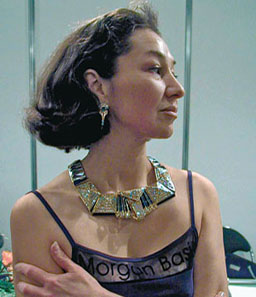
 Yelena Opaleva is a well-known jeweler and designer, Professor of the Jewelry Art Chair at the Urals Academy of Architecture and also Academician of the Russian Academy of Jewelry Art. She is the prize winner of numerous international jewelry exhibitions and contests including the international award established by De Beers and considered to be a “jewelry Oscar.”
You studied music and architecture – How did you come to be a jeweler?
I was not bad at painting when a child so I opted for the architectural institute and after my graduation worked along this line being engaged in commercial advertising and fashion. I did not think about gems at that time. Then I incidentally met a woman who was the chief designer at a jewelry factory and I made some sketches of jewelry sets for her, so six months later the factory invited me to work there as designer. This was how I came to jewelry design but I never reached the jeweler’s workbench - staying a drawing designer I put my sketches on paper.
Tell me please about De Beers’ contest – How did it happen?
I felt immense desire to take part in the contest, to prove that I was able to do something – so I dug into the rules of the contest, examined the winning works for 10 years and thought I had a chance. If you want to win you have to make something special, consonant to the current day. Initially the necklace I made was devised as masculine and I was inspired by the art of Egypt. The Sphinx Necklace shines with 664 polished diamonds in combination with mild blue enamel – it took six months to carve it for the craftsmen and cutters of the Yuveliry Urala Company. It was appraised at $1 million and was chosen out of 2,285 jewelry pieces from 14 countries. The awards ceremony was held at Grand Opera in Paris attended by famous couturiers and Hollywood stars with Anthony Oppenheimer presenting the prize.
What was the fate of Sphinx?
It is not yet determined. The necklace was displayed in various countries and now is in private hands being safe-kept in Yekaterinburg – it is too expensive. About forty years are to pass to make it antique – maybe after another couple of crises it will be sold at Sotheby’s or Christie’s two or four times as much. I’m glad it stirs interest in people up to this day: recently a government-ordered film was released to describe how this necklace had been made – so now it has its own history.
Any chance to relax after getting such an award?
Of course, responsibility is my great drawback… Now I cannot see any other way for me to go, although in this situation around the crisis it would probably be easier to turn to something else – going into commerce, for instance. Still, there is responsibility before the academy and students: I must give educational material and master-classes telling about new trends and events going on at international exhibitions. I am interested in the theoretical part of teaching trying to find new imagery, stylistics, and new schemes of archetypes. And I am also interested in all problems related to production, marketing and the ways the markets are developing in Russia, Europe and Asia.
What is going on in the industry and with you personally due to the crisis?
The crisis is a serious examination for jewelers and manufacturers; it’s a test for their creative attitude towards the business they are in. If formerly many people in this business did not make much reckoning of quality and kept churning out drab-looking mass-consumption goods sticking to standard schemes, now they have to change their ways: there is a sufficiently increased demand for way-out design and exclusive quality. Nowadays nobody wants mediocre design – even offered with a 60-percent discount. Unfortunately, the fate of many high-titled designers in Russia was not developing quite well. Because the main thing for their customers was to earn money immediately and many of them did not entirely grasp the necessity to promote brands working for perspective and creating a product range for tomorrow. However, the crisis puts new accents. Those who come out with new ideas, design trends and techniques will be among survivors. As for me, today I have more clients than before.
Chief executive officers of jewelry companies, even most stable companies, complain of flat sales and credit crunch.
Everyone complains of lower sales. However, though there is a downturn everywhere, to my view, the jewelry industry has the smallest losses of all. Despite the overall tension, the jewelers from the Urals have a good business on the whole – they are taking part in every jewelry show, they change their ways minimizing production costs – and I believe they will survive this crisis continuing to work in a professional way, maintaining quality standards and being honest. Almaz-Holding has received financial support from the state – so they are not expected to have any problems. Only the best will remain in the market: Smolensk-based Kristall, Yuveliry Urala, Almaz-Holding and among those smaller ones – Sirin and Ermi. The companies which will survive will get their reward for the experienced difficulties. They don’t have to be afraid!
What do you think, will the crisis affect diamonds?
I don’t think so. Diamonds have eternal value – people should have something to take their bearings. Now we have quite a lot of orders exactly for diamond product range with good stones. The entire world’s tradition is to give diamonds as gifts on family occasions, each time adding on their carat size. If earlier people bought jewelry with their spare cash, now they are rather governed by common sense, not emotions: customers want to invest into jewelry, which can be sold tomorrow. Well-off people are trying to invest into something small but financially sizable – and diamonds meet these requirements.
What is a diamond for you – something special?
For me this is definitely a symbol – a symbol of strength, success or victory. A diamond is more a charm than an adornment – it gives inner energy. By the way, a stolen diamond or a diamond acquired dishonestly causes bad luck. I like to work with diamonds of all other stones and I know which steps should be taken now to have them worrit along.
Have you got any customers you are proud of?
I have permanent customers with whom I am working many years. There are many famous people among them. It is not always convenient to speak about it – many clients prefer confidentiality. We have made several objects for Patriarch Alexii including a panagia set for the 40th anniversary of the Episcopal Consecration: a pectoral cross and panagias “Christmas” and “Resurrection.” When I worked with Yveliry Urala we made a fireplace clock containing fancy diamonds as a gift to the Moscow City Hall to commemorate the 850th anniversary of Moscow – now it is in Yuri Luzhkov’s office. My jewelry pieces are worn by Lyudmila Zykina, Irina Allegrova and other show-business stars; I have some buyers from Great Britain.
What are your plans for the future?
Work – I am now making collections for many jewelry factories. I know which schemes should be used for diamond design and I want my experience to be useful for the industry – we are going to run a round-table discussion for jewelry designers during the nearest exhibition of the Jewelers’ Guild to be held at Gostiny Dvor.
