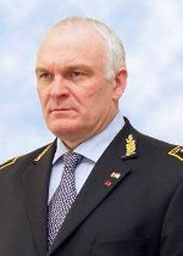
 Vladimir Litvinenko is the Rector of the Saint-Petersburg State Mining Institute (Technical University), Doctor of Engineering, Professor. He heads the Working Group of the State Council of the Russian Federation on problems related to improving the state policy in the field of subsoil use. V. Litvinenko is the winner of the State Award of the Russian Federation. In his interview to Rough&Polished he shares his views on the situation in Russia’s mining industry.
What is the crisis from the point of view of the mining business?
One of the major reasons for the current crisis was non-transparency of raw material markets, which gave rise to wonton growth of speculative dealings in shares, the real value of which was impossible to assess. This was the case not only with investment banks and mortgage companies – mining companies were not exclusion. It is impossible to assess the real value of shares issued by mining companies without precise evaluation of their indicators related to the quality and quantity of their stock. Without these data there is no practical way to assess their real capitalization judging by their financial results only. As a consequence, there is always a risk of speculative bubbles inflated by unscrupulous players operating on stock and raw material markets. The transparence grade of mining companies today is varied depending on their national identity – for instance, Canada’s legislation prescribes independent auditing which provides appropriate information to market participants; here in Russia there is no such practice. On the whole, the level of transparency in the mining business is so far starkly insufficient. Taking into account the level of globalization in the modern mining business it should be acknowledged that demand for radical improvement in transparency of mining companies, and first of all large, transnational companies, is an indispensable condition to overcome the crisis as soon as possible.
The mining business in Russia has some specific features, which will inevitably influence the terms of negotiating this crisis. They include the state of capital assets, qualitative and quantitative deterioration of the mineral resources base and absence of an exchange-based framework for pricing raw materials as well as the critical condition of personnel resources virtually in all the mining industries and particularly in geological exploration. Unfortunately, these problems were not given sufficient attention in happy years, when prices for major Russian exports were high, and now we have to solve them in an emergency mode employing the accumulated funds. By its available material deposits Russia happens to be a potential leader on many raw material markets, but the burden of the above mentioned problems threatens to turn our movement out of the crisis protracted and difficult.
All the state institutional mechanisms regulating the development of mining companies in a crisis environment must take into account the peculiarities of this business. The mining business is distinguished by high-level risks and a long term of return on investments. All this requires a stable and predictable state policy in shaping business climate in this sector. All of us should not forget that raw material markets have a cyclic pattern of development. It is very important to make its amplitude coincide with the amplitude of economic development in this country. If this will not happen, the aggregate effect may unfortunately turn out utterly negative since the share of resources in our GDP is several times greater than in other countries.
The crisis has heavily hit diamond-mining companies. Rough diamond trade has been virtually stalled. However, ALROSA continues to develop underground mines – wouldn’t it be more reasonable to mothball such capital-intensive projects until market recovery?
Rough diamonds and polished diamonds can be viewed as a sort of indicators reflecting the state of people’s confidence in the days to come. These markets display stable development when people believe in their future. And future is to be taken care of today. ALROSA came to a point when it cannot go further without underground mining. It is economically meaningless to stop their development of underground mines right now, since expenses for preservation and engineering maintenance will be comparable to expenses for underground construction and mining. Besides, mothballing will inevitably result in losing a significant number of highly skilled personnel; people will leave Western Yakutia since there are no other jobs for them there and to recover such losses afterwards will be extremely problematic and most likely impossible.
The state of affairs in ALROSA and its development outlook cannot be considered in isolation from its social function, from the role it plays being a state-budget-forming enterprise in Yakutia. So preserving jobs is one of anti-crisis measures which is not only less important, but may be more important than maintaining the company’s economic performance. Today we see some positive steps made by the government and ALROSA’s management to stabilize the situation: Gohran is buying rough diamonds and the company is getting rid of marginal assets. High qualification of ALROSA’s management and good diamond business insight of Yakutia’s administration should also facilitate successful anti-crisis decisions. Under the present circumstances there is a need in a long-term integrated, consistent and transparent program of state assistance to the domestic diamond mining taking into account the negative changes in mining and geological conditions of recent years; necessity to revise the taxable base related to these changes; significant growth of product cost in underground mining; social factors; and new realities of the world diamond market. There is no such program today, but it is necessary, if we want to come out of the crisis having preserved an efficient domestic diamond mining business.
The world diamond market is under the pressure of the accumulated diamond stock, the size of which, in the opinion of some experts, is substantially exceeding the annual output. It will take a significant amount of time for the market to “digest” these diamonds. Can this be a reason to save on geological exploration – just because the need in new diamond fields becomes non-exigent?
The cost of exploring new deposits occupies a very small part in the total cost of mining business. This may be very well illustrated by petroleum extraction: the cost of prospect evaluation survey is currently about $0.5–$0.9 per barrel. With oil priced at $140 per barrel and even at $40 per barrel the ratio of such expense is insignificant and you cannot save much on this. But without these paltry expenses the industry will be under the threat of distress. Today geological exploration is the major headache of our entire mining sector; it is surviving a system crisis involving outdated and worn-out equipment, retirement-age personnel and stagnating scientific schools. Companies continue to “save” on geological exploration, and prospect evaluation surveys have virtually been halted. As a result, everything which was discovered has already been put into mining. There are only an insignificant number of earlier discovered deposits, which are so far not engaged in mining. To save on geological exploration means to deprive ourselves of the future advantages as a nation rich in raw materials. Currently ALROSA is starting underground mining, and if there will be no new fields for it – in 10 years it will face a catastrophic collapse. This is just the average time spent from the start of a prospect evaluation survey to getting a first commercial product from a deposit. As I see it, in this complicated crisis period the state should motivate mining companies to intensify geological exploration by generating appropriate investment environment. This is an obvious requirement of economic security of our state. And undoubtedly, it should be part of the state program to support domestic diamond mining I mentioned earlier. Raw resources in this world are a serious tool of geopolitics.
Starting from this year De Beers stopped its purchases of rough from ALROSA and this means that the one-channel diamond market is eventually buried turning the major diamond producers into direct competitors. Speaking about the crisis, wouldn’t it be right to come back to some sort of cartel agreement if not at the level of companies then maybe at the level of nations for which diamond mining is an important item in their budget revenues?
The free market mechanism is the most efficient means to distribute resources between alternative types of activities and investment areas. Rules, instructions, regulations and strict control over their implementation aimed at higher efficiency in the performance of mining companies – this is the main tool of government regulation in the mining industry. And not only business climate but also how fast we shall be able to employ the available unique resources potential to the benefit of our economy and our people depend on how much the mentioned tool is consistent with the requirements of the current economy.
I am not an advocate of state intervention in business, particularly by way of cartel agreements, but I don’t think that a model similar to OPEC may be transferred to the diamond market. However, at the level of mining companies it would be useful today to establish a framework coordinating joint efforts in seeking ways out of the crisis.
In what way do you evaluate China’s expansion in the field of mining business, including Russian mining business?
China’s current colossal financial capacities inspire both respect and apprehension. In itself, China’s purchase of large stakes in first-rate mining companies and extending large-scale credits tied to raw material projects is a natural process and it is most likely that such deals will be growing in their number. The problem is how the interests of national companies and those of the population will be protected and to what extent? For Russia this problem is of particular urgency taking into account that we are neighbors with China and China is evidently interested not only in our raw materials but in jobs created within the projects it is crediting. But this is not the problem pertaining to the mining business. The main thing here is how much adequate the government’s actions will be in regulating this process, including the inflow of workforce. The last moves taken by the president and government permit to count on a favourable development.
Sergey Goryainov, Rough&Polished from Saint Petersburg
