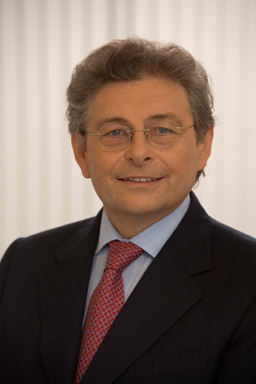
 Freddy Hanard, Chief Executive Officer of the Antwerp World Diamond Center, gave this interview to Alex Shishlo, Editor of the Rough&Polished European Bureau in Brussels
In what way has the global financial crisis affected the work of the AWDC and HRD Antwerp?
AWDC offers services through its Diamond Office, the customs and import/export office for diamonds, and its commercial subsidiary HRD Antwerp, with the HRD Antwerp Diamond Lab as major division. The economic slowdown has strongly reduced the demand of these services, and thus the revenue of AWDC. Thanks to the unique Belgian social legislation, which allows us to put our staff in temporary economic unemployment, the impact on employment is however limited. However, other restructuring measures have been taken as well.
Belgian imports and exports of rough and polished goods in February as published by the Antwerp World Diamond Centre show the ongoing slump in demand for rough and polished diamonds. Belgian polished exports fell 32.7 percent to 577,144 carats last month, and dropped 36.4 percent to $758.7 million. Meanwhile, declines in polished imports were even larger, falling by 40.1 percent to 493,290 carats in January, and by 37.9 percent to $541.3 million. The data for the first two months of the year showed a similar decline. Polished exports fell 34.9 percent to 1.05 million carats, and by 37.4 percent drop to $1.32 billion. Polished imports in the January-February period fell 42.1 percent to 1.11 million carats, and by 38.0 percent to $1.20 billion. As for rough exports, the situation was even more severe, with a 65.9 percent fall to 4.08 million carats in February, while in financial terms, there was a 69.4 percent fall to $344.8 million. In the first two months of the year, there was a 65.6 percent fall to 8.73 million carats, and a 69.9 percent drop to $649.1 million. Rough imports posted a decline of 58.1 percent to 4.20 million carats, and a 71.2 percent drop to $277.2 million. In January-February, there was a 42.4 percent to 12.9 million carats, and a 63.5 percent drop to $737.7 million.
What kind of problems in your opinion were generated by the global financial crisis for the diamond industry?
The international diamond industry is affected in several ways.
First of all, the main producers – Alrosa, De Beers, Rio Tinto, BHP Billiton – have cut their production drastically in order to maintain the price level. They are now doing maintenance. What is the use of digging op diamonds that have been underground for millions of years when there is less demand?
The demand for polished diamonds has dropped. For example, the diamond jewellery consumption in the US during 2008-2009 Christmas shopping period went down with more than 20%. This means that a lot of goods were returned to the wholesalers, who have now a lot of goods in stock. Due to the ripple effect, less demand for polished diamonds will generate less demand for rough diamonds and thus the producers have reduced their activity.
Especially the smaller and medium sized diamond companies experience great difficulties, since diamond trade is practically paralyzed. The diamond sector is greatly dependent on credit facilities, which are covered by invoices. Diamond companies are left with unpaid invoices and cannot make new ones, their credit lines maintain their level, but new credit lines seem not to get approved.
Can the financial crisis and the problems arising in the diamond industry result in re-distribution of roles and gravitation centres in the industry producing rough and polished diamonds?
Antwerp now proves to be a very strong centre compared to f.e. Tel Aviv and Mumbai. However, once the crisis is over, those centres will too start to pick up their normal roles. We do not expect any redistribution of roles or gravitation.
What is the amount of diamonds supplied by Alrosa to Antwerp for processing and further sales? What are the outlooks for cooperation between Russia and the Antwerp World Diamond Centre?
Due to very strict Belgian legislation, we are not allowed to make these figures public. However, it has to be clear that the cooperation and the ties between Alrosa and Antwerp are very tight and that most of their production passes through Antwerp.
How much urgent is the problem of diamond certification?
We would not call it a problem. However, diamond certification becomes more and more important since consumer confidence is one of the priorities of the industry. It becomes even more important if we want to counter new technologies which make it possible to fabricate diamonds or to improve the colour of natural diamonds. The consumer has a right to know exactly what he is buying.
What is, in your opinion, the reason of lower turnover of the Antwerp World Diamond Centre? What should be done by the Antwerp World Diamond Centre to restore its previous positions?
Total turnover recorded by the AWDC for 2008 actually rose to 45 billion USD. The decline in the last quarter of 2008 was due to the meltdown of the world financial markets, starting with the collapse of Lehman Brothers in the United States in September. The situation was not limited to the financial world, but quickly spread out to the diamond sector. On November 17, AWDC convened an emergency industry-wide summit meeting, with more than 900 diamantaires attending. What confronts the market is a credit crunch on the one hand and consumer insecurity on the other, but not a lack of confidence in the diamond itself. The position of Antwerp is still what it has always been. 80% of rough and 50% of polished transits through Antwerp.
In an interview to our agency Mr. Avi Paz called Israel a world diamond centre and said that the workmanship of Israeli diamond cutters was much higher than in Belgium and that he was not sure there was any cutting business in Belgium at all. What would you say to that?
Mr Avi Paz should know better.
Could you describe the situation on the Belgium diamond market?
Contrary to f.e. Israel, Antwerp has always been transparent and sees no harm in publishing the export and import figures, even in times of difficulties. For the specific details, see before.
What are in your opinion the main trends in diamond jewelry sales in Europe nowadays?
We don’t have these data, as wholesale diamond centre.
What kind of measures are to be taken by the world’s rough and polished diamond industry to overcome the crisis? What is to be done to avoid such situations in the future?
We discussed the possible measures to be taken at the Antwerp diamond symposium in November 2008. The major rough diamond producers (De Beers & Alrosa) agreed on reducing significantly the volume of rough they release to the market in 2009. Industry leaders called on their colleagues to act responsibly when it comes to purchases of rough diamonds. A market that is flooded with rough diamonds would raise the level of risk considerably. While the banking system is generally under strain, the major Antwerp diamond banks financing the industry will avoid taking drastic measures that will increase pressure on the industry. At the same time, the bankers urged their clients not to engage in activities that will raise their level of indebtedness. Self discipline should be the keyword. Measures that improve liquidity should take precedence over others. Asset protection prevailing over asset growth.
There is a general agreement among all major players about the need to establish a pan-industry organization that will manage the global campaign to promote diamonds and diamond jewelry generically. It is of paramount importance to avoid marketing diamonds as a commodity, but rather as luxury product which retains its value over time. Industry leaders call upon government support and insurance of exports through the Delcredere Office.
What is your evaluation of the intention pursued by some African countries to develop their own cutting industries?
The African countries have every right to pursue beneficiation and deserve every support necessary to obtain their goal. However, it will be very difficult for them to compete with the traditional trading and manufacturing centres.
For many years De Beers has been the guarantor of a stable diamond market. Now we cannot say that with certainty. Is there any company or country which can assume the role of a leader and regulator in the industry in the current situation?
Since the 90ies, new diamond producers are sharing the market: not only the Beers, but also Rio Tinto, Alrosa, BHP Billiton, Harry Winston, etc. De Beers will never again monopolize the market as before. These are different times, where national authorities monitor activities very closely and where situations of monopoly or cartels are considered being a danger of the free market and thus are considered to be illegal.
How vital is the sightholder format of De Beers in this crisis period?
The sightholder format seems to be under a lot of pressure and has changed since the crisis. Sightholders are no longer obliged to take the goods they sign up for.
After the decision of the European Commission to stop large-scale cooperation between ALROSA and De Beers became effective, what are the outlooks for the Russian company on the diamond market to your mind? In what way, in your opinion, should it outline its sales and marketing policy?
We are very happy to see the Alrosa goods coming to Antwerp. The Antwerp infrastructure and stability that is offered by our centre is beyond any doubt the best in the world. Alrosa would hopefully continue to sell the majority of its goods through its sales office in Antwerp, or through tenders. Antwerp is the major rough diamond distribution centre, with 80% of the total rough diamonds passing through our city.
Can polished diamonds play the role of an investment vehicle? What should be the quality of diamonds to perform this role today?
Diamonds are not a traditional investment vehicle since a diamond is not a homogeneous product as f.e. gold. Diamonds differ in colour, weight, clarity and the way they are cut. So before starting to invest in this product, the characteristics of each and every one of them should be described in a certificate.
Diamonds should never be considered as commodities, diamonds are a symbol of love and affection.
According to Idex Magazine, some diamond funds are already operating, or are still in the making. The investor buys shares in a fund that invests in diamonds. F.e. Diamond Circle Capital, began purchasing large diamonds just before the crisis set in 2008. Also, the Antwerp Diamond Bank Private Equity launched a Diamond Value Chain Fund that invests in the entire diamond pipeline. Some analysts (Chaim E. Zohar) are in favour of a rough diamond fund, that would operate as a price stabilization fund. It is however too early to evaluate the performance of the existing funds.
What could be done by participants of the diamond market (including ADC) to boost the investment attractiveness of diamonds?
Certification, transparency and ethics, are the assets to be put forward.
What are the functions of the Antwerp World Diamond Centre?
Founded in 1973, Antwerp World Diamond Centre is a not for profit organization that serves as the official representative of the Belgium diamond industry. As an umbrella body, AWDC is charged with managing the relationship between the diamond sector and government, and promoting the interests of the Belgian diamond industry worldwide. Today, AWDC fulfils important social, economic and political functions. On behalf of Belgium’s federal government, AWDC assists in the regulation of the diamond trade and in the monitoring of both rough and polished diamond imports and exports.
Its commercial arm, ‘HRD Antwerp’ provides a variety of services to the international diamond community, including diamond and gemstone grading, education, and research and development.
What are the functions of the Chief Executive Officer of the Antwerp World Diamond Centre?
The CEO of Antwerp World Diamond Centre is charged with the daily management of the AWDC, and acts in close cooperation with the board of directors, headed by the president, Mr. Jacky Roth.
To manage such a powerful body – is it honor or responsibility?
Both.
