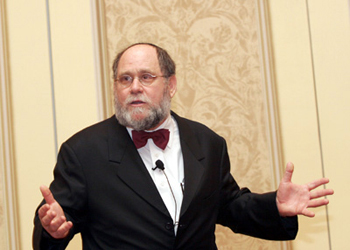
 Martin Rapaport is a famous diamond market expert who is also publishing the Rapaport Price List. We met him at the CIBJO Congress in Istanbul held on May 2-5 and attended by prominent figures of the global jewelry industry to discuss anti-crisis measures, its major subject. Within the framework of this congress Martin Rapaport showed his film shot in Africa and delivered a report on on-line diamond trade. Mr. Rapaport kindly agreed to give this interview for Rough&Polished.
How did you start your way into diamond business?
I entered the family business in 1975 starting as a rough and polished diamond broker in New York and immediately came to the conclusion that it was necessary to make a summary report registering retail supply prices for polished diamonds on the New York market. The Rapaport Diamond Price List was created in 1978 and encountered resentment. Brokers were afraid that the price list would serve to decrease diamond prices and would not permit any further deals based on the “traditional handshakes.” Despite the criticism, I started to publish my price list, the Rapaport Diamond Report, which is now the main source of information about rough prices and the market of polished diamonds. In 1980, I established the RapNet – an interactive diamond market, as well the Diamond Exchange, an on-line diamond market.
Please, say a few words about the diamond On-Line Exchange.
This is a financial instrument for investors; it accepts bids for purchasing and selling rough diamonds of various sizes and quality. The aim of establishing the on-line diamond exchange was to saturate the market with cash. The exchange is trading in diamonds certified by the Gemological Institute of America and rated as “excellent” or “very good” starting from one carat and above and having a warranty from the Rapaport Group. Currently, the gem industry has a bank debt of $15 billion. Plus an amount minimum two times as much in credits to market participants. Due to the great amount of credits the situation on the gem market is deplorable and it needs, in the same way as others, an immediate inflow of cash.
Your critics believe that the changes being proposed will be harmful not only for investors, but for the whole jewelry industry.
It is shortsightedness. The diamond industry is undergoing complicated changes: control is shifting from the monopolist cartels to the free market. My task is to create an efficient, standardized, competitive and transparent market. The process of selling diamonds, despite any techniques, is changing slowly – De Beers still accounts for 40% of the world diamond output and brokers continue their old practice of doing business – “by handshakes.” However, you cannot work with diamonds “in the same old way” for you will need cash since the credit market in this field is rapidly contracting. Polished diamonds may become as attractive for investors as gold. Open auctions are changing the closed world of diamonds. The majority of buyers will be made up of traders and enterprises. But if consumers will wish to buy diamonds themselves (in one-stone lots) they may register as market participants and buy them. Auction winners will be named after the bidding will be finished. This is why I am planning to use such prices as the basis for a new Rapaport Diamond Index, which will be used to develop the market of diamond futures and other financial products, including the index fund.
In your view, diamonds are not losing their investment attractiveness, aren’t they?
People are striving to buy diamonds to preserve their wealth. Recently diamonds have already moved up in price and as before they remain an attractive instrument for investments particularly taking into account that investments in real estate and equities do not meet expectations of investors – interests on bank deposits lag behind the inflation index and money at banks depreciates. I believe that prices for diamonds will go further up, which is especially true for large-size stones. In the nearest future, diamond purchases will be more and more investment motivated.
Currently, there is too much talk going on about the crisis and still – What do you think about it?
This is a kind of new reality. In other words, we think about the crisis as if it is something bad – however, it means change, some shift giving us new opportunities and new ways of doing business. Old hierarchies controlling the business were stifling the incomes of rank and file, but now they are thrown out of business and they should have been thrown out. It is fair that ALROSA and De Beers are not so powerful today – because prices for rough diamonds are falling. Mining companies were strong pushing rough prices higher and higher. No one else had a chance to earn. The situation was unnatural and prices unfair. I hope this time has passed, and the industry will be renovated and turn better. This is sacrificial and cleansing fire and it will bring a new way of life.
When do you think it will happen?
It is difficult to predict. This will depend on how we shall live through this time. I think that to accumulate diamond stocks for a rainy day is a rather dangerous thing. Just as the best diamonds should be natural and transparent, so the diamond market should be natural and transparent. You don’t need lab-made diamonds, you don’t like them – so the market should not be artificial, without any stocks and other things because this is unhealthy. Let prices go down for they are not important while the important thing is profit and it is important to give the market a chance to breath and live introducing new ideas and new products. Let prices fall and stay low giving an opportunity for diamond cutters, jewelers and retailers to earn. The more powerful are the mining companies the more they are raising prices, the more they are stifling the capabilities of the diamond industry.
Is the jewelry industry successful in weathering out the economic downturn?
Competition driven by prices, quality and service remained in the past. Today you have to compete in an environment marked by the economic downturn, credit crunch and two-fold inflation. Strategic planning is indispensable in such a situation. Those who make it smarter will be able to survive the tough time, while others - contrariwise.
Your name is associated with diamonds and vice versa – What are they in your life? What made them so important for you?
You see, I believe in diamonds, that they are wonderful and esthetically beautiful. They possess emotional power and some supreme idea. People engaged in this business understand that the power of diamonds is in symbolism, emotional and notional meaning. This is a fantastic commodity – buying it you get some drive – it’s like engine thrust, this is blessing, this is always triumph, joy, feast and all this, never measured by money, you receive as an additional bonus.
Do you get additional energy from diamonds?
I am getting energy from the industry as a whole – from the thought that I can really change the world, from the struggle for market transparency, for new technologies, against monopolies; I am doing a lot of different things – and all this excites me and gives me energy.
Do you often buy diamonds?
Of course, for my wife, children, each of my daughters! Women enjoy diamonds – so let them have them!
Rough&Polished, Turkey, Istanbul
