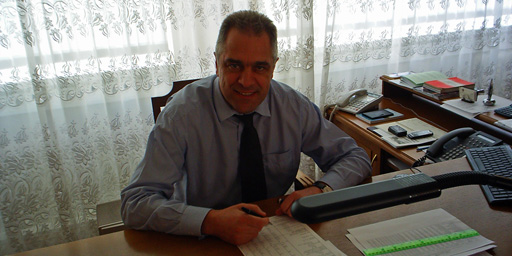
 At the extraordinary meeting of the Guild of Jewelers of Russia Alexander Boguslavsky, General Manger of the Priokski Non-Ferrous Metals Plant, broke the news about “gold credits” which his enterprise was going to issue starting from July 1, 2009 to render support to the domestic jewelry industry. Mr. Boguslavsky has kindly agreed to share the details of this venture with our correspondent.
The mass media say the state-owned Priokski Non-Ferrous Metals Plant will lend some of its affined gold to jewelry-making companies as credits or subject to deferred payments in case it is permitted by the Russian Ministry of Finance. What kind of crediting schemes have you developed in reality?
We are offering two standard schemes to jewelry companies. The first one is meant for large-scale jewelry makers, such as Adamant, Adamas, Estet and Yashma-Zoloto, which will be given metal for jewelry production and they will be returning shorts to us for recycling. Incidentally, recycling is a sore subject (court proceedings related to old criminal cases are still dragging on). The difference in “gold balance” will be either covered by money or by any primary or secondary gold-containing materials. In this way jewelers will receive materials for manufacturing without spending any working capital, while we shall have an opportunity to increase the production load (which is now below 50%) and get paid for our services. The second scheme involves regular gold sales on a deferred payment basis. It has been devised for small-scale jewelry workshops using 20-15 kilos of gold. Of course we shall not give gold to anyone. Clients for our company will be cleared by the Certification Center at the Guild of Jewelers of Russia (the Certification Center is headed by Sergey Ososov): it will check their production and financial situation and will issue appropriate recommendations.
For what term will you issue gold credits?
We are ready to lend gold for the term of up to six months (of course we shall agree the term with each customer separately). For us it is more convenient to make the term as short as possible to attain a higher ratio of capital turnover while jewelry manufacturers prefer longer terms because of their technological processing and sales proofing. So every day costs quite a lot of money. For example, if a jewelry plant takes 300 kilos of gold it will worth $10 million. Now the bank credit interest rate runs at 20% per annum, which is equivalent to $1 million in saved working capital for a six-month period!
Are you not afraid that some of such “gold credits” will turn into bad debts?
The question of guarantees is now being very carefully trashed over.
What will be scale of you programs?
This year we are planning to lend one ton of gold and ten tons of silver. In 2010 these values may go up to three and forty tons accordingly.
You propose to support the jewelry industry despite the recent pronouncements of some of the public figures (as for instance Sergey Mironov, Chairman of the Federation Council, and Boris Titov, Chairman of the Delovaya Rossiya Public Organization) in favour of taxes on luxury?
It is always difficult to comment political declarations. I would like to draw attention to the fact that despite the most complicated situation in the country the Soviet government in the 1920s decided to establish the jewelry industry of the USSR being very well aware that this meant jobs and taxes and that in the opposite case everything would be replaced by illegal traffic.
Rough&Polished
