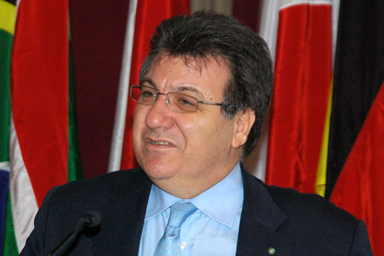
 Dr. Gaetano Cavalieri is the president of CIBJO, the World Jewelry Confederation, from March 2001, when he was elected to this post at the CIBJO Congress in Paris. He has been involved with CIBJO for more than 12 years, representing the Wholesale Sector for Italy. Currently, Dr. Cavalieri acts as a consultant to the Italian Ministry of Industry and Commerce, and to the European Economic Commission in the areas of standards and taxes on gold. He also runs his own wholesale company, which was established nearly 200 years ago.
Tell us please about the tasks pursued by CIBJO.
The World Jewelry Confederation was established in 1926 as a European union of jewelers representing and promoting the interests of the jewelry industry in the area. The confederation acts as an information center and agency responsible for decisions taken to protect the interests of the world jewelry industry. CIBJO relies on the enterprise and support of national jewelry member-organizations contributing to greater confidence toward the entire industry on the part of society.
Today, there are 41 member-countries in CIBJO, including in particular Australia, Austria, Bahrain, Brazil, Canada, China, the Czech Republic, Denmark, Egypt, France, Germany, Greece, Hong Kong, India, Israel, Italy, Lebanon, Lithuania, Netherlands, Norway, Pakistan, Peru, Portugal, Russia, Saudi Arabia, South Korea, South African Republic, Sri Lanka, Switzerland, Thailand, UAE, Great Britain, USA, and Japan. The Guild of Jewelers of Russia is also the member of CIBJO.
What is required to be a member of the confederation and what are the benefits?
Jewelry enterprises should abide to the rules and regulations declared by CIBJO which in the long run serves to increase the quality of jewelry goods and consumer confidence toward the jewelry industry. In its turn, the confederation recommends potential investors to be more active in entering the market and putting their money into the jewelry industry of a country being a CIBJO member. Having joined CIBJO it is possible to forecast a significant growth in the national market of precious stones, gold and silver jewelry.
Besides, CIBJO membership gives an opportunity to take part in solving problems related to resisting illegal traffic and corruption, money laundering, unlawful funds and financing terrorism from the turnover of precious metals and gems. The membership brings the activities in the field of expert evaluations of precious and semi-precious stones in line with international standards and facilitates settlement of disputes which may arise.
From CIBJO’s point of view, what is needed to overcome the crisis?
Currently everybody in the world, not only jewelry marketers, is paying his tick. Evidently, there was not a single country braced for such a disaster, but in many cases the jewelry business showed it was able to act more concordantly and correctly than many other industries. The crisis proved the necessity of establishing a new system of marketing, which would be closer to the expectancies of suppliers and customers. The only way to move along this path is to increase the transparency of our business, corporate and social responsibility.
Complete openness is a business practice to be accepted by the entire industry community. We are busily engaged with our educational program in the field of corporate social responsibility in the jewelry industry. To finance and manage the program the CIBJO Congress in Dubai established a foundation supported by the United Nations and it well may be that this will be the best tool for education purposes, business management, reaching agreements, making deals and developing production.
Although the foundation has been established by us, it functions as an independent organization. A team of experts in the field of corporate social responsibility from Switzerland, Great Britain and China have developed basic elements of the educational program. There will be set up a center based on the existing educational institution with an aim of drawing up curriculums and coordinating the foundation’s activities.
To promote universal standards and terminology in the jewelry industry, CIBJO has developed the so-called Blue Books nowadays recognized as universal and world-wide standards, a collection of industry specifications on purchasing precious metals, and a reference book on diamonds, color gemstones, pearls and precious metals for retailers. Anyone is free to use these standards at his own will. However, we believe that they should be applied by all people and corporations engaged in the international trade, and they should be referred to when using trade terminology in markings, sales, advertising and promoting jewelry products.
Could you comment the results of CIBJO Istanbul Congress?
It was a regular congress which discussed the problems arising from the current situation. Istanbul is a place of interest: it is in the middle between Europe and Asia, North and South; there is a sapid jewelry industry and community bringing together all kind of international features. Turkish jewelers did a lot to organize and hold this meeting and we are grateful to them for their hospitality. We had really very productive days in Istanbul.
We are facing now a complicated and challenging period of time, may be the harshest since the great depression of the 1930s. And if then the economy was raised by the efforts of several Western countries, now it depends on the policy and interests of all countries – all over the world. In 1975, there was established the G6 group, followed by G7 and G8, and it was already G20 when the leaders of pace-setting economies met in London in April to discuss the situation. The atmosphere there was not entirely northern; it was also southern, western and eastern.
In our jewelry industry we had to create a long chain of production and distribution from one country to another and across the world. Every country knew its place, where it fitted and where it was good to work. All of us have equal rights to profit from our skills and national advantages taking part in the decision-making process. There are miners and manufacturers and there are consumer markets.
The world economy is an open system where the turnover rate of funds and products is high as never before. The emerging markets in the East are one of the major hopes of the world jewelry industry. Turkey is a peculiar kind of jewelry cross-roads and it turned out to be the most convenient place to discuss our vital problems. Every item which we make and sell is the result of efforts by miners, engineers, designers and jewelers from various countries of the world. We are all dependent on each other protecting and promoting the reputation of our brands.
You have visited Russia on several occasions: What do you think about the Russian jewelry industry?
Development of the jewelry sector is always beneficial for the development of a country’s economy. Since Russia is going to join WTO, there is no doubt its economy will be developing under the common banner of this organization pushing its industry forward. We are glad that the role of Russia is ever more growing in the international jewelry industry.
Although the population of Russia is less than that of China or India, you have rich mineral resources, a growing middle class and long tradition of jewelry culture, which has never been discontinued and may be proud of such names as Faberge. We have long been talking about the Russian market using the future tense, but now it would not be fair to speak of Russia as of an emerging market – this country may become one of the major players by the middle of the 21st century.
Rough&Polished
