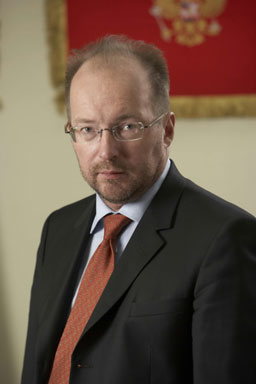
 The management reshuffle in ALROSA was commented to the Kommersant Daily by Sergey Vybornov in his last interview as the company’s CEO.
Is it true that you are leaving the company?
It is true. I am resigning as ALROSA’s President from the 13th of July. This is the decision taken by the Chairman of the Supervisory Board of the company.
When you were not included on the Supervisory Board, there were rumors you fell afoul of Yakutia’s President Vyacheslav Shtyrov who was your traditional supporter. Is it true that he proposes to change ALROSA’s President every two or three years?
I have not quarreled with anyone. If the point of view you mention really exists, it is the position of one of the shareholders. Last year I got votes of some part of the federal equity package (incidentally, at that time I was elected as an independent candidate). However, this time there was a strict order to have eight people elected from the federal slate including five independent candidates, so only Yakut shareholders could vote for management. In fact it was they who nominated me as a candidate. But why they preferred the Vice President of ALROSA (Ivan Demyanov, a native of Yakutia. – Kommersant) to the company’s President, this question should not be addressed to me.
As a rule, emergence of independent directors is an unmistakable sign that the company is gearing up to access public capital markets. Is ALROSA planning to do this?
To start with, this is not the best time to reach stock markets. The order to vote for independent candidates was the decision of the government to be fulfilled. There is some logic here, since Fyodor Andreyev, for instance, is well briefed on our matters (before his employment with RZD he worked in ALROSA.- Kommersant). However, there are people who are new to the diamond business. But on the whole it is good. So far we had on our Board only functionaries conversant with our problems just within the frames of their service duties, and this is not always beneficial to the company.
Usually, independent directors represent minority shareholders’ interests and after the federalization of ALROSA was completed their number has decreased several times.
Indeed, we have less than 10 percent of minority shareholders left. And their number is not going to expand even if after ALROSA will be re-registered into an OAO, open joint-stock society, and decide to seek funds on the market. There is a conflict of laws about it. In the course of ALROSA’s federalization the correlation of stakes between Russia and Yakutia at the level of 51/40 was fixed by the amicable settlement agreements, which were approved by courts. This situation is now very difficult to reverse. What kind of free float will the company have in case it ventures to the market? About 5 or 6 percent. It is not very good for company plough-back. But how is it to be changed? Court hearings all over again? I do no think this is the right way.
They say that Yakutia has rowed you up the Salt River during the ballot after you have cardinally changed the system of rough sales tying up long-term contracts on money-losing terms for the company at a market decline phase.
Money-losing? Sounds like in the well-known joke – “It’s hard to understand the Petrovs.” (The joke is about two fishermen on the river’s bank, one of whom, Petrov by name, is berating the other for visiting his wife too often and the other replying, “It’s hard to understand you, the Petrovs: your wife says it’s good and you say it’s no good.” – Editor’s note.) Initially we were reproached for going to sell at high prices and told, “There are no such prices on the market!” But when we signed our first five contracts based on such prices and there was a queue for other contracts we heard rebukes, “Why did you not include me on the list?” Our customers gain from three-year contracts: any bank will be happy to have such collaterals and not one’s personal guarantee as it was done previously. For us the price formulation along “the Financial Ministry’s price-list plus 17%” is a fair price capable to sustain the company’s economy and stable returns on investment. It is higher than many customers would like to see, but they are ready to pay more to make their own business predictable. Right now we have executed more than $900 million worth of long-term contracts in a year. It is most important that we are selling rough across the entire section of annual output since we cannot afford piling up stocks.
Is every customer obliged to take all the section?
No, customers take section pieces, every one of them getting his own and consuming our entire output. Every company is operating in its own niche, virtually avoiding assortment collisions with other ALROSA’s clients. To choose such customer pattern is the most difficult part of our work. Besides, we had to alter the sorting process adapting it to our customers.
All in all, how many contracts have your company concluded?
About fifteen. We have chosen companies having strong balance-sheets, good bank histories and sustainably high needs in rough diamonds. We have no interest in short-lived companies, which ask $10-20 million worth of rough just to get bank guarantees. To solve the task of distributing the entire section of the company’s output we have taken interest in such customers, who need about $200 million worth of rough diamonds.
It is known that one of the long-term contracts has been signed with Tiffany. What other companies have become ALROSA’s sightholders?
I can name just some of the companies, because we have confidentiality agreements with the majority of our customers – these are such Belgian companies as Dali Diamonds, Diarough, and some others. We have also entered into contracts with the Israelis. We have started with Belgium simply because the Belgian government offered guarantees to “diamond banks” to the amount of $1 billion. A bit later this initiative was upheld by the Flemish authorities announcing guaranties for $250 million. There are such companies also in Russia. Lev Leviev is so far considering our offering. We are planning to complete the system of long-term contracts by the end of this month. However, strictly speaking it is incorrect to call our customers as sightholders. We are just hedging some of our risks by tying up three-year contracts. These guaranteed shipments should account for almost 40% of our sales, while the rest will be sold on the free market.
It seems that ALROSA’s new sales policy does not sit well with everyone?
Indeed, there is some discontent and it has a clearly defined economic ground. Everyone got used to the fact that the sales system for Russian diamonds has not changed for 50 years. During the whole history of our company up to its recent time the “responsibility” for selling Russian diamonds was virtually held by the Oppenheimer family. The last two years produced a three-stage system: the best stuff was sold in Russia at prices I’d say being far from the market reality, while rough diamonds of a bit lower quality were exported to the free market and totally bad went to De Beers. However, this system could not last forever. The end of collaboration with De Beers and crisis served to terminate it. The slightest signs of a demand slump left ALROSA with no customers but Gokhran. Currently, the terms for everyone are equal and this arouses annoyance particularly in those market participants which formerly had preferences. Remember, how often it was talked about the need to support the Russian cut, manufacturers and the like. The beneficiaries, which all these domestic manufacturers had, were of not at all a domestic origin and all their business was based on an artificial price difference between the domestic and overseas markets. Sometimes domestic discounts reached up to 30%. The company could not endlessly maintain someone’s private interests.
Do you mean Smolensk-based Kristall? Was this company among ALROSA’s regular customers?
It took too long for Smolensk to make up their mind. In April we offered them a long-term contract, but they told it was too expensive. Now the window of opportunities has closed. However, this is a problem which may be solved. They may buy rough on the spot market.
It is no secret that during the last six months you personally supervised the company’s sales. Is it true that recently you had to pass these powers to a new employee?
Two weeks ago Vladlen Nogovitsyn was appointed as the company’s sales vice president. He has long worked in London and Hong Kong and has a good sales record. During six months the Arcos Company (Hong Kong) which he headed earned more than our other overseas subsidiaries. I had to switch sales to “manual operation” in the beginning of this year when I understood that nothing was going on except idle talk. I invited Michael Brooker (a former employee of De Beers. – Kommersant). So far he works as a consultant, but I think that soon his appointment to the staff will be agreed with the migration service. This kind of personnel solution produced controversial reaction, but the results of his work prove it was correct.
Is it not embarrassing to De Beers that ALROSA’s new sales policy is developed by their former employee?
No, it is not. Now all the diamond marketers should think how to sustain the market’s stability. Incidentally, in a week we are planning to complete the establishment of the International Diamond Board Association which will promote polished diamonds within the frames of the international project ‘Generic Diamonds.’ It is the question of promoting polished diamonds as an eternal value independently of those companies, which produced them. Starting with the Kimberley Process the diamond industry was somehow always made to excuse oneself for its own existence. But I hope you will agree that diamonds bear no more blood on them than oil, gold or aluminum. Despite the complicated financial situation in diamond-mining companies, they are eager to make up a budget for this organization. I believe that by the end of this summer the project will be submitted to the Supervisory Board of ALROSA for approval.
What is the total budget of this project?
This year it will be small, but on an advanced stage it will amount to about $70-100 million a year.
And what will be the financial contribution of ALROSA?
I think we should be guided by our share in the global market or, in other words, approximately 25%. Accordingly, De Beers, Rio Tinto, BHP and Harry Winston will take up some part of the expenses.
Is ALROSA ready to spend $25 million per year for these purposes?
In the best years De Beers used to spend $200 million to promote diamond jewelry. Later it launched a joint project with Louis Vuitton and they both got busy financing it. It took an enormous amount of money and efforts and as far as I know they changed three or four teams, but the project got rolling. Now as I know from my colleagues in De Beers, financially it is more successful than mining. Essentially, it is utterly difficult for a mining company to have the heart to take such a step.
How is going ALROSA’s project with UK Leader?
Currently the documents are being agreed with the Federal Service on Financial Markets and Financial Ministry. We need a legislative framework to regulate circulation of polished diamonds as an investment instrument. At present we just haven’t got it. Together with Leader we have an idea to set up a special mutual investment fund, whose resources will be invested into a diamond stock. It will be kept in a depository and employed as a basis to issue securities. The current world economy is such that private investors and pension funds are more motivated to preserve money than to increase their amount. But putting this project into life will require serious changes in the legislation, which is something we are working on now. There have already been attempts to launch similar projects but they failed because of two reasons: firstly, the amounts they envisaged were insignificant and secondly the idea to issue a security collateralized by polished diamonds was suggested by customers themselves. However, when such a step is undertaken by a mining company investors understand this is serious and for a long time. As far as I know, De Beers is now developing a similar program.
Is it not embarrassing in your opinion that rough prices are subject to sharp and unpredictable fluctuations?
This is exactly our aim to remove such fluctuations. When prices for certain categories of rough soar 80% in a year, it is evident that they are doomed for a similarly serious slump. This is what happened to large-size rough diamonds: at first, speculators were busily buying them overpaying 15-20% and then no less busily started to unload them.
Hearing you it may seem that ALROSA has avoided the world financial crisis.
Of course this is not true. We also have an anti-crisis plan and emergency response center. We had to curtail our expenses significantly, this year cutting them by 20 billion roubles. This hit all the aspects of our activities, but mining was affected to a lesser extent. We have calculated that if we stop construction of underground mines we shall save not more than 30%, while their further mothballing will require almost the same amount of money as the construction itself. Till the end of this month we shall launch the Mir Underground Mine and in October-November it will be Aikhal. Still we shall have to introduce significant corrections into capital intensive projects. Some experts believe that ALROSA’s underground mines cannot be rated, putting it milder, as state-of-the-art and besides that are expensive. Two years ago our company was joined by a “mining” team whose people had enormous experience of underground construction in Norilsk. We managed to introduce serious corrections into the construction, significantly increase the pace of work and labor safety level as well as rationalize the projects which had already been approved. Still there is a problem.
Any problems with financing the projects?
ALROSA has a bank with which we are working quite fruitfully, VTB. It can be called a “home bank” since this is our former share holder and today it is our major creditor. Our colleagues there have complete understanding of the situation in the company and we are not concealing anything from them. I would like to note that all ALROSA’s credits are not collateralized, but the presence of VTB as a creditor demonstrates our company’s safety margin to the market. This is why in the crisis period we afforded to avoid great discounts for rough diamonds as it was done by our competitors. At that time different companies dropped their prices from 50% to 70%. De Beers had even to close some of their mines in Africa. But we cannot stop mining for purely economic and social reasons. Western Yakutia has a territory equal to one half of India and we have there 200,000 people working for our company. Despite a very hard burden we are staying within the required limits. And we have already started our sales.
Is the situation on the market improving?
Definitely, but now it is utterly important to avoid disrupting stabilization out of the wish to sell more on the market. By the way, our customers understood our position amid the crisis. There was not a single of them who stricken by panic would dump their stocks of our rough diamonds understanding that price sinking for high-quality Russian diamonds will stop earlier than for rough diamonds of other producers. On our part we maintained prices not to let our customers go bankrupt. So we were propping up the market from both sides and I believe we managed to do it.
Luckily, unlike its competitors ALROSA has always an opportunity to sell its excess of rough to Gokhran. Is it because of this the head of this agency, Vladimir Rybkin, is now on the Supervisory Board of ALROSA?
This was a correct decision. Gokhran is traditionally involved into our activity since we sold them a certain amount of rough diamonds even before the crisis on an annual basis. We also held consultations with this agency. Besides it has the functions of state control. In recent years, our annual sales amounted to $2.8-2.9 billion, of which $2 billion I would now remove from the market understanding that a significant part of rough goes to Gokhran.
Does ALROSA’s sale of non-core assets appear to be one more anti-crisis measure?
The reasons why we sell them are different. Development of Geotransgaz and Urengoyskaya Neftegazovaya Compania requires enormous investments and currently we have no money. But the assets are good: in case these companies will reach their design performance levels their output will be similar to that of NOVATEK. To be honest, I am not sure that ALROSA should establish such a large gas player. Basically, we have not concealed that we bought these assets for investment purposes. These are good projects if ALROSA were engaged in gas business. Besides, there were a lot of unsolved problems related to licensing and property. In particular, the well framework was not on the balance sheet of these companies. Now the talks with the buyer are in their final phase.
But VTB Capital which is buying these companies from you is also not engaged in gas business. To whom are they going to re-sell these companies?
But VTB Capital is an investment bank, so it is quite in line with their business and I do not give comments on our colleagues’ plans.
And how about Irelyakhneft?
It’s quite another story. Their oil has a great specific weight of tailing fractions with fuel oil and bitumen accounting for 60%-70%. There is not a single boiler-house in Yakutia capable of using them. At the same time, their utilization or trapping is expensive. The oil field is of interest only to petroleum companies which will lay a pipeline connecting it to Transneft’s system. This company has found its buyer as well. It is a Russian company, so to say, belonging to the second echelon. The talks with it entered their final stage.
What is going on with Sakhaneftegaz?
By the time ALROSA bought Sakhaneftegaz, it did not exist as a company, the more so because Yakutgazprom had mysteriously ‘sailed away’ in the process of acquisition (Sakhaneftegaz’s subsidiary bought by Magomed Mamedov’s Summa Capital. – Kommersant). There is an unfinished pipeline there, the picture of which would be disastrous to show, plus a thin stake in Yakutgeofizika and a 15-percent stake in the above mentioned Yakutgazprom. Besides, this asset is claimed by Rosneft since this is the debt of Yukos in due time bought out by Prana. We have a simple task – to minimize our losses. I can hardly see anyone around and ready to pay at least something for this “asset.” Currently a bankruptcy procedure is being launched in this company.
To whom are you going to sell the iron ore assets in Yakutia?
We are not selling these assets but seeking a partner to develop them. This project attracted large-scale steel and iron consumers, mainly in China. Now IG ALROSA (ALROSA’s subsidiary. - Kommersant) is holding talks about the shape of such partnership. I can only say that this is a Chinese state-owned company.
Which of the African projects is ALROSA ready to part with?
We had plans to build two hydro-electric power stations on the border between Namibia and South Africa, but because these projects are tied to bank financing their fulfillment terms have been shifted. We are not launching any new projects there – due to the crisis. Last year African rough slumped in prices, but now the situation turns for the better. In any case, Catoca is one of the most efficient projects in the world by its cost. The Luo Project in Angola is generating the greatest number of problems. Geological exploration showed that its reserves are much less than we expected. I would like to remind you that ALROSA has no direct stake there controlling only 20% through subsidiaries. Strange as it may seem, the most successful project turned out to be the one related to exploring for oil on the Atlantic shelf (started in 2007 in collaboration with Sonangol. – Kommersant). Just recently we received seismic interpretation results for one of the fields proving there are 45 million tons of oil reserves. And it is oil of a very good quality.
Do you regret parting with the projects you’ve been concerned with in recent years?
No.
