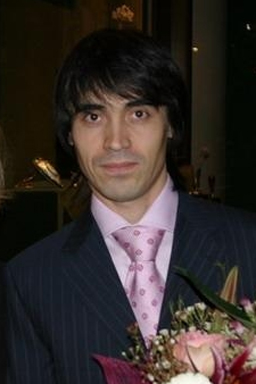
 Although until recently the name of Ilgiz Fazulzyanov was known to just a few, his trademark ‘Ilgiz F.’ is renowned among connoisseurs and his clients include many celebrities.
Ilgiz Fazulzyanov has worked in France for several years taking part in large-scale shows and collaborated with the Ritz Hotel boutique. As far back as 1997 he presented an enamel jewelry collection in France: the jewelry experts of Cartier and Van Cleef & Arpels gave a high appraisal to his works. However, these jewelry firms could not use his drafts: too much delicate and expensive manual work.
Back to Russia, Ilgiz took part in major Russian exhibitions and jewelry contests where he was the prize winner of “Jeweller-2001, 2002,” “Golden Constellation” (in the Precious Idea Nomination) and ALROSA Jewelry Contest.
Fazulzyanov’s jewelry strikes first of all by the quality of idea and its implementation – everything down to particulars: the way gems are cut and fixed… Made as a single piece only, his jewelry artifacts are distinct by his intrinsic style, taste, elegance of lines and color clarity.
Have you received your art education in Kazan?
Yes, I graduated from the city’s art school and established my first jewelry workshop in the Kazan Kremlin. After stained glass and batik I switched over to jewelry and understood this was where I belonged. I started to work with precious metals and gems making everything myself starting from drafts. I was fascinated by the complicacy of jewelry manufacturing – all the technologies I learned unassisted. In 1994, in Pakistan I got the Grand-Prix at the international contest of young jewellers working in Moslem countries after which I collaborated with the Armoury Chamber and Diamond Fund of the Kremlin studying the works of old-time jewellers and mastered all the technologies all by myself.
What makes your work easier?
Knowledge of the graphic art. My teacher was the apprentice of Feshin (my favorite painter) and this is why I am more of a painter. I like the Victorian Art and art-nouveau style of French painters. They had colorful things, more plastique, and smooth lines.
They say you are not only drawing sketches but also possess a range of different techniques…
In my works I use both antique techniques employed by Faberge and new ones, as well as various styles and materials. But I prefer to work with hot enamel.
You often combine enamel with diamonds which is not quite usual. Do you like to use diamonds while making jewelry?
Diamonds add portliness, an aura of power and luxury. They are always present in my jewelry pieces, though beside them there may be inexpensive stones – I want to show the beauty of all gems.
You take part in international shows and exhibitions. Do you find there new currents and trends?
There is nothing particularly new there, and the trend is only one – more plastique, more color. The focus is overwhelmingly on individual taste. You will not impress anyone with large-size stones, including diamonds, if they have no history. And if someone makes an exclusive thing, it may impress people much more than regular things, though at a cheaper cost.
Is it important for you to win in contests?
Sometimes it is intriguing for me to take part in them. But when I was invited to participate in a panel discussion by Cartier or Van Cleef it was a greater award to me than winning a contest. Currently, Christie's is going to sell my things. I believe it is recognition.
Do you think you have reached the pinnacle of professionalism or are there any perspectives for further growth?
It is difficult to speak of oneself, but some time ago I was superior to Bvlgary maestros in filigree and I got disinterested in that; speaking of old-time top jewelers – such as Lalique, Fouquet – I can only say that I have surpassed them in many things. Having such technological possibilities at your hand it is shameful not to do better. However, there are no limits in the jewelry art.
Jewellers often disclose their clients – you never do this. Why?
I believe this a cheap kind of self advertising. I like when my works speak for themselves. And then when people say that jewelry pieces made by somebody are worn by some celebrities it turns out they have just been given them as gifts. And my things are bought – I do not give anything as gifts. I have permanent clients who perceive the jewelry art and their number is expanding. Today there are many well-to-do connoisseurs of masterpieces belonging to the jewelry art and the latter is more important for them than brands.
Does your company review its marketing policy due to the crisis accompanied by slackened demand and consumers’ spending power?
If we compare art and brands I would say that there exists no crisis for art. If one’s works move to the category of art, they will enjoy demand at any time, while demand has of course dropped for ultrafashionable things.
I started to produce a greater number of serious works. And demand has risen, so I started to work with Christie's and Bonhams, which is the world’s third-largest auction house – this involved London, New York and Hong Kong – they all want to sell my things and this is a new level. Now we are negotiating with Dorotheum, which is also one of the largest and most respected auction houses in the German-speaking countries with a history dating back over 300 years and which runs around 600 auctions in a year. So far we have terminated our talks with Sotheby’s – they need a purely diamond collection and meanwhile I decided to abandon this subject.
What is to be done to create a successful brand in Russia?
To create a real brand here you have first of all to get recognized there. This has always been so. It is impossible to establish a trademark without going beyond Russian boundaries. Unfortunately, we have all turned our heads to that side and are awaiting recognition. The European market does not like spontaneity – to get appraised and make people seriously interested in you work, you have to spend several years taking part in jewelry shows. During the first year you will be noticed, in the second year your growth will be given evaluation and then people will se how thoroughgoing the person or the company is…
What is needed to win success in the West?
In the segment where I started vigorously working there are not so many competitors – so it seems there is no one to compete with – I do not know of anyone in Russia. In the West to my knowledge it is JAR which may make a brooch for five thousand dollars and sell it at an auction for one hundred thousand; there is also Chinese jeweler Tao Ma… But we are working in different venues and do not absorb each other’s clientele. If I were making the same kind of jewelry pieces which are made by Cartier, Choppard, Van Cleef, or Russian JT I would have a lot of competitors on my field.
What definition would you give to your segment?
Collection pieces based on an interesting artistic idea, high class items professionally made – this is fashionable at all times. Mainly, these are one-of-a-kind works. It is important to have some idea in a jewelry piece and it should be correctly offered and epitomized in a quality manner. I often see works which have attractive ideas but if such pieces are made awfully, by rule of thumb, they will not fit well in any segment.
What do you think of the state of jewelry business in Russia?
We have a lot of good craftsmen but very few artists. We do not enjoy any support from the state, our jewellers and other applied artists have no promoters or gallerists as in other fields of art. Even Ms. Gagarina says there are no jewellers in Russia – after Faberge. Still I am lucky – I am supported by collectionists and I move by steep and toilsome ways to my goal. However, others cannot afford this. They are making things ordered by wealthy people but cannot fulfill their ambitions – they are making what they are told. Maybe they are good jewellers but as artists they are dying. How can they rise is a question; to make it possible one will need money, goals and time. Meanwhile artists can only paint and cannot manufacture jewelry pieces or even control the work of jewelry craftsmen. We have no school, no education, and no specialists able to teach; the conservative traditions of the Soviet school are still strong and may be seen in prevailing geometric forms, design left over from the 1970s and almost absent plastique. Our schools of higher learning have obsolete equipment which is reflected on the quality of ideas. There are virtually no serious master classes on the subject and they are rather expensive for students.
In what is the future of the jewelry industry – in new techniques, in new ideas?
I spoke a lot to the Italians who are now reaping the fruits of those machine-based techniques which are currently widely employed – they sound the alarm saying that if they will not learn how to make high-precision pieces the jewelry industry of Italy will die. This is actually what is happening: modern techniques are aimed at lower costs and higher production, but here we cannot outstrip the Chinese or Indians and even Turkey. It is especially true for Russia – using modern techniques we can only copy Italians models. In Russia only creative design has its future.
Rough&Polished
