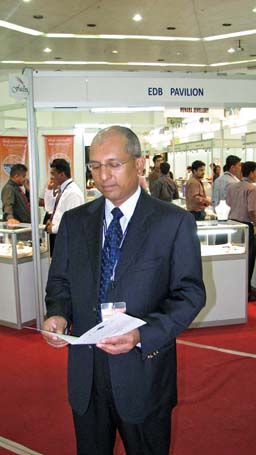
 The Facets Sri Lanka 2009 Gems and Jewelry Show held in Colombo in early September was one of the first probes in the run-up to the coming winter holiday sales embracing major jewelry markets world-wide. Chanaka Ellawala, the head of the Facets Organizing Committee, found time to share his opinion of the situation in the industry and on the market with the Rough&Polished Agency.
Please say a few words about the role played by the Sri Lanka Gem and Jewellery Association in the jewellery industry of your country.
The SLGJA is the Apex Trade Association of the Gem & Jewellery Industry and its role is to help the membership in particular and the industry in general to develop their businesses. We work in close partnership with the government to improve the business environment by influencing government policy, advocating regulatory changes, finding new market opportunities and facilitating support services such as training, testing etc.
SLGJA accounts for almost 300 member companies. How does it manage to rule this congregation and solve all arising problems?
The membership is quite diverse and is made up of the major exporters, manufacturers, wholesalers, retailers and miners. The SLGJA is structured in a way that each segment of the industry has a committee that is headed by a Vice-Chairman and each committee has its own agenda and is responsible to implement it own programs. This autonomous structure minimizes conflict while promoting cooperation. Any disputes will be settled in the open forum of the Executive Committee.
The Rough&Polished Information Agency had a chance to visit this year’s edition of Facets Sri Lanka released by your Association. Could you provide some figures describing the results of this event?
This years’ show had approximately 150 booths showcasing 135 exhibitors. Out of this number, 85% were Sri Lankan Firms. During the 4 day event, we had approximately 5,000 visitors, out of which around 600 visitors were foreign nationals.
This year it was the 19th time you ran the Facets Gem Show. How do you manage to finance it and does it pay back in any way?
The SLGJA is a non-profit organization as is FACETS SRI LANKA. However, we are also self financed. Therefore we have to ensure that our revenues match or exceed our costs. Our revenue is from the sale of stalls and from sponsorships. There were 12 sponsors this year. The principal sponsor of the event is the National Gem and Jewellery Authority, the state agency that regulates our industry.
Sapphires are Sri Lanka’s number one gem and it was amply displayed at Facets Sri Lanka 2009 (by Ellawala Exports (Pvt) Ltd. and others). What is so special about Sri-Lankan sapphires?
Gems, particularly sapphires from Sri Lanka have been known to the world since Biblical times for over 2 millennia. No other nation has produced large sized, high quality sapphires in such volumes for so long a time as Sri Lanka has. What is unique about the Ceylon Sapphire is the unmatchable combination of colour (cornflower blue, hot pink, bright yellow), clarity and size. That makes Ceylon Sapphire the Queen of Sapphires.
Did this year’s Facets Show serve to boost their sales and to what extent? Anything sold to Russia?
From the feedback that we have received from Exhibitors, the results are mixed. Some exhibitors claimed very good sales which others claimed no sales. I suppose this is a sign of the present market condition of selective buying. If you have the right goods at the right price there is business out there, the rest have to wait patiently for market improvements. As for sales to Russia, the feedback is that there was strong interest. Official export results will be available only towards the middle of October.
Facets Sri Lanka 2009 showcased an abundance of color gems but it offered less diamond jewelry and loose diamonds despite your country’s quite impressive diamond cutting facilities. Why?
This is because the diamond manufacturing in Sri Lanka is basically contract cutting operations. This means that they are processing goods for their principals based overseas, they don’t own the goods and therefore cannot offer it for sale.
Can you give any figures describing your diamond cutting industry?
The exports of diamonds from Sri Lanka in 2008 was approximately $410million. There are about 5 diamond cutting factories in the country and the number of persons employed in these is now around 2000.
Recently the Surat Diamond Association in India appealed to the Russian consulate in Mumbai to enable easier access to rough diamonds from Russia opening an office in Surat so that the local diamond manufacturers can get rough diamonds easily. Where do your cutting factories import rough diamonds from? Do they use Russian rough diamonds in their work?
Factories import diamonds directly from their principals or clients. The goods are shipped mainly from Belgium and Israel, but I am not aware of the origin of these goods. I don’t think that any Russian diamonds are being cut in Sri Lanka. But I’m sure that at least some of the diamond manufacturers would be interested in buying Russian diamond rough if they can access the goods.
What markets are your polished diamonds mostly sold to?
80% of the diamonds are exported to Belgium, about 10% is exported to Israel. Thailand, USA and Switzerland are the other significant markets.
Does your Association deal with problems related to gem exploration and mining licensing in Sri Lanka?
Yes. We have been advocating a national survey of gem deposits. Our Association also makes representations mainly on matters pertaining to regulations. For example, recently we succeeded in negotiating a concessionary tax rate for income from gem mining. We work closely with the National Gem and Jewellery Authority on matter related to gem mining. Licensing is a regulatory matter, solely under the purview of the National Gem and Jewellery Authority and we do not interfere in this aspect.
If there is any illegal gem traffic in the country, what kind of measures is taken to stop it?
Both the import and export of gems is completely free of taxes. Income from the export of gems is also tax free. So there is very little incentive for local firms to resort to illegal imports or exports. However, due to some buyer needs, mainly due to strict regulations in certain countries, I suspect that there may be some illegal traffic. Our efforts are directed at deregulation and market liberalization as a means to stop illegal activity.
The above is closely associated with certification regulations and facilities. Do those you have in your country meet international standards to get your gems well positioned on the global market?
Unfortunately, international accredited or accepted certification is not yet available in our Country. Most valuable gems are certified by foreign laboratories. However, our Association and the National Gem and Jewellery Authority have started a joint venture to establish a world class gem testing facility in Sri Lanka. We hope this will be operational in 2010.
The value added tax is often a stumbling block in the jewelry industry worldwide. What is the VAT situation in your country and how do you manage it?
VAT on jewellery manufacture is zero rated in Sri Lanka. Our Association was successful in convincing our government to remove VAT on jewellery manufacture in order to develop the jewellery manufacturing industry.
The jewellery business in Sri Lanka does not seem to be the least source for its national budget. What is its import and export performance during the current year? Is it worse or better than before September 2008?
Up to August 2009, the export of gems and jewellery is down by about 27% compared to the same period in the previous year. 2008 was a record year for gem and jewellery exports from Sri Lanka with exports crossing the $500 million mark for the first time, so 2009 has been definitely worse than pre-September 2008. But it seems that the worst has been passed, and there are already positive indications of recovery.
Vladimir Malakhov, Rough&Polished, Colombo-Moscow
