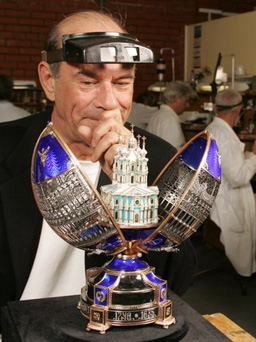
 Andrey Ananov. A jewelry artist, he is the general manager and founder of A. Ananov, a private company. He is also a professor holding the title of Honored Worker of Arts of Russia. Andrey Ananov is the Knight of the First Degree Karl Faberge Order and holder of the title “The Best Jeweller of the Century.” Jewelry pieces bearing the Ananov trade mark are in the collections belonging to Her Majesty Elizabeth II, the Queen of Great Britain, Her Majesty Sofia, the Queen of Spain, Rainier III, Prince of Monaco, Albert Gore, Montserrat Caballe and many other outstanding personalities in the field of culture, art and politics.
The artist recalls:
Those were the Soviet 1970s. It is so strange to say this word - you start at once feeling yourself as an antediluvian.
Having just inadvertently dealt with the jeweller’ work, I took a great interest in it. With enormous difficulty, getting knowledge from the most different and at times ridiculously unusual sources I studied the art of making jewelry. I remember that quite often I joined the queue in a jewelry workshop where they made various jewelry pieces for their customers and where it was possible to see through the glass counter how the jewellers worked. Sticking my neck out like a goose, I tried to peep for some working methods. Then I joined the queue again …
I used to seek for ancient books on “goldsmithing” at book bazaars, visited all the museums and almost lived in the Hermitage of Leningrad. Riding in a tram, I gazed at earrings and rings - women kept off from me…
At that time, I worked as stage director at the V.F. Komissarzhevskaya Theatre and there is no sense even mentioning my salary there. As I remember, I dreamed of a leather jacket and Montana jeans - but these were unreal and chimerical dreams.
I was carried away by making jewelry and the possibility to earn a bit was not the least driver behind it.
I did not have immense plans for saying a new word in art and I did not think about any marketing and brands, not to mention that we virtually did not even know such words at that time.
I simply took pleasure in staying at my workbench and it also paid off a little.
In different periods of my life I asked myself one and the same question - How much useful for society is what I am doing for myself? I thought of it when studied at the University and Theatre Institute and when I staged plays and when I became an “underground jeweller.” And each time I said to myself it is useful for society and I like it. That means I am a happy person …
By the end of the 1970s, I managed to understand much in the jewellers’ trade and set before myself a “super goal” using the language of stage director. I decided to become the best jeweller of Leningrad.
After 20 years, there is a new super goal – I want to remain in the history of Russia as a well-known jeweller, repeat the way of the great Karl Faberge and revive the fine and graceful art. Yes, I was vainglorious, and more likely – ambitious. I left the dearly loved theatre having understood that my efficiency in the jewelry business was higher. And then, I have never wished to agree that life is short and that we leave as water disappears in sand. Playbills will decay and reviews will turn yellow and spectators will forget. And here each item bears the name of Ananov and the better it is made the longer I shall live and be remembered and kept safe and handed down hereditably.
This is virtually everything I wanted to tell.
What is nowadays called as “brand” has emerged from my love for work, from my respect for the work and skill of Russian jewellers of past centuries, from vanity and passion for the “Faberge style,” from self-esteem and civil consciousness, from my fidelity to the chosen image of jewels, and from various pieces of knowledge.
And now I shall briefly answer your questions.
What is your opinion of the situation the jewelry business in Russia is in now?
It couldn’t be worse. It is hindered by cheap jewelry smuggled from Turkey, etc.; people who are engaged in jewelry manufacturing have no other goals but to earn quick money; traditions are neglected; self-exactingness is low; there is no civil consciousness and self-esteem along with a low professional level.
At best, we are trying to catch up with Italy in manufacturing gold consumer goods having lagged behind the world industry approximately for one century.
What is necessary to create a successful jewelry brand in Russia and what is more important - art education, taste, study of old techniques (in which Faberge worked) or possession of new and knowledge of advanced trends? What kind of marketing efforts are needed? What were those employed by you – as is known, you did it in a most unordinary way, even writing a book (incidentally, the book, “Two Aces in the Widow,” is read with no smaller pleasure than for example “The Count of Monte Cristo”)?
To answer these questions requires writing another book … But in brief – I knew that to become well-known to Russia it is necessary either to die in obscurity or become famous abroad. It was too early to die. So I chose the second, and then it was pure art direction, performance which I staged myself and where I was starring. Exhibitions in Paris, London, Monte-Carlo, Stockholm, Sao Paulo, Madrid, plus a lot of work, adventurism, risk and gambling.
Was there anything which caught your eye at the last jewelry exhibitions or contests? What are your favorite jewelry trade marks - if there are such?
I don’t go to Russian exhibitions, since there has been nothing of interest for a long time already. Window cases are heaped with monotonous items cast of precious metals with badly set small diamonds. These exhibitions, as well as their participants, are faceless and bear no image. Though, certainly, in Russia there are self-made talents but, alas, they make no difference …
And I love old things made by Lalique, unique diadems by Boucheron, Michael Perkhin's or Pauzier’s pieces. But all this was made two centuries ago.
Do you think you have reached the top of professionalism or is there still where to go further?
During all the years of work in my workshop I was inspired by what I had not yet made, but had already made up my mind to. We seldom released small editions and as a rule our works existed in one or two copies. But each person has his or her own “ceiling” although not everyone dares to admit it. Now, when we have mastered and learned every conceivable thing, when we are making very elaborate pieces and even more complex ones all this turned into a “struggle between good and very good” and ceased to excite…
Now I wonder about any new turn of destiny. I became a professor and head of the Jewelry Art Department at the St.-Petersburg State University for Technology and Design, and starting from the next year I shall teach art jewellers. And if I shall manage to form their world outlook and civic stance and teach them my trade – it will be possible to say that I haven’t lived my life in vain.
Unlike other Russian jewellers, you are not afraid to disclose the names of your clients - why?
I do not mention all of my clients. And if I do, this is because I wish to say there is nothing impossible in this world.
What are you proud of? What is the most pleasant in your trade?
I am proud of respect I enjoy on the part of my clients and I am proud of love to our jewelry pieces and that my conscience is quiet.
Do you feel any slump in demand and consumers’ spending power due to the crisis?
Certainly, we all feel that consumer demand is falling, but during the 20 years of operation of my workshop I got a small circle of true admirers, and for me it is enough.
What is your motto?
“Life never forgets to close one door before opening another.” My father taught me to understand this. And I believe in this and I believe in destiny…
Do you like to use diamonds in jewelry? What is your attitude to diamonds?
I like any stones or metals if they are correctly chosen to fit the image of a jewelry piece.
And for me the main thing is not the size or price of a diamond and not the amount of profit you gain, but the number of centuries lived by a happily, carefully and affectionately made jewelry item born by the master’s warm fingers.
Galina Semenova, Rough&Polished
