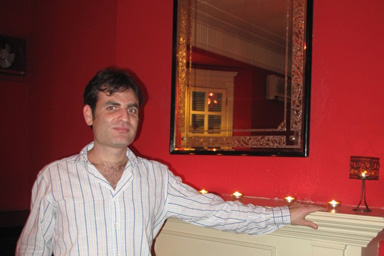
 Israeli diamantaire Eran Mandler recognizes the high potential of the Chinese market and is confident about bright prospects for his family business Beta Diamonds (diamond wholesale http://www.betadiamonds.com), as well as for his jewelry company TD which he founded in China in the end of 2008 (http://www.tdiam.com). China’s vast population, still low labor cost, growing purchasing power of its increasingly rich and consumption-oriented nationals make China a highly desired market for diamond and jewelry businesses from all over the world. In the interview for Rough&Polished Mr. Mandler shares his experience and thoughts on peculiarities and special features of doing business in China.
It's been over one year since the establishment of your jewelry company TD in China. Setting up a Foreign Investment Enterprise in China is a complicated and expensive process, how did it go for your jewelry company? Just for reference, one would need up to 6 months to register a company with 100% foreign investments, while the average “passable” authorized capital for such companies in Shanghai amounts to $200,000.
Yes, it’s true. But I was very lucky in this regard as my Chinese partner and friend helped with all the registration formalities. I really trust him. Literally this is a local company without any foreign investment. This is very unusual for China since there are a lot of sad stories about the foreigners who were deceived by their Chinese partners and lost their business. One day they came to their office and just couldn’t enter it. Legally, this company was registered in the name of a Chinese national, so nothing can be done to sue him. But again, I was very lucky with my Chinese partner.
Are you registered with the Shanghai Diamond Exchange (SDE)?
Only our family business, Beta Diamonds.
What advantages can SDE bring to its registered members?
To be a member in the SDE it’s the only way to bring diamonds legally into China. We sometimes buy diamonds from the other members of SDE, so if you’re also registered with it, you can get lower purchasing price since you can bring in diamonds outside of China. By the way, do you know why diamond business is vastly family-based? Yes, traditions do matter, but it’s mostly because of a high risk associated with this industry. Family business is more trustworthy.
How many years have you already been in China?
I came to China in 2002 for the first time to study Chinese in Beijing.
What is essential for opening a successful jewelry company in China? What difficulties should you expect?
I believe that you need a reliable Chinese partner in the first place; it just won’t do without a local guide. If I arrived to China just now to start a new jewelry business or develop our family’s diamond business, I would be so lost with all those local rules and regulations. Where to hire local professional staff (who would work and wouldn’t fool you)? How to promote your business on the local market and many other questions would arise. In China you can’t do anything without “Guanxi” (relations), and it is very demanding on time and resources, since you have to go to the endless dinners, attend KTVs and bath-houses with your prospective partners to establish strong network and build mutual trust with them. I guess it's still pretty much the same in Russia, right? It’s very important for the Chinese businessmen to get to know you from a personal angle, at first like you as a person. For example you are at a dinner, you drink with them, you talk about everything but business, then you head to KTV, drink more, still don’t discuss business. And at the very end, 15 min before going home you ask ‘so what, we do business together?’ ‘Ok, let’s do it!’ is the answer.
You worked in Israel, the United States and China, what are the differences between these three retail markets?
To begin with, there’s almost no such thing as retail jewelry market in Israel. We prefer to spend money on traveling better than on jewellery shopping. So there are only a few jewelry shops there. Israel is more like an International Diamond Wholesale Center, focus of diamond manufactures and polishers.
The USA is the world’s biggest market so far. There’s an old and well-established tradition of diamond engagement and wedding rings in the States. When you propose to your fiancé – diamond is a must to give. Nowadays this tradition is becoming increasingly popular in China, Russia and also Turkey, the countries traditionally accustomed to gold wedding rings. American customers are more concerned about a diamond’s size and carats than its clarity or cut quality. ‘The bigger the better’ is fairly typical for the American consumers. The most popular stones there are SI1/SI2 clarity diamonds.
The Chinese market has a huge potential, but it is currently smaller than in the United States. It’s hard to speak of the Chinese market in general as the situation differs greatly in different cities. According to statistics, 75% of all couples who got married in Shanghai in 2009 chose a diamond ring, in Beijing it was 50% and only 25% in Guangzhou. In fact, it emphasizes that Shanghai is a benchmark of new fashion and modern trends which come to China from the West. Besides, a Shanghainese customer is more sophisticated, the favorite choice in Shanghai is VS-SI diamonds, while VVS diamonds are more popular in Beijing.
One new Belgian jewelry company is planning to promote its products through efforts of sales agents who would visit jewelry stores in Shanghai and present the company’s jewellery catalogue and samples. Do you think this kind of field sales strategy would work out well for China?
It depends on where they manufacture their jewellery. If they import them from Belgium to China the cost would likely be too expensive and not very competitive.
TD’s corporate website works also as an online store. Do you think the future of retail jewelry sales in China is Internet trade?
No, I don’t agree with it. Online shop is a necessary tool for a jewelry company. But a Chinese customer also requires an opportunity to see a product personally, touch it and try it on in a shop. Firstly, they go online, check and compare prices, many of them print a picture of a desired product or book it online and then go to a real life shop and buy it there. I’m confident that pure online jewelry business has not much prospects in China. My company TD has a store in Shanghai and we hope to open soon in the other locations in China and develop our market network in 2010.
Will you attend jewelry exhibitions in Shanghai (in April) this year?
Definitely, industry exhibitions are great for networking, meeting new people, keeping in touch with old contacts and spotting new trends. Though I wouldn’t name these events as the biggest ones. The most important in jewelry circles of China (and maybe of Asia as well) will be the Hong Kong exhibition in September, 2010.
Do you create designs for TD’s jewellery by yourself?
We usually buy ready-made designs. You know, it’s not even possible to create a unique design in China as the Chinese competitors would immediately copy it once it’s done. Chinese visitors are at times not allowed in during some big jewelry shows and exhibitions, because they’d make pictures of all the samples today to duplicate them tomorrow.
What is the most rewarding part of your work?
I love all aspects of working with diamonds. Diamonds are what I know best.
And what is the most challenging one?
I guess to translate my ideas into the Chinese market. My hands-on experience confirms that special solutions are required to achieve success in China.
Olga Patseva, Rough&Polished, Shanghai
