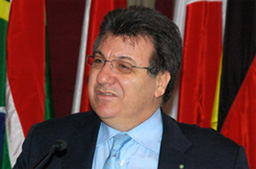
 Last February, CIBJO, the World Jewellery Confederation, concluded its annual congress in Munich attended by 135 delegates from national jewellery, gemstones and precious metals associations from around the world, as well as representatives of many of the largest multinational corporations involved in the industry. In March, this was followed by Baselworld 2010 considered one of the most important occasions for the watch and jewelry industry. Dr. Gaetano Cavalieri, President of CIBJO, fielded the questions of the Rough&Polished correspondents apropos of both these events.
CIBJO Congress 2010
In your opinion, what is the main result of the CIBJO Congress wrapped up in Munich?
We had described the Munich congress as a working event, and it was definitely just that. It produced a number of very important results, which have great significance for the jewellery and gemstone industries moving forward. These include:
A decision to broaden the number of acceptable terms to describe synthetic diamonds, which now can be qualified as “laboratory-grown” and ”laboratory-created,” in addition to the previously acceptable term “synthetic;”
The approval of the first Gemmological Laboratory Blue Book;
The approval of a set of codes to be used within the industry to describe gem treatments;
The release of a new appendix to the Precious Metals Blue Book on the precious metal finenesses standards around the world;
And the release of a diamond, coloured gemstone, pearl and precious metals guide for jewellery consumers.
Speaking about diamond jewellery, its major problem appears to be that prospect buyers are somewhat wary of long-term diamond sustainability these days. Do you think this attitude may leave some ‘residue’ even after the crisis?
If by sustainability you refer to the value of diamonds over the long term, I do not believe that there is anything to be concerned about. The long-term prospects for diamonds appear positive, and indeed prices are likely to rise quite steeply over the coming decade. This is because rising demand in developing markets is likely to outpace the supply of rough coming into the pipeline.
If you refer to diamonds as a sustainable economic factor, that is something that CIBJO has been working very hard to achieve as part of its Corporate Social Responsibility programme. In this respect, our goal is that industry ensure that part of the revenue from its activity be used to develop sustainable economies in the very same areas that are part of our distribution chain.
Thus, while the diamond as such is not a renewable resource, the economic activity it generates most definitely must be, and it should be a catalyst for economic development in places like Africa, the Northwest Territories of Canada and Yakutia in Russia.
Diamonds, unlike gold, are not so homogeneous and thus not so simple to value and some diamantaires believe they should not be treated as a commodity but rather each stone should be viewed as a piece of art. However, in this case prices will turn unpredictable with some stones going very high and some very low. Could you comment on this?
Anybody can take an ounce of gold and receive its correct market value at the point in time at which he or she sells its. Clearly the process with a diamond is more complicated.
But it would be wrong to assume that the diamond’s price is not a function of physical characteristics. Carat, colour and clarity are measurable, and these all are factors. So is cut today, although this is somewhat of an intangible because it is not decided in nature. However, among the major grading labs there is a general consensus as to what constitutes a good cut and what does not.
So while we cannot pinpoint to the final cent the price of a diamond like we can with gold, we can come relatively close with diamonds. And ultimately, the prices of gold and diamonds, not to mention platinum, silver, pearls and the full range of coloured gemstones are set according to what people are prepared to pay for them in the marketplace.
Now that the diamond cartel system is presumably losing its grip on the market, what is your view of the conflict of prices between rough and polished diamonds? Do you think rough will push polished higher or vice versa?
The end of the single-channel system will hopefully set in motion a process that will change what to date has predominantly been a supply-driven industry. It is the market that that should set price levels, although clearly there are built-in costs involved in the prospecting for and then extracting diamonds from the ground, as well as for cutting and polishing the gems that are set in jewellery.
As I said, I believe that the growth in demand in developing jewellery markets – and particularly those in China and India – coupled with the fact that there is not a corresponding increase in the number of rough goods being mined at present, will be the critical factor in driving the price of polished diamonds higher. This means we are talking about a demand-driven business, in which the decision-making power exists with the consumer, and not in the board rooms of diamond producers.
Does the decision by the CIBJO Diamond Commission to broaden the number of acceptable terms for synthetic diamonds mean that such stones will have a broader application in the jewellery industry?
The intention of our Diamond Commission to broaden the number of acceptable terms to describe synthetic diamonds is not to influence whether such items are sold in greater numbers or not. It is meant to ensure that, when a consumer buys a synthetic diamond, they know exactly what it is they are getting, and that they are able to make a reasoned purchasing decision.
We do not question the legitimacy of synthetic diamonds, but we recognise that they are different to natural diamonds. The client has to be provided the information necessary so that they will understand this as well.
Just like oranges and lemons are related, but consumers know that they are different, consumers need to know that natural and synthetic diamonds differ from one another. Which one they want to buy is up to them.
Among the highlights of your Congress was the CIBJO Coloured Stone Commission's approval of a set of codes to be used within the industry to describe gem treatments. In what way will it improve the situation on the market compared to what it is now?
It is very important to point out that these codes are only meant to improve communication within the industry. In other words, they should be used only by industry professionals, and they will be, now that the system has been endorsed by CIBJO, AGTA and ICA.
Consumers, on the other hand, should be provided with a full description of the treatment. This is essential in order to ensure full and proper disclosure. We recommend that retailers use the terminology included in CIBJO’s Coloured Stone Blue Book.
The newly introduced Gemmological Laboratory Book is a guide for gemmological laboratories, which are many. Meanwhile, in diamond business there are virtually only two world-level authorities (HRD, GIA) to certify a diamond’s ultimate value. If there was a uniform global certification system, diamond certificates could be traded as stock exchange securities virtually turning diamonds into a commodity. What do you think?
The Gemmological Laboratory Book sets standards for gem labs; it does not define grading systems.
With that said, CIBJO is in favour of harmonised grading systems, so that what is understood and accepted in one market, is understood and accepted in other markets as well. That, indeed, is the purpose of our diamond and coloured gemstone Blue Books. But the primary purpose of harmonised grading standards is not to turn diamonds into a product that is traded on commodity exchanges, but rather to enhance transparency and the accuracy of disclosure, and to defend consumer confidence.
CIBJO released a statement strongly endorsing the Kimberley Process (KP), while its founder Ian Smillie some time ago said this organisation had to be reformed to become efficient. What are its strong and weak points in your opinion?
Ian Smillie is a dedicated and praise worthy humanitarian and champion of human rights, and he has played a most noteworthy role in the campaign against conflict diamonds. However, I think that he, too, would point out that he was not the founder of the Kimberley Process, but rather one of a group of men and women who worked together in creating the system.
The Kimberley Process Certification Scheme, which has been operation for seven years already, has been a most effective tool in ending the trade in conflict diamonds, but like any regulatory system it constantly needs to be monitored, fine-tuned and improved. The system remains the most effective means we have to continue the campaign.
Regarding how it can be improved, I would echo some of the points that were made by my good friend Eli Izhakoff, the chairman of the World Diamond Council, when he spoke at the CIBJO Congress in Munich in February. These are:
A professional management team should be created to ensure the efficient administration of the KP;
There should be a change made in the KP system of voting, so that one participant cannot block progress for undisclosed reasons;
There should be a reform of the KP rules on the publication of internal reports, to promote full transparency of all the actions and conclusions reached by the KP;
And there should be a strengthening by governments of the level of oversight and compliance with KP requirements, so that illegal smugglers will be exposed and then prosecuted by the authorities.
Alex Shishlo, Editor of the Rough&Polished European Bureau in Brussels
Baselworld-2010
What are your impressions of Baselworld-2010?
I visit Basel already for 30 years, it is by all means a permanent point in my business schedule. It is an element of jewelry culture, a source of new ideas, the world’s crossroads for major manufacturers and sellers, owners of watch-making factories and jewelry brands. If you wish to find something new in manufacturing or meet top clients the best place where it can occur is Basel. This time I did not observe any stampede in the jewelry area, but there was a feeling of ever stronger confidence. The market has obviously come into motion, its mood is positive and it gives hope.
Have you observed any changes in comparison with the previous Baselworld?
Yes. I saw former participants who this time did not expose anything and new companies which presented their stands. There were new decisions in design and visible experiments and support rendered to young designers and in general there were many young people among exhibitors. Taking part in Basel means a lot of money – a small stand costs 20-50 thousand euros. So, people before going to such expenses think hard if the game is worth the candle. New faces there means the market recovers its attraction. The post-crisis time bears novelty in itself as well as offers new opportunities for those who will correctly meet its challenge.
And it is possible to formulate this challenge?
Consumers change their priorities. The attitude to family values is changing. Because of their fear to lose jobs people are afraid to burden themselves with a family and a house. Traditional incentives to purchase jewelry work worse than ever and classical marketing strategies turn less efficient. A new type of marketing is required which will return the taste for jewelry to consumers, making jewelry pieces no less desired than new clothes and travel.
The crisis has greatly changed the geography of luxury market …
Yes, it is obvious – especially if juged by the stands of Asian companies. Now Asia means diamonds. They need a lot of diamonds. As many as possible!
What is left to Europe then?
Elegant classics. What I call turning back to the past for the sake of meeting the future.
Galina Semyonova, Rough&Polished, Switzerland
