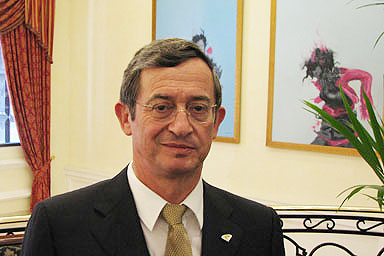
 In the course of yesterday’s session of the World Federation of Diamond Bourses Congress in Moscow Avi Paz, WFDB President, gave this interview to Rough&Polished.
Mr. Andreyev, ALROSA’s President, said in his opening address that the diamond industry is moving towards greater concentration and easier regulation. Do you see the situation in the same way?
I see the situation in the same way, but I’m not happy with it. I believe that the diamond industry shouldn’t be concentrated in fewer hands, but it should be like a pyramid going from big companies atop down to smaller companies beneath. It is important to have as many manufacturers and traders as possible, I think it’s important to diversify.
As far as can be seen from this meeting, Zimbabwe will be one of the major questions to be discussed at you closed sessions. In my view, this is something different from other cases of blood diamonds. This is a case involving a government which tried to restore law and order but very awkwardly. What shall WFDB and Kimberley Process do with this peculiar situation?
We do not call this blood diamonds, we call this conflict diamonds. It is a big issue at the WFDB Congress but it will be more of an issue at the Saint Petersburg World Diamond Council meeting which we shall hold on Wednesday. It is important for all of us, for the state of the industry that the Kimberley Process will go on and be strong and recognized by all people. Don’t forget that over 99 percent of rough diamonds in the world are conflict-free. We shouldn’t make from this case something for the entire industry. It’s a big problem which will find a solution. I believe there are other solutions to be found. But you know WFDB and Kimberley Process cannot interfere into the conflict itself. It’s an interior problem. I believe that this problem can be resolved. Then with Zimbabwe it’s not the entire country, it’s only Marange. So I believe there will be a solution.
Lately there have been quite a lot of outlooks from various companies and organizations in the diamond industry saying diamond supply will be reduced in the mid-term since there are no new deposits either discovered or to be put into operation. On its part De Beers says it is not going to ramp up production to its full capacity since polished demand is so far rather low. On the other hand the diamond community says it hopes Russia’s Gokhran will not use its stock to flood the market. Sometimes it looks like a concerted action to boost prices. What is your view of this problem?
It’s true that the main problem of the diamond industry is to balance the rough coming into the industry and the polished diamonds that are going to consumers. It’s a very difficult situation. Until now I can say we managed to balance it quite well and when the downturn started we saw reduced production of rough and the diamond industry to go over this economic problem quite well. I believe in common sense of producers, countries and governments in the diamond sphere to find a way to go on with a balanced rough and polished trade.
And there is an associated problem of prices for rough and polished diamonds. Once again rough prices are ahead of polished prices with another crisis looming on the horizon. How do you think this can be avoided?
This problem goes on for years and years. This is a never ending problem. This situation is related to the general global balance.
Vladimir Malakhov, Rough&Polished, Moscow
