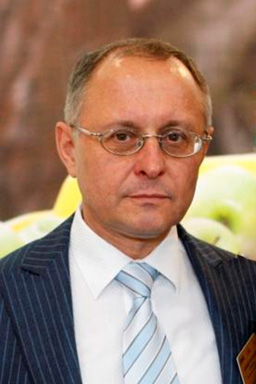
 Valery Budny, CEO of RESTEC JUNWEX Media Holding, in charge of the Jewelry Russia Unified Exhibition Program, answers the questions of Rough&Polished.
The Jewellery Russia Exhibition Program is today on a top position in the calendar of Russian jewelry exhibitions. What other projects are being implemented by RESTEC JUNWEX?
The activities of the RESTEC JUNWEX Media Holding include high-end exhibitions, the industry website www.rjexpert.ru, Russian Jewellery Trade Club, magazines Jewellery Russia and Best Jewelry of Russia, an educational center, design studio and advertising agency. These projects provide an opportunity to evaluate the situation in the jewelry industry comprehensively. Since we do not compete with anyone - either in trade or among manufacturers – we enjoy a thorough inflow of information. Our main task is to be objective and encourage healthy market processes.
What are the trends outlined by JUNWEX MOSCOW 2010 held in September?
I would like to draw attention to the following: firstly, its participants got a higher standing and we saw examples of serious attitude towards the exhibition as a market mechanism. The vast majority of participants were willing to abandon retail sales at jewelry shows – it means that we are turning into a civilized market. Even if someone came trying to sell in retail at this exhibition, attended by a huge number of wholesalers who proved to be very choosy and demanding about goods demonstrating an earnest attitude towards suppliers, this atmosphere made them abandon retail operations for lack of time and due to the necessity to attend to wholesalers. Secondly, the product range has become considerably enriched: if three or five years ago the stands exhibited by participants could be described by the Russian saying "One and the same color in winter and summer,” now everything has changed. Seasonality became apparent, since jewelry is a seasonal product. And fashion trends that were earlier maintained only by the Italians, now we are promoting ourselves. Fashion caught up with us despite our backwardness in design. Today we are featuring very rich and varied collections. In our opinion, the volume of purchases was 25-30% less than one year ago. The financial crisis has taught people how to manage money - commerce has become selective and buyers followed suit. Now they purchase only what can really be sold during this season. But diamond jewelry enjoys good demand.
In the crisis period the discussion about whether diamonds can be an investment instrument got heated. What is your opinion?
Yes, there are a lot of disputes concerning this issue. And the World Diamond Congress did not manage to find a definite answer in this respect. I believe that diamonds can be used as an investment instrument, but for instance Sergey Oulin, one of the leading diamond experts, says they cannot. I believe that jewelry pieces have a high value as collaterals. Not only for the Russian people life is at times so difficult that for a common person a piece of gold like a gold diamond ring is an opportunity to survive in a woeful period. During the last war jewelry was exchanged for medicines or a piece of bread, or just given to save one’s life. For me, it was a discovery that the Americans during the Great Depression used to buy gold jewelry almost twice as much than usually. I still think that diamonds have a future as an investment instrument. Those reserves of diamonds which are still underground will one day end - and as a limited product they will only increase in value over time.
Marketing programs in the Russian jewelry market are implemented mainly by retailers, while mining companies do not participate in them. Does it fit in the current trends in the jewelry trade?
Today it is not uncommon for perfumes to be priced higher than really worthy things carrying diamonds. Clothing, accessories, consumer electronics – all these goods increased in price only because of good marketing. We must acknowledge that by the level of corporate culture we are losing to the competitive markets. We need modern marketing along the whole chain: diamond miners – diamond cutters – diamond manufacturers - jewellery trade. Only working together we can keep the market and resist the market of related products.
In recent years, the Russian market witnessed a curious trend – provincial jewelry companies seek to create unified brands...
This is a positive phenomenon. It was the first time five years ago when we decided to make such an offer to jewelers aimed at facilitating promotion of major jewelry regions: Yekaterinburg, Kostroma, Kaliningrad and Yakutia. This year, companies from Yakutsk and Yekaterinburg showed a brilliant example of common interests prevailing over private aspirations regardless of internal competition between the companies. And it is very promising. The Days of Regions at JUNWEX MOSCOW 2010 is not just making financial resources and advertising campaigns work together, which of course pays off, but it is also a coordinated policy to attract attention of serious investors in the region.
Is the Russian jewelry industry competitive in the global market?
I believe that the Russian jewelry industry today could successfully move to foreign markets. Technologically, we are now even better equipped than the recent leaders in the jewelry industry, the Italians. We have accumulated the best technologies from the Italians, Germans and Turks. It is unlikely I shall be wrong if I say that in modern Russia the jewelry industry is one of a few industries dealing with a really deep processing and it is capable of delivering world-class final products. Unfortunately, our legislation is more focused on selling raw materials. So far all the innovations in the jewelry industry happen to be the result of the initiatives launched by entrepreneurs, while the industry is operating virtually without government support.
Galina Semyonova, Rough & Polished
