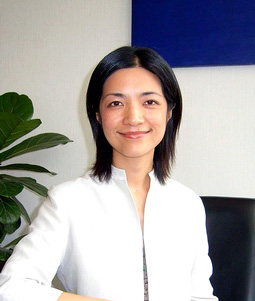
 Caroline Yuan, Vice President of the Shanghai Diamond Exchange, has kindly answered the questions filed by Rough&Polished. Her Chinese name is Yuan Wenyao.
Please tell us about your work at the Shanghai Diamond Exchange.
At the Shanghai Diamond Exchange I coordinate operations performed by its participants. Our diamond transactions center based at the exchange is a management platform. It gives participants an opportunity to handle transactions independently; the local operating mode differs from the work of other exchanges. Transactions carried out by participants do not need to be processed via the exchange, but the exchange is responsible for recording transactions. Therefore, our team is very "compact". In fact, a little more than ten employees can do the whole job.
How did it happen that the diamond industry became your vocation?
I was not trained to have some jewelry specialty; my specialty is economics and management. The jewelry industry was not my own choice. I graduated from the university in 1987. At that time everyone got a job through the state distribution system. I was assigned to work in this industry, there I stayed and worked for many years. Since 1987, I worked as the head of the export-import jewelry company at the China National Arts & Crafts (CNAC) Corporation. Prior to January 1, 1994 diamonds were classified as a commodity. So the company in which I worked – the export-import jewelry company of the China National Arts & Crafts (CNAC) Corporation – was a single industry-wide agency.
Are there any universities in China which offer training in jewelry specialties?
Now there are many universities incorporating gemological institutes with similar specialties. For example, the Jewelry Institute of the Shanghai Tongji University, or the Gemological Institute at China’s University of Geological Sciences.
In October 2010, the Shanghai Diamond Exchange celebrated its anniversary - 10 years since its establishment. Congratulations! Could you describe what progress and results were achieved during this period?
Thank you! I would not call it "success" for it sounds like a big talk, but in ten years, of course, there was some enlightenment. First of all, we are an enterprise. The Shanghai Diamond Exchange is an excellent platform for interaction between the industry and government. Our tireless efforts aimed at government agencies for over 10 years, which were instrumental to developing a government policy to promote the diamond industry, happen to be our greatest contribution to this business. Thanks to this policy, the diamond industry in China began its rapid development. Simply stated, right now our diamond trade has the advantage of duty-free importation and offers a zero customs duty.
Working with our diamond exchange means to gain access to the bonded area and bonded transactions. If you will try to sell goods in the domestic market of China bypassing this platform then you will have to pay a 17-percent VAT. Currently, the VAT rate for diamonds is reduced to 4% - this is a very favorable rate, because other goods in China are mostly subject to a 17-percent VAT, so bringing it down to 4% is a huge advantage for the polished trade in China.
At the same time, from the government's point of view this rate is balanced. Such a product like diamonds is characterized by high value and small size, which makes it very easy for smuggling. If you set high customs duties, the state will actually not be able to collect them, and at the same time the operating environment will turn bad. Therefore, we have persuaded the government to apply a reasonable tax policy. So, by way of tax regulation the government's coffers started to receive more tax money, while our industry started to develop. I think this is a great way to go.
Do you think diamonds are a good investment commodity?
Investment diamonds? Some time ago, you turned to me for advice on this matter. Now I'm still not sure about such a commodity as diamonds. They are not a standard contract product. I believe that diamonds cannot be used as investment goods. To achieve this it would be necessary to solve a lot of problems in this regard. On the one hand, due to a falling dollar diamond prices are constantly increasing, so if we consider diamonds as a store of value, then it is absolutely ‘yes.’ But one should not turn them into an investment product and get involved in speculation just because diamonds are able to preserve their value, it makes no sense. I do not recommend developing diamond investment operations at the present stage because this product is not similar to gold. Gold is a standard product and assessment of its value by all parameters is simple. I think that it would be unreasonable to overly invite people to diamond investments since it would not be a very conscientious step in relation to consumers, because at the moment diamonds have no free-market prices. In this situation (given the still very popular jade and nephrite, which are also able to maintain their value) due to insufficient knowledge of consumers their excessive desire to invest may turn out to be very risky. So we should not encourage diamond investments too much. This is my personal point of view. However, diamonds have the property to preserve value, and this is true. What’s more, I think that diamond prices may increase further. This I can say for sure.
One of the articles posted on the Rough&Polished web-site says that diamonds lag behind gold in terms of their increase in value.
I believe that diamonds grow in price slower than gold, but I cannot say that diamonds are cheaper than gold. Diamonds enclose so many different factors. For instance, if you are engaged in the diamond industry, then I think you may invest in diamonds. However, if you do not quite possess the whole amount of information contained in diamonds, you will not have a good purchasing channel and it is very risky. If I were to act on behalf of the consumer, I would not buy diamonds for investment purposes.
How many companies are now listed at the Shanghai Diamond Exchange? In your opinion, what kind of benefits do these companies have?
We now have approximately 280 member companies. Being registered at the Shanghai Diamond Exchange gives its participants the advantages described above. Our diamond exchange has been operating for 10 years demonstrating the obvious benefits of our policy towards diamonds. From a national point of view, the mentioned preferences are also playing the role of a management tool. Only members registered at the Shanghai Diamond Exchange can enjoy preferential policies, exemption from customs duties, etc.
As is known, according to forecasts the total diamond trade in China in 2010 will exceed $2.5 billion. Will this figure increase in 2011?
I'm sure about it. From the perspective of my 20 years in this business, it seems to me that the Chinese diamond industry is actually growing in sync with China's GDP. I am optimistic about rapid development of the Chinese economy, as well as about the diamond market. However, what kind of problem is there still to be solved? Diamonds are not serial industrial products, so one cannot say their output should be tied to demand. This resource is limited, so the volume of supply will not necessarily match the market volume. We can say that if we shall grow by transactions value, it will not necessarily result in a higher number of transactions, because the resource has its limitations. And this is also should be taken into account.
The policy pursued by Mainland China in respect of the diamond trade is very favorable. Transactions at the Shanghai Diamond Exchange decreased in their cost significantly, and it is appropriately reflected in trade costs. Is it likely that in this way the Hong Kong diamond market will be affected? Or are prices in China more favorable than in Hong Kong?
Hong Kong is already a tax-free haven in itself, one of the most favorable tax areas in the world. The existing tax rates in Hong Kong are very sparing, so I do not think that we can somehow influence the situation. In fact, the diamond industry of China and that of Hong Kong are in a mutually stimulating partnership. The dawn of the diamond industry in China started approximately in the late 1970’s and early 1980’s. At that time there was no internal consumer market for diamonds in China. Currently, our country is the world's second largest diamond manufacturer. Since we started to develop in the 1980’s, in fact, it was Hong Kong diamantaires who lent us great support. It was a time when China just started an open door policy and the diamond industry was virtually non-existent, while Hong Kong was step by step turning into a center of diamond trade, especially in South-East Asia. Hong Kong diamantaires gradually handed over some of their diamond processing operations to Mainland China. This prompted the development of diamond manufacturing in the country. Currently, the diamond market in China is also the diamond market for Hong Kong diamantaires. Purchasing power in China’s domestic market has increased becoming the major purchasing power on the retail market in Hong Kong as well. China and Hong Kong have mutually advantageous relations.
Are there any foreign participants at the Shanghai Diamond Exchange?
They are not just there. If you add companies from Hong Kong, Macao and Taiwan to the number of enterprises with foreign capital then it will turn out that we have 70% of foreign participants. This is because our own diamond manufacturing may even be disregarded because it is so small since we are not a rich country in terms of resources. On the basis of the Shanghai Diamond Exchange we have brought together many world famous enterprises and most of the suppliers of rough diamonds are foreign companies. And conversely, 30% of our diamond exchange members happen to be Chinese companies, most of which are retail and manufacturing businesses operating in the domestic market.
Do you think that consumer demand for diamonds in China may increase in 2011? If you do, could you give an approximate scale?
In 2011, consumer demand for diamonds in China will grow, but I think it is very difficult to predict to what extent. I can name any figure, but I think it's pointless, as in all other projections. Nevertheless, there is some probability for an accurate answer. If you want to know a forecast for this growth, according to my personal feeling all you have to do is to know the forecast of GDP growth in China, which will give you a chance to conclude how consumer demand for diamonds in China will go up in 2011 with a small probability of deflection. I think that this concept appeared as a result of my many years of experience is true.
According to your forecast, what kind of diamond prices will be at the Shanghai Diamond Exchange in 2011?
Diamond prices in China’s diamond industry keep in synch with diamond prices on the world market - such is the pattern. We cannot have some kind of internal prices for diamonds because the majority of supplies come to China from abroad.
Are you satisfied with the results of the Chinese Diamond Conference held in Shanghai from November 30 to December 1, 2010? As you know, the Shanghai Diamond Exchange was one of the organizers of this event. In your opinion, what kind of opportunities will it open for China’s diamond industry?
I am satisfied and the majority of my colleagues who participated in the conference are satisfied as well. The main role of this event, I believe, was to exchange information. The world's major diamond centers also host similar conferences. Our circle in the diamond industry is very small, and the main result of the conference was to give a chance to exchange views, meet in person, share information and thoughts - this is our goal.
Do you expect new laws on diamond trade and export-import operations in 2011?
Normative acts cannot change often, I think. Over the past 10 years, the diamond trade policy was corrected only three times. The government has already rendered great support and provided significant preferences. I think further changes will be introduced in this area. However, as a diamond exchange we shall make every effort to communicate further with the government agencies related to our work to achieve improvements in the law enforcement mechanism to make our members' operations more expedient and convenient.
What kind of jewelry do you like most?
As for me, I believe that jewelry is first and foremost a way of aesthetic and emotional self-expression for a person. I like any jewelry that can express beauty and bring me pleasure. Today, China has become one of the fastest growing markets for luxury goods. My attitude towards consuming luxury goods is this: they are there to buy them, and the process of their consumption should be easy and enjoyable, but people should not exhaust themselves for the sake of these things. In the Chinese market, I see a lot of people who buy luxury goods in excess of their economic power, doing so more for the sake of creating a certain impression rather than out of well-minded considerations. However, this is also an indication of success enjoyed by luxury goods marketing.
Olga Patseva, Editor of the Rough&Polished Asian Bureau in Shanghai
Lu Xiangdong for Rough&Polished from Shanghai
