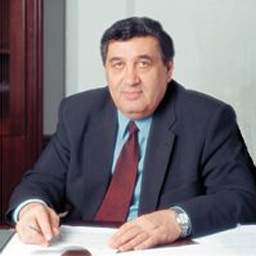
 The first president of ALROSA and current Chairman of the Committee for Entrepreneurship in Mining, Production and Processing of and Trade in Precious Metals and Stones of Russia’s Chamber of Commerce and Industry told Rough&Polished how Yakutalmaz became a joint stock company and what should be preserved in ALROSA.
The idea to separate Glavalmazzoloto, a state committee, from the Ministry of Nonferrous Metals Industry (Mintsvetmet, for short) and bring together all the diamond companies giving them marketing functions belonged to you. What was the reaction of De Beers at that time?
It was very positive. De Beers needed a reliable partner. I was in charge of Glavalmazzoloto when we entered into an agreement with De Beers in London. In the late 1980s our Vnesheconombank’s hard currency reserves were drastically reduced. At that time the government was headed by Nikolai Ryzhkov, who called me and asked where we could get a loan of one billion dollars. And I thought that we could take a loan from De Beers using Gokhran’s diamonds as a collateral. We had a branch of Almazyuvelireksport in London, which had a guarded office and sorting facilities. We flew to London, drew up an agreement – it is noteworthy that the interest rate was 3% per annum. I reported to the government - where economists and lawyers approved what we did – so we signed the contract and one billion was immediately transferred to Vnesheconombank.
What amount of diamonds was there in carats?
Roughly there were 10 million carats. At that time Yakutalmaz produced 40 million carats per year. And we sold to De Beers no more than 10%. The rest was stockpiled at Gokhran - there were already hundreds of millions of carats accumulated in all those years. And in our case it was only ten million - but this increased our sales to De Beers which was very helpful. I was still arguing with the State Planning Committee: why do we need to produce so much, if 85-90% of the output is piled up at Gokhran – it would be better to store diamonds in earth. De Beers was interested to maintain long-term relationships with our diamond industry. Later on they bought these diamonds. And De Beers had no complaints against us.
You are one of the founders of the ALROSA Company. Who gave the idea to establish joint stock companies along such an unusual pattern?
When in 1992 they began to split Yakutzoloto into separate gold mining companies, gold mining started to decline (only from 2000 onwards gold mining settlements began some kind of recovery). In that period attempts were made to separate Udachny, Aikhal and Anabar from Mirny. As a diamond miner and old-timer of Yakutalmaz I was afraid that if this were to happen, the diamond mining industry would die as well. And I offered such an option: to establish a state-owned company, where Russia and Yakutia would be major co-owners. I suggested this to Vice Premier Oleg Lobov and Mikhail Nikolaev, President of Yakutia, who immediately agreed with this – to make the company owned by the Yakut Republic and Russian Federation. We wrote a draft decree and gave it to Mikhail Nikolaev, who went to Yeltsin with this decree and persuaded him so much that he signed it even without consent of the government members – for which he was later frequently blamed. So the merit of establishing this company belonged to two presidents, while mine was only the concept how to preserve Yakutalmaz - as its former director. And virtually all these years the company remained the best miner in this country.
Why the shares were distributed in favor of Yakutia, meaning the 8 percent given to uluses – Yakut municipalities?
According to the original concept, this stake was to be given to Glavalmazzoloto, but at that time it was already wound up, so it was given to the uluses, where diamonds were mined. The details of stakes and proportions were discussed with Vyacheslav Shtyrov, who was then the Vice President and Chairman of Yakutia’s government. At the same time 20 percent were distributed among the company’s employees - everyone received one share, and I also have one share.
Is it really only one?
It’s true, only one. Although later I often received letters asking to sell my shares...
Later on the proportion between Yakutia’s stake and the Russian Federation stake changed and it seems it will continue to change...
Recently, I consulted with Shtyrov – so far there was no decision taken for Yakutia to sell its shares. It is meant here that there will be an additional issue of shares to be released to the market, which will a bit improve the company’s financial situation.
Being a founder of ALROSA, what is your attitude towards making the company public?
With your permission, I would not discuss this issue. All the years the company was owned by the state it operated successfully - despite the fact that it frequently changed its presidents. Not because of its Moscow office, but because of those people who mine diamonds in Yakutia. I have no predictions - it is unknown how and what would happen if the company will be joined by some private persons. I do not care now, who ALROSA’s owner will be. For me it is important that the whole ideology, strategy and structure of this industry are not changed in favor of individual interests.
What is your view of diversification projects pursued by the company - such as Timir, for instance?
I am a miner and production worker, and I care only about production. I am sure that in Yakutia it is possible to mine diamonds successfully for at least another 35 years. And no decisions should be taken, which could affect the overall organization - the situation in exploration, construction and reconstruction of enterprises... I am for avoiding changes in the economic and social policy in the areas where there are diamond deposits and where diamonds are mined, and for me it is immaterial as for who the boss will be. The main thing is to prevent any worsening in the conditions of existence for all these enterprises, social policy, treatment of workers and social development - this is the main thing for me.
You are now dealing with gold – how do you assess the prospects of this industry?
I hope that in 10 years Russia will take the first place in the world both by gold reserves and gold output. I am confident we shall be able to produce up to 400 tons of gold a year.
Galina Semyonova, Rough&Polished
