 Diamond laser inscriptions are a growing trend for a technique that provides an easy way to identify a diamond. Without causing any damage, a micro-laser beam is used to etch microscopic inscriptions on the girdle of diamonds weighing 0.18 carat or more. Laser inscriptions usually contain the certification laboratory initials and certification number.
A grading report is developed by an independent laboratory that certifies the quality of a diamond, using all the characteristics of the four C's, along with several other characteristics of diamonds.
The Diamond Laser Inscription is to register your name and personal information along with that laser inscription that identifies that a diamond is yours. That is then used to track diamonds which are lost; and police agencies use that registry when diamonds are recovered to match them up with their original owners. Laser inscriptions are said to be useful when diamond owners take their rings in to get it cleaned, repaired or put in a new mounting because such inscriptions ensure they “get” the same diamonds back.
Repair shops like laser inscribed diamonds because one of their biggest concerns is that a diamond can be switched before it is brought to them, hence they end up getting the blame for the switch. This is especially important for high clarity diamonds.
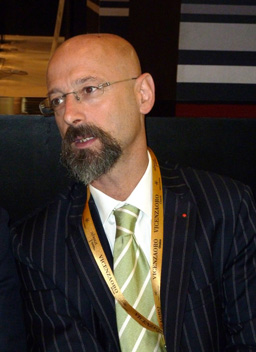
To get more closely acquainted with the laser engraving process, Rough&Polished managed to ask a few questions to RDG Marketing Director Raffaele Ciardulli.
Can you briefly describe what your company is all about?
Our manufacture is 100% Italian featuring creativity and excellence of Italian labor. We have a network of 40 agents, long experience in the diamond world and direct relationships with major sightholders.
The name of our company is RDG, it’s a Rome-based company and at the heart of our operations is the Diamond Laser System (DLS). This is a system that we have been using in the past 15 years to engrave information on diamonds.
So the idea is to safeguard our customers on both the rational and emotional sides. On the rational side, because they know that a stone can be replaced by mistake or inadvertently and the other side, which is probably the most important thing now, is to make our customers confident emotionally because DLS allows them to have their old stones as they can engrave not only the diamond’s identification data but if you want to engrave sentences or bar codes or whatever you like we can do it.
Why is it important to have gems engraved?
The idea is that out of thousands or millions of stones, one will have a stone that she or he can identify themselves with - their own stones, which they can engrave with a love sentence for their fiancée or the fiancée making it a more emotional stone.
The idea of engraving is to give security to the diamond and it also gives more emotion to the stone, so that is the objective and for this reason we are also not limited to the stone but we also make small runs of jewellery pieces which are very classic.
Of course we are more creative in other brands but with jewellery pieces we want to be very, very classic and very, very easy. The stone is a masterpiece; it is the centre of affection and emotion. And if someone wants a present for his wife or fiancée it’s nice to have it as a solitaire. Everything is made in Italy. For this year, which is the 15th anniversary of DLS, we have done a special edition. It is not more than 100 solitaires of one carat each.
When you buy a jewellery item you will get a certificate saying where the stone was mined and who was the sight-holder, where it was polished, where the jewellery piece was made and where the retailers bought it.
Does your company certify jewellery?
Yes, we have a certification centre in Rome.
Is there any chance the laser may make a mistake?
The system is very, very precise but I cannot tell the exact depth of engraving for I am not a technician but it does not have any impact on the dimension of the stone and the way it is made.
What is the attitude of people to engraving?
You will always find someone who does not want to have an engraving made because they feel it is human invasion into the natural side of the stone, so you will probably find people that just want something totally pure. They will think that, if I engrave something it will be less pure. So on the other hand you will probably find more and more people that understand that engraving is not a system that brings less purity to the stone and there is a lot of advantage in it. However, it depends on where you strike the balance between the natural and human. If you want something that is 100 percent natural you will probably buy a rough diamond, but if you want more human in your gem it is totally acceptable to have a DLS engraving.
Has the Kimberley Process allowed you to engrave stones?
Yes, because the fact that your stone has been engraved means that you can recognize it so it is something that is totally coherent with the Kimberley Process.
Veronica Novoselova, Rough&Polished, from Vicenza
