 Jewelry House Aesthete has a 20-year history and is one of the pace-makers in the jewelry industry in Russia. Today, Aesthete has its own production facility, which is the largest jewelry factory in Europe. The company's products are showcased in a great many stores scattered across Russia and the CIS countries. Jewelry artworks made by designers of this house were awarded quite a good number of top-notch diplomas, prizes and premiums at international exhibitions and contests. In 2009, Aesthete won the highest award of Russia in the field of jewelry - its necklace, Snow Queen, was recognized as the best jewelry piece created in this country and awarded a prize by Gokhran, Russia’s State Repository. In 2010, the Fashion TV channel named Aesthete the Best Jewellery Brand of the Year.
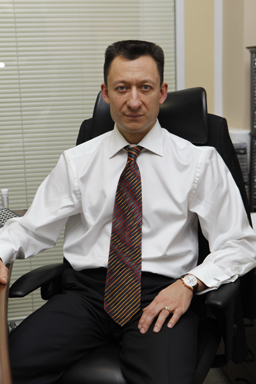
Rough&Polished’s observer met with Mikhail Khrychev, Aesthete’s Vice President and Commercial Department Director, to talk about the outcome of the past year and plans for 2011.
What are the general problems you see today on the jewelry market?
Some decline compared to the "golden" years - such as 2006-2008 – was, of course, felt in 2010 as well, although not to the same extent as in 2009. This is to say that we distinctly observed if not the crisis itself, then at least its consequences. The main problem was the steady increase in gold prices, especially in the second half of the year when prices reached record highs. Since the end of last August we re-evaluated our products 5 times, that is we had one or even two price hikes in a month. Naturally, this produced an extremely negative impact on the market. Wholesalers barely had time to get used to one level of prices as other prices were quick to appear. Actually, we had a paradoxical situation where jewelry sold in retail could cost almost as low as wholesale supplies. I'd like to hope that in 2011 we shall not see this kind of price race.
In your opinion, what is the reason for such a wanton surge in gold prices?
I think this is due to the crisis of confidence in global currencies since no one is sure if the dollar is there to stay the next day. In fact, gold is the only asset in which people can invest. In general, this may not be a bad thing, but not for the jewelry industry, because gold for us is not the subject of investment, it is the material we work with.
What are the ways to solve this problem?
Of course, jewelry market will not die. Another thing is that it is becoming harder to operate on it. This is not only related to domestic competition due to the influx of new players to the market, but also due, as we have said, to growing prices for raw materials. The solution is simple and fairly predictable: you have to work better. You have to offer new collections, you need to invest in design, since in fact it is the latter which will largely determine who the market leader will be. And we should also have a clear understanding of those price niches that exist in the jewelry world. Certainly, given today's realities, in 2009-2010 jewelers tried to make collections weighing less so that they could be affordable in price. After all, the price of materials used to manufacture a jewelry piece makes approximately 70% of its total cost. I’d like to stress that we are not talking about "premium" products - just about mass demand jewelry.
What kind of relationship is currently taking shape between business and government authorities? Are there problems to be solved?
These are the same problems facing anyone, not just those engaged in the jewelry business – there are certain procedures in this country which are overly bureaucratized. For instance, if you receive goods from overseas, you have to wait 2 or 3 weeks at the customs terminal until your cargo is cleared in a proper way.
How much important are jewelry shows for the industry and what do they actually give to Aesthete in particular?
Of course, I believe that exhibitions and trade fairs are necessary for all manufacturers operating in the jewelry market. We are regular participants of two national exhibitions, in Moscow and St. Petersburg, held in September and February, respectively. Every exhibition gives us a chance to find new partners in various provinces of Russia. It is also a good opportunity to showcase our new collections. As a matter of fact, there is a number of other shows run in Russia, although at a minor scale; they are probably of interest, but for smaller companies. However, Aesthete is more attracted by exhibitions of a central character. There is no point in discussing the issue whether we need more or less exhibitions since this is a self-regulating process.
What is your evaluation of commercial success attained by the Aesthete Jewelry House in 2010?
In my opinion, our results are not bad. Sales rose by about 30% compared to 2009 which is above the market average. If at the beginning of the year (January, February) there was a slight decline, the further dynamics was continuously positive. In my opinion, it is partly because the overall market bounced back and partly because Aesthete introduced new technologies. For example, we continued to open franchised stores. In 2010, Aesthete added 15 more stores to its network. In 2011 we plan to launch at least 20 stores.
What kind of jewelry was most sought after in 2010?
I can say that consumers have turned to be very picky about jewelry design. When the crisis broke out, diamond jewelry sales slumped. In 2010, the market in this segment was somewhat restored. Jewelry inlaid with semi-precious topazes and amethysts was not a bad seller.
Are there any technological achievements your company may be proud of in 2010?
We issued a collection bearing natural inlays made of briolette-cut gems. They differ from traditional cuts. If a regular stone is cut so that one side of it has a certain spike, these stones are faceted symmetrically. However, they look good, and technically they can be used in jewelry pieces of another kind which is different from those commonly used. This collection has already proved to be popular. We continue to develop jewelry chain-bending equipment and managed to produce a good collection based on chains and decorative items, such as balls. In 2011, Aesthete plans to move 6 to 7 collections to the market, and they are now being developed. As for equipment, we are upgrading it permanently introducing new machines once or twice a month. Unfortunately, these are not made in Russia but imported from abroad. Italy is the leader in manufacturing equipment of this kind. One of our last purchases is the equipment to make jewelry balls, which I have mentioned. This machinery is quite expensive, but we think that it will be a money-earner, because we see that such jewelry goods are in demand.
Christina Salimova for Rough&Polished
