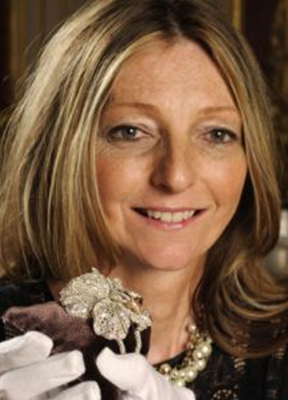
 The name of Faberge has long become a common noun. And fortunately, the Faberge brand has not ceased to exist after the revolution of 1917: the famous brand, which was part of the history of the jewelry art in Russia, revived, though not in the country of its origin, but in Switzerland. At the recent Baselworld exhibition the Faberge stand took its rightful place alongside other jewelry brands and pleased the eye with jewelry pieces and works of applied art.
The House of Faberge was founded in 1842 by jeweler Gustav Faberge, whose son, Peter Carl has created unique and precious Easter eggs for the imperial family. After 1917, the grandsons of the founder became exiles in Paris where they opened a new business, but after World War II they found that a U.S. businessman was selling perfumes under the family’s brand name. They brought an action against him, but after the litigation the heirs, having exhausted their means, were forced to transfer the rights for the brand to a U.S. firm for only $ 25,000. Subsequently, the brand repeatedly changed owners, and in 1989 it was bought by Unilever, a cosmetic concern turning out mass consumption goods, for $1.5 billion. Two years ago, the right for the Faberge brand was bought by a group of investors from Pallinghurst (the transaction sum was not disclosed). They established a Faberge heritage council, which included two great-granddaughters of Carl Faberge - Sarah and Tanya. In Basel, the legendary family brand was represented by Sarah Faberge engaged in design. Her works appeared in the collections of Elizabeth Taylor, Bill Clinton, and Mikhail Gorbachev. The British great-granddaughter of the famous jeweler has kindly responded to questions from Rough&Polished.
Sarah, please tell me about yourself and about your roots.
My grandfather was Nicholas Faberge, he was the youngest son of Carl Faberge, and Carl Faberge had two sons called Nikolay, as you know. Suddenly one of them died in infancy, and then they had another child. They had a boy again and so they named him Nikolay again, but he was known as Nicholas to make it slightly different. And he came to run the Dover Street brunch of Faberge in London, and that is how he met my grandmother and the reason why my father, Theo Faberge, was born in England and had an English accent like me. I’m a quarter Russian, but I’m not all Russian and my father was raised, brought up in England and the same is me. In his early years, my father was an engineer by trade and when in later years he went into creating beautiful objects it was because he had a very creative sight.
Genetically?
Genetically, yes, indeed. And then I will talk a little bit about the past because as you may know the Faberge trademark was lost by our family back in 1951, and it was subsumed into other companies for some time. In the meantime my father designed pieces in his own name, separately, just because he was very gifted in that area. He has passed away now but I am just telling you how I came to be involved. So he designed beautiful eggs and objects, and then I also came to design some eggs and objects, and we operated in London and then, more recently, the Faberge Trademark was acquired by a company that wanted to make the name great again, because many people were doing very pretty things in the name of Faberge, but it wasn’t the big company that it once was.
And this particular company decided that it would be a good idea to revitalize the name of “Faberge”. They acquired the trademark, back in 2007, and then they invited myself and Tatiana Faberge, my cousin, to come and sit on a Heritage Council, in order to steer the reunified Faberge towards the future and to make sure that we kept the vision alive that was the original Faberge, but to translate those ideas in visions for the future and to make them relevant for now. So I sit on a Heritage Council with Tatiana Faberge and myself and John Andrew, a Faberge collector and family friend, who knows a great deal about the history. He’s a Faberge specialist. So now the Faberge Company and the Faberge family are finally reunified after many-many years.
Could you say a few words about your collections?
Now we are all creating what we consider to be beautiful things for now but retaining the history and the magic of the past, and translating that into collections that you see today. We have several collections. Our first collection which was made by a Parisian designer, which is Les Fabulueses, and it’s very organic collection with a lot of Faberge proficiency. This collection has Les Fauves inspired by the Russian artistic movement and Les Fleurs and Les Fables inspired by the Russian fairy tales. And we just had a new collection in December, which is Le Carnet de Bal, which was inspired by the Russian imperial balls at the court and their balls in the winter seasons. All of diamonds. Yes, purely diamonds, because our customers loved the colored stones collection but they also said, ‘Well you know, you had the colored stones and where are the diamonds?’ So we listen to our customers as Carl Faberge did and we said OK, we will provide you with a diamond collection too.
Do you combine the traditions of the Faberge art with modern trends?
Yes, definitely. It’s particularly true with the first collection and Les Fauves and Les Fleurs. It’s very important for us to respect Peter Carl Faberge’s values like innovation, craftsmanship, perfection, artistry, so everything we are doing is really in line with his vision, but we have contemporary pieces in which we don’t recreate previous pieces. We never copy. But we take the best from what Carl Faberge was famous for, and we also have our first objects on show here at Basel. So the cups you saw, the enamel cups, didn’t you see the collection yet? Have you had a good look?
Yes.
Our creative director Katharina Flohr decided that it would be very good to recreate some scenes from the Winter Palace in our windows, so we have original, very old furniture in all the windows which is a tribute to the past but showing the modernity of our jewels today. So we very much combine, we very much want to take the ethos and the vision of Carl Faberge and project it forward today. Our heart and soul are Russian and we want to interpret those stories and those visions.
What do you think about Faberge’s masterpieces of old days?
They are amazing, and I think some are very indicative of his vision and his craftsmanship and artistry – those pieces even now are fetching so much money and they still inspire and enchant and delight people who look at those pieces. I mean I was looking at some private collection recently, and I’ve seen many pieces. But the attention to detail never ceases to amaze, and I think again that’s where we have to be focused, it’s our attention to detail and references and stories, so that customers can look at a piece and immediately understand what we’re talking about.
And at the same time it’s a great responsibility to carry on this brand.
It is indeed. We don’t take it lightly, we take it very seriously. And that is why myself and Tatiana Faberge are quite deeply involved, we are quite a small organization and we have an influence on that side as well. We take that responsibility very, very seriously.
How many jewelers do you have and where do they work?
We have various workshops. We have some in Switzerland, some workshops in Paris, and we have in-house designers, partly in our office and we also have different jewelers and artists working with us. So it’s a mix, but all of them are inspired and directed by Katharina Flohr, so all of them are trying to stick to Faberge’s period by identity. So that it’s not too diverse, so that it’s harmonious. It has to be harmonious, it has to fit together, it has to be correct.
In Russia there is no jewelry brand equal to Faberge despite the attempts to create something similar. Where do you have your boutiques?
We have a boutique in Geneva. But we do have plans to open another boutique in Europe and one in the U.S. And our sales team is travelling all around the world to meet our clients, they go to Russia, to Asia, to the U.S. – basically they bring the pieces to the clients. Exactly like my grandfather used to do and my great grandfather – they used to take the pieces to the client and we offer a special service like that.
Do you plan to open a boutique in Moscow or Saint Petersburg sometime?
We would look forward for that, we will. I’m sure that will be on the plan, but not immediately.
It was a very serious step to revitalize the brand in the days of crisis, wasn’t it?
Yes, indeed. But I think it says a lot about people’s love affair with the company in the sense that they are very interested in what we are doing, but of course like you say we have to get it right and that’s our mission. And I think the crisis shows the new era and people really want to have good quality products, they are really about craftsmanship and that’s what Faberge gives. Like real products which can go through all the time and that’s what people are looking for. I mean the pieces should be endearing and inspire a sense of fun and happiness and wit which embodies all those values.
I was deeply surprised when I saw the Faberge cigarettes many years ago and I thought it was impossible, because the name is associated with something very luxurious, like jewelry, diamonds or high art.
Absolutely. Many good things and not so good things have been done in the name of Faberge during the intervening years. And that’s why we re-launched with the high jewelry collection to reposition the company and we are satisfied that that has happened. And now we are looking forward to making a variety of different exciting pieces. You have some more pieces to see in the future, naturally we can’t discuss those at the moment, because in a true spirit of Faberge it’s always a surprise, and that’s very important. But I think that as a family we’re feeling very positive about the future, it’s a very exciting time and we have a wonderful team that we work with, very inspiring.
Alexandr Shaburkin, Rough&Polished, Switzerland
