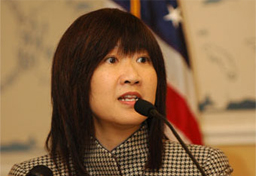
 Margaret Fong is the Deputy Executive Director of the Hong Kong Trade Development Council (HKTDC), an organization officially responsible for foreign trade development in Hong Kong. In 2004-2006 she was the Director-General responsible for Hong Kong Economic and Trade Affairs in Washington and in 2006-2008 worked as Commissioner for Economic and Trade Affairs in the United States.
How do you assess the situation in the jewelry market in Hong Kong?
The jewelry market in South East Asia is developing very fast: its activity may be judged by the number of Asian brands in the international jewelry trade shows and the number of customers they attract. In terms of the number of buyers and also the number of exhibitors our March fair was actually a record. We had 2,830 exhibitors and 37,000 buyers. In buyers we have seen an increase of over 23 percent, in overseas buyers. And I’m talking not just about our usual markets like the U.S. Europe and Switzerland, they are all doing well, but also in terms of our emerging markets like Russia and Czechoslovakia – they are also doing extremely well. In terms of the total export value last year there was a growth of 21 percent. So, it was also very good and it was across the board. It was in the U.S., E.U., Switzerland, which taken together make up 64 percent of our total market. The Hong Kong jewelry export reached $4.4 billion and that makes us number four in terms of export to the world market of fine jewelry. Because the E.U., U.S. and Switzerland are our main markets it is good to see that it is an across-the-board improvement.
What is driving this increase in export, what is the reason for it?
Of course I think that for the U.S. and European market 2009 was not a particularly pretty year and still we see a recovery in the U.S. market. For the E.U. it would be some countries, in particular like France, where we see a 30-percent increase, but that is of course not uniform across the whole of the year. Switzerland has been very strong – 38 percent – and we continue to see it growing. But this is also I think driven by Asia as well because even though at this point they may not account for like the top three in our total market, but Mainland China certainly is growing substantially, and the emerging markets. I think that what you are seeing of course is that overall in Asia consumption power is really growing. The middle class is growing. If you look at Mainland China they have 200 million people in their middle class and it is growing by one percent per year. So they are already accounting for 15 percent of the total world luxury market and it is expected to reach 44 percent in 2020. So I think Asia overall is driving quite a bit of that.
And in terms of the segmentation of Hong Kong jewelry exports, which types of jewelry are going faster – is it diamond jewelry or other types of jewelry?
It would be generally gold and jade related jewelry because these are always our strongest and then of course it will be diamonds and precious stones.
Among the precious stones which are the most sought after?
Diamonds will always be, but increasingly it is also yellow gold with diamonds, so it’s a mix of both now. But for diamonds in particular we are seeing growth in Mainland China and also India. So that demand is really growing very fast and as I said gold and jade have always been our stable products, but increasingly we are seeing pearl coming up, because of the rise of South China pearls, so Hong Kong is now fast becoming the trading and distribution center also for pearls.
What is the impact of soaring and volatile precious metals and also precious raw material prices on export of Hong Kong jewelry?
Actually, we would have things that would go, say, for a million Hong Kong dollars a piece away and those would be not really affected too much by it, especially if you are looking at markets like the Middle East, we are certainly not affected. And I think for the mainland as well because of this increased demand for fine jewelry, they are also ready to pay the prices.
Since Chinese production increases do you see Hong Kong as a hub for distributing Chinese jewelry?
I think Hong Kong has always been such a platform for whether it is overseas brands wanting to break into Mainland China or Mainland China brands wanting to go out. We believe we will continue to see that happening in the jewelry business as in all other businesses. I think at the moment still it is very much Western brands wanting to be in Hong Kong in order to sell in the Mainland China market. I think at this point we still see that the jewelry sector in Mainland China does not have so much of its own grand names that are world known.
Is most of Hong Kong jewelry manufactured in Mainland China?
If we are talking about jewelry, actually we will have quite a bit of them made in Hong Kong, especially high-value jewelry. One of our extra advantages is that we have an agreement with Mainland China, as you are probably aware, the Closer Economic Partnership Agreement (CEPA, for short) and under this arrangement if the product is actually made in Hong Kong you may export it to Mainland China at zero tariffs. But if you are a foreign company wanting to go into Mainland China, this is 35 percent. So there is a huge difference there. That is why we are still having most of the really high-value processes all done in Hong Kong for the jewelry sector. Of course we, too, have in Panyu and Shenzhen a little bit of the production but that would not be the key processes. The key processes would be done in Hong Kong because there we would have that extra advantage as well.
What is the perspective for the diamond jewelry market? Is it going to grow as well or on the contrary drop down?
Well, we certainly see it growing as I’ve mentioned. In particular, in India and China before they were very much into gold and that will continue to be the case but increasingly we see with their middle class growing they are looking at diamond jewelry. And so we see actually that white diamonds are going to be the trend for Mainland China and also for India. I think that in terms of the younger generation they look at jewelry as very fashionable items, but they also want something that you can wear every day. So that is why color stones become more fashionable because you may match them with your clothes and so on.
What about platinum jewelry demand in China? How is that progressing?
I think that overall platinum may go together with diamonds, but platinum on its own is not as popular.
Do you think that the recent Japanese disaster may influence the world jewelry market and the South East Asia jewelry market in particular?
I think for jewelry in terms of production we don’t have a lot of suppliers from Japan, though of course they have their pearls, but they are not of a volume that will be able to meet really the market demand so they have their niche and their own production. But in terms of selling to Japan, of course we expect there would be an impact. At this point it is very hard to predict what this will mean, but in the short term I think certainly where the demand will be for resources it would probably go less into luxury items than into other capital investments and other things. So I think that there would be some impact. And in any case if you have seen, I’m sure, the CLSA report a few weeks back, they are predicting that Mainland China which is now accounting for 15 percent of the world’s total luxury market is going to grow to 44 percent by 2020. So they are going to overtake Japan as No. 1 in the luxury market. I think overall that will mean that what is happening to Japan will certainly have an impact in the short term, but in the long term the trend is for China to really grow to such an extent that I think that demand for luxury products will not be affected that much. And of course the Japanese economy has always been thickly resilient as we have seen what they have gone through in the past 15-20 years. So we believe that perhaps in a couple of years’ time it will be back to where it is now.
Galina Semyonova, Rough&Polished
