 Former African Diamonds managing director (MD) James Campbell was recently appointed as the new chief executive and president of the South African-focused Rockwell Diamonds following the resignation of John Bristow last December.
Campbell worked for De Beers for about 20 years before leaving to become MD of African Diamonds in 2006.
African Diamonds was however taken over by Lucara Diamond in December 2010 and Campbell agreed to join the company as vice-president.
He was once quoted in the media as saying that becoming a vice-president at Lucara after running African Diamonds was a “step down”.
Now that he has made a “step up” on the corporate ladder, Rough & Polished’s Mathew Nyaungwa caught up with Campbell to find out how he was faring at Rockwell since he took-over on June 1.
You were recently appointed as Rockwell’s chief executive and president. What are your plans to improve the recovery of diamonds at the company’s mining operations?
Since my arrival I have taken decisive action to turn the company’s fortunes around. [These are] some of the top priorities:
a) I brought in a new COO (chief operating officer) and a diamond mining metallurgist to look very carefully at our processing plants to make sure that we are using our infrastructure optimally. These actions have already resulted in some early indications that diamond recovery is improving from doing some simple things on the plants.
b) Completing the Tirisano plant – we are busy finishing the first two streams and are redesigning the third and fourth streams which we be built after the first two are completed.
c) We have approval to replace the front end screen at Saxendrift to alleviate some of the front end problems we’ve had with the plant.
d) We are considering bringing in other new technologies to improve the recovery of diamonds. The pan plants are known to be around 60 percent efficient when running at their best, but there are new technologies which can be up to 90 percent efficient.
e) We are focusing on moving “quality tonnes” of gravel, rather than just meeting high volume production targets. Our focus is on moving the right product through the processing plants, at the appropriate throughput rates to enable the plants to be efficient. For example, by feeding lower volumes through the Klipdam plant in the last few weeks, we have actually improved production!
How far has Rockwell gone with its quest to turn underperforming assets around?
It is a long and ongoing process, but as you can see from above, we have taken some very tangible steps towards this. It is my top priority and I believe that we now have the right team to do it. As I said in the recent news releases, I am very confident that we have an in depth and accurate understanding of our geology.
We have now brought some heavyweight metallurgical skills to make sure that we run our plants correctly to extract the diamonds.
Can you name the underperforming assets, and factors that had been contributing to low capacity utilization?
Saxendrift and Klipdam have not been performing optimally. The challenges have arisen largely due to a focus on production volumes rather than a focus on quality tonnes as I like to call it.
We have brought on board these metallurgy specialists who are focusing on optimizing our plants. As I said above, we are already seeing early indications that their actions are moving things in the right direction.
What is the company’s projected diamond output for 2011?
We prefer not to make forecasts in the market. From our corporate presentation on our website you will see though that we have plans to increase production from our current rate of about 1.5k carats per month to 2.5k to 4.0k within two years and then to between 9k and 10k per month within five to six years.
How does Rockwell view the current diamond market?
The market fundamentals are very strong. We had expected the market to take a breather in the last few months, but prices have continued to climb. Our production is focused at the top end of the market where our large and unusual stones are purchased by high net worth individuals for their investment qualities. Diamonds are increasingly seen as a store of value.
Do you see the current diamond price bubble continuing, and if so what will sustain it?
The demand and supply dynamics in the market indicate that pricing for diamonds should continue to strengthen. Over the last fifty years, diamond prices have increased on average by about 5 percent per year, which provides some evidence that the prices should continue - over the long term - to strengthen.
Some analysts noted that the global diamond output will start shrinking by 2013. When do you see your resource base dwindling at South African mines?
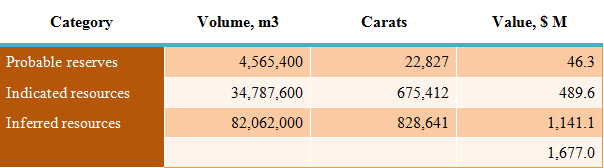
Our different mines and projects have LOM’s of between 5 and 18 years – but this is based on the NI43101 technical reports and we have scope for further exploration on our properties, which could extend the life of our mines beyond that. Here is a summary of our mineral reserves and resources as of Feb 28, 2011:
What is Rockwell doing to complement plans by the South African government to boost beneficiation of special minerals in the country?
We support these initiatives by government. We are very pleased to be able to say that about 80 percent of the beneficiation on our product happens in South Africa through our joint venture beneficiation agreement with the Steinmetz Diamond Group. This happens at their diamond factory in downtown Johannesburg.
There had been talks on the nationalisation of mines in South Africa. If implemented, how will this affect your mining operations in the country?
Nationalisation is not the South African government’s policy.
Alexandr Shaburkin, Rough&Polished, Windhoek
