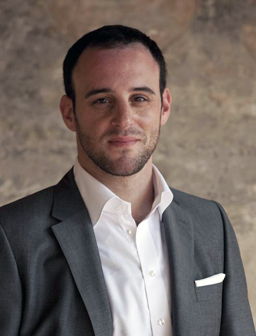
 David Prager is the Director of Communications for the De Beers Group, responsible for developing and delivering the company’s global communications platform.
Prior to joining De Beers, David was in charge of UK communications for AstraZeneca Pharmaceuticals, where he was responsible for corporate, brand and internal communications. David has also worked as a communications consultant with Ogilvy PR, providing counsel to clients top tier brands. He began his career as a White House Intern during the Clinton Administration and graduated from the University of Wisconsin with degrees in both Political Science and Journalism.
David Prager was kind enough to give an interview to the correspondent of Rough & Polished in his office in London.
Could you say a few words about how the cooperation between De Beers and LVMH is developing?
De Beers Diamond Jewellers is a 50/50 joint venture between De Beers and LVMH. It was set up in 2002 and is independently managed. They have been successful at starting to branch out in the major diamond consumer markets around the world. As with most retailers, the recession was certainly a difficult time for them, but I think what we found was that the brand and the categories like bridal jewellery, were strong throughout the recession. Coming out of the recession they had a very strong first half for the year. Sales were up in 2010 something like 47%. Granted they were starting from the low base because 2009 was so difficult, but 47% is very impressive nonetheless. And the big news for De Beers Diamond Jewellers is they’re moving into China. They’ve just open their first store in Beijing, and over the next five years I think you’ll really see a focused move into China - onto the mainland and in major cities. And as everybody knows China is the key emerging consumer market along with India, and some of the statistics we’re seeing about the growth of these markets are staggering. China and India together by the end of the decade are likely to equal the size of the United States in terms of consumer diamond jewellery markets. And the ability for De Beers Diamond Jewellers to get in there now and start to create a brand footprint is very important. So it’s an exciting time for them.
But the latest news is that now the demand in South Asia starts declining and some analysts predict new waves of global crisis. In this aspect, what is your projection on the situation with rough and polished diamonds?
China has grown at such an impressive rate; it’s not particularly surprising to see it slow somewhat. China grew at 25% last year, so at some point logic would hold that we have to slow down. However, we are seeing growth that remains impressive. You know, if you were in China 10 to 15 years ago, you would have seen almost no diamond jewelry acquisition tradition. Now, in the big cities there is a big diamond jewelry acquisition tradition, based primarily around bridal. And so now the task will be for retailers to move from the bridal market into the non-bridal categories. For example people owning a second or third piece of jewellery – that’s where there is room for a lot of growth.
What are further prospects for your jewelry brand, Forevermark?
Forevermark is really exciting. Forevermark is now across more than 440 doors or retail stores. It’s been launched in China and India, and it’s been received very well by consumers. It’s a diamond jewellery brand based on the uniqueness of diamonds. Only the most carefully selected diamonds, crafted by the world’s best diamantaires, are eligible to be part of the Forevermark programme. Along with that each Forevermark diamond carries a provenance promise, giving the consumer confidence that the diamond has benefited the local community. The diamantaires that cut and polish Forevermark diamonds are only the finest craftsmen, and the jewellery is classic jewelry that has resonated with consumers as a proposition. So it’s done very well in China, India, Japan and Hong Kong. Perhaps more exciting, the team will be launching in the United States later this year. United States is still the world’s largest market, accounting for between 35%-40% of diamond jewellery consumption, so we’re very excited about Forevermark’s roll-out there, and what it offers American consumers.
And what about LVMH?
There are two distinct brands here, De Beers Diamond Jewellers (our independently managed JV with LVMH), which is a retail brand - that is the De Beers store that you’d see on the street on 5th Avenue or in Beijing or in Hong Kong. And Forevermark, which is De Beers Group’s diamond jewellery brand that consumers can find in partner retail outlets. Both come from De Beers, but the two aren’t linked, except to say that but both have an exciting future.
Maybe you know that some experts connect the assignment of Mr. Mellier with some new great strategies at De Beers and maybe Mr. Mellier has his own view upon the development of a diamond jewellery brand?
Phillipe Mellier is coming in and is looking across what we call the diamond pipeline, or the diamond supply chain. Obviously the vast majority of our business is focused on diamond mining. And so he’s first looking at diamond mining, understanding what the operations look like on the ground, and making sure that mine managers have what they need. From there the next big space on the pipeline is diamond trading, which is what the DTC does. Just a few weeks ago, Philippe was meeting with clients, understanding their needs and understanding whether or not we are fulfilling those needs. Obviously he’ll have a big role to play in the DTC’s relocation to Botswana. Looking further down the pipeline, there is clearly, an opportunity to look further at the downstream side of our business. Philippe is very excited about Forevermark’s expansion plans into China, India and now the US.
Now coming to Botswana, Namibia and South Africa. Taking into account the political events in the Middle East, what do you think about possible development of similar processes in these African countries after the Libyan scenario?
We mine in four countries – Canada, South Africa, Namibia, and Botswana, but obviously three are in South Africa. And the three countries in which we operate are democratic countries that believe in the rule of law and representative democracy. De Beers is fortunate to have such strong and respected partners. For example, Botswana has been a democratic country since it gained its independence in 1967, and it has consistently ranked near the top of the world rankings in terms of low levels of corruption, good governance, and rule of law. Just two years ago US Secretary of State Clinton held up Botswana as a place where consumers could be confident in knowing that the government was using the proceeds of the country’s natural resource responsibly - building roads, building hospitals, and building infrastructure. So you have a representative government that has a track record of not exploiting its people, but exploiting the resource for the good of everyone. Obviously all of the countries in which we operate - just like the United States and Britain - have their issues and challenges, but they are stable countries and their citizens make up the vast majority of our workforce. We feel good about our partners, and that’s important because the ability for us to invest billions of dollars in these countries, and have confidence that that money would be invested safely, is critical for a business of our size.
Could you describe the prospecting activities in Africa? Are there any chances to discover new diamond fields there?
There are several prospective areas. But probably the most prospective right now we are focusing most of our attention is Angola. We have got a few promising kimberlites in Angola that we are taking to a next phase of study, which involves sampling and drilling, and the exploration team is quite positive on those. Botswana, Canada, India and South Africa are also prospective and our exploration teams are hard at work, particularly around mines we currently have, and seeing if there are other clusters around those mines where we can find something economically viable. It’s important to say though that there is, at least in the short term, no big mine on the horizon - nothing, at least, the size of Jwaneng in Botswana. We always continue to look, but as Nicky Oppenheimer always says, it’s not easy finding a diamond mine, if it was, people would do it all the time. There are only something like 26 or 27 commercially viable kimberlite pipes in the world, and so it’s not a particularly easy thing to do. Our challenge is that as we speak, consumer demand is rising quickly in China and India, while our supply is plateauing. The supply-demand dynamic is only going to diverge and grow over time.
Now the question about De Beers’ experience in selling diamonds at tenders. Was it valuable or the traditional system of dealing with sightholders is more preferable?
Well, we get asked this question a lot and I think people forget that we do both now. The DTC sells De Beers’ diamonds to its Sightholders from around the world and we’ll continue to do that because we believe the best way to provide our clients with a stable and predictable system is to provide them with long term contracts, with which they can plan their businesses. At the same time Diamdel, which has primarily supplied to the secondary market, has been running regular auctions since 2009. Both the secondary market and Sightholders can participate in these online auctions. Those have been successful, and we believe they have a role to play. They help us understand what prices are doing and what demand is doing, but for a producer of our size with 35% of the market, we think long term contracts, where you give Sightholders contractual agreements and predictable supply over an extended period of time, is the right way to go and we’ll continue that.
And which system is preferable?
The DTC will continue with the Supplier of Choice system, which is selling diamonds at Sights on a contractual basis. Diamdel will continue its online auctions. Both play a role, but the primary focus on the DTC Sight system will not change.
Maybe you know that most of the diamond community were surprised with the assignment of Mr. Mellier, who is an outsider and his previous activity was far from the diamond sphere and luxury. Can you comment?
We’ve obviously had a lot of questions about Philippe who comes from a background in transportation and automotives. I think what people are less aware of is that he has degrees in both engineering and an MBA. So, first of all, he is very sharp, very bright, and that’s evident to somebody when they meet him for the first time. And I think what Philippe would say if you ask him that question is, ‘I’m coming into the world’s greatest diamond company. I’m not an expert on diamonds, nor do I need to be an expert on diamonds. I’m coming in to be a Chief Executive, and to run a company that is focused on mining and selling a product.’ And to that extent it’s not all that different from what he has done before. He has managed large organizations with complex processes - whether it’s manufacturing a train with Alstom Transport, or now, extracting diamonds from mines. He’s not doing the actual extraction, but he understands processes, asset optimization, how to create efficiencies, and how to keep people safe. At the same time he’s got a real appreciation for brands. He has worked for Jaguar and Ford and he understands the power of brands. I think he would also tell you that he believes the De Beers brand is unparalleled, that it’s iconic, and that it can do more. And so I think he’s quite excited to get his hands on the brand to make sure we are maximizing its value for the shareholders. So the sectors are different in terms of the type of business, but what he has been asked to do is very similar, and he’s got a pedigree. He’s being asked to lead a large complex organization that makes a product and sells a product. And he has proven the ability to do that very well over time.
And he’s made a great impact so far. He’s been here since July, and he has already been down to the mines. I think the guys on the mines were pleasantly surprised by his level of knowledge, his level of curiosity, his level of interest, and he is asking all the right questions. He gets the business and that is quite exciting for everybody internally.
Was he recommended by Bernard Arnault, Louis Vuitton’s head?
I don’t know about that specifically. What I do know is that the people who put forward references on Philippe’s behalf were impressive people, and they strongly recommended him.
The diamond business has always been traditional from generation to generation. Nicky Oppenheimer said that De Beers with Mr. Mellier will be quite different.
De Beers is 123 years old, and Philippe is our first non-internal CEO, or Managing Director. And frankly I think externally that’s been more difficult for people to accept. Internally, I think once people have spoken to Philippe, and met Philippe; it’s been a no-brainer, because they see that he is sharp and intelligent and will bring a lot to our business. I think Nicky’s belief, and all the shareholders’ belief, was that we are at a critical moment in our history. We are standing on the cusp of what we refer to as the diamond decade - a decade in which we have a tremendous amount of opportunity in front of us, and in order to capture that value and maintain De Beers’ leadership position; we needed some outside thinking and a world-class pedigree. It says a lot about Nicky that he was confident enough to look beyond the walls of De Beers and find a leader like Philippe.
Thank you very much. David, I didn’t intend to touch the rumors in the mass-media about relisting. But if you wouldn’t mind to comment…
The IPO question seems to come up probably every six months or so. Something happens or we produce good results and people ask the question. The answer is no, we have no plans to re-list. The shareholders continue to say they are happy with what the business is doing. In the first half we produced the best sales we’ve seen in 10 years, so management is focused on growing the business and making a return for our three shareholders.
Galina Semyonova, Rough&Polished, from London
