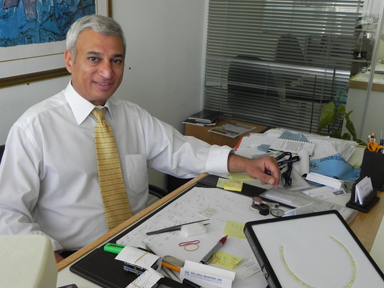
 Ben Yona Diamonds Ltd is a leading diamond manufacturer, which has been in the diamond business for 50 years. The company was established by Yuval Ben Yona who worked alongside his father, Yona Ben Yona, the founder of B.Y. Ben Yona Ltd polisher and dealer of precious gems and one of the founders of the Israeli Precious Gems Industry. Ben Yona Diamonds Ltd. is renowned for best quality diamonds that are polished by expert Israeli cutters using the latest technology. The company is also running a state-of-the-art online store giving a profound description of every gem on sale. All the rough stones used by this manufacturer are certified under the Kimberley Process Certification Scheme. In his interview below Yuval Ben Yona answered the questions from Rough&Polished.
Please, say a few words about your company and its business.
The Ben Yona Company was established in 1970 and manufactures precious gems such as emeralds, tanzanite, and spinel, and then branched out to manufacturing polished diamonds. Today, Ben Yona manufactures diamonds of all sizes starting from 0.50 carats to 10 carats, in all ranges from D-L and in all clarities and shapes in addition to fancy color diamonds.
Your fancy color diamonds are almost all yellow. Is this color something special for your company?
Fancy color yellow diamonds are more in demand than all other fancy colors. Also, their rough form is more available. Pink and other color diamonds are quite rare.
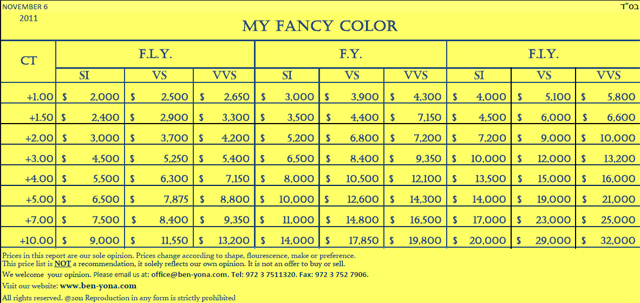
Recently, you have introduced a price list for yellow diamonds saying it was meant for manufacturers and traders as opposed to consumers. What is the difference then between your price list and that of Rapaport?
We are not competing with Rapaport. We provide a free service solely for fancy color since there was no price list for them until now.
Could you describe the procedure followed by your company in setting a price for a polished diamond?
We speak with clients and suppliers worldwide and learn the prices from them. We are very happy to receive feedback at any time.
Since your company appears to be specialized in yellow diamonds, could your describe this market segment in more detail?
People buy fancy color for a number of reasons:
1) Generally, when people buy fancy color this is not the first time that they buy diamonds.
2) The market for white diamonds is plentiful, whereas, fancy color diamonds are innovative; there is the possibility of combining them with white diamonds. Generally speaking, a piece of jewelry looks much more interesting and special when it contains a few colors.
In your opinion, what is the volume of this market segment in terms of money?
The volume for this market is a few hundred million dollars, but I am not authorized to give an exact estimation.
What was the biggest yellow diamond manufactured by your company and how much did it cost?
I do not divulge details about large diamonds that we manufactured since they are very rare and I don’t want to harm our customers’ privacy.
Where do you get rough diamonds from?
We buy our rough diamonds from around the world which operate in conjunction with the Kimberley Process.
In view of the recent uncertainty in the diamond market caused by fluctuating rough prices do you think the steps taken by De Beers, which ran a special sight to buttress prices, and by ALROSA, which promised to reduce its supplies to the market, will help to amend the situation before the Christmas season?
The suppliers of rough diamonds do what is good for them, and this is natural. But if they hadn’t raised the price of rough in the last two years, the price of polished wouldn’t have risen as it has. From a comprehensive point of view, I think that ALROSA takes better care of the diamond industry.
What do you think of current prices for rough diamonds: are they sustainable in the long term taking into account the scarcity of resources?
I do not think that there is surplus merchandise in the world. There are many types of merchandise that are missing, mainly the 3-4 carats in medium clarities.
There is a standstill that comes from psychological motives stemming to the global economic instability. Yet on the other hand there are four billion people in the world who have never seen a diamond; if a thousandth of them will buy diamonds, our situation would be wonderful.
The diamonds sold by your company are certified by different laboratories. Why don’t you choose one of them to do the job?
There are different customers who want different certificates at different prices.
From your experience, did it ever happen that a diamond certificate for one and the same stone issued by one lab ran counter to or diverged from a diamond certificate issued by another lab?
There are differences among various labs.
Don’t you think that nowadays the high quality of diamond processing, which actually cannot be evaluated by a customer’s naked eye, turns diamond certificates into the most cherished goods leaving diamonds in the background?
I don’t [think] there is any significance whether a diamond receives an excellent or very good grading. Sometimes a diamond with a very good grading has more life and beauty than one that received an excellent grading.
Your company is manufacturing diamonds mainly in the range from 0.5 to 10 carats, which means you are dealing with larger stones. What is the market for them these days? Is it going up or down?
Mainly the demand is for stones 1-3 carats and for larger stones 4-10 carats with a medium quality particularly SI1 and P1.
Who are your customers geographically?
We have sales persons in the USA, Hong Kong, and in Europe.
What kind of diamonds manufactured by your company are selling best?
Mainly the demand is for round and cushion stones. There is a constant growing demand for fancy color.
What were your sales in 2010 and in 2011?
We don't give any information about our figures.
Does your company feel the pressure of the coming Christmas season right now?
We expect the season to be very good in general but we are not sure that we will be able to supply these requirements because of shortage in some items.
Do you think 2012 will be a different year for the diamond industry and in what way?
We believe that the demand in the Far East will break records in 2012. However, we can't anticipate how the market in 2012 in Europe will be due to the economic uncertainty in Greece, Italy, and Spain. The instability can hurt the European economic market. Therefore, I can’t say how I can anticipate what the coming year will be.
As for the United States, in the last three years we saw a slow and steady increase following the 2008 economic crisis. 2009 was the bottom as it was the year immediately following the crisis; 2010 was better that 2009, the situation improved even more in 2011. We anticipate that the coming year, 2012, will be better than 2011.
Vladimir Malakhov, Rough&Polished
