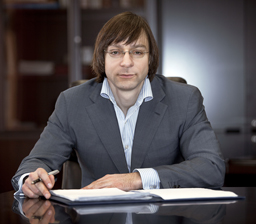
 Mikhail Diaghilev, appointed General Director of OAO Krastsvetmet in the end of 2011, took part in the CIS Metals Summit 2012 incorporating the CIS Precious Metals Summit 2012 held in Moscow, which brought together industry leaders from across the post-Soviet area. At the event, the new head of the Krasnoyarsk Non-Ferrous Metals Plant answered questions from Rough&Polished.
How would you evaluate your participation in the CIS Precious Metals Summit 2012?
The summit is important to us because it is one of the few events in Russia held to exchange views on various issues and problems of the industry.
What markets are of greater interested to Krastsvetmet? Any plans to reach out to China and develop cooperation with companies operating in this country?
In addition to primary processing of raw minerals, we are very busy developing and improving processing techniques for various kinds of recycled materials and base products with a low content of precious metals. Besides, we consider promising to recycle automotive catalysts and manufacture nitrous gas purification catalysts, produce anti-cancer drugs based on platinum compounds and provide services involving analysis of geological samples.
There is a new and dynamic line of business which is manufacturing technical products made of precious metals and their alloys.
As for the plans to reach out to China, we are currently engaged in preliminary negotiations. So, it is premature to talk about some particular project. It is rather learning how to do that.
How do you evaluate your company’s performance last year?
In the past year, Krastsvetmet established its own record in gold production turning out more than 90 tons. The company’s revenue from refining services increased by 11% compared to 2010, while sales of technical goods made of precious metals went up 85% with jewelry sales going higher by 2%.
Due to the economic crisis and uncertainty about the future, demand and, consequently, jewelry production declined significantly. In addition, gold went up in price almost twice during the last three years. All this prompted a shift in demand towards cheaper goods.
In line with this trend, we have also introduced major changes into our product range increasing the proportion of lightweight goods and hollow chains. We have boosted our output of silver chains several times.
Our silver jewelry production went up twenty times during the past three years and today it is measured by the ton. So, silver is growing and ‘catching up’ gold and next year silver jewelry output may reach that of gold jewelry.
And palladium? As a jewelry metal?
Palladium was able to find its niche, but it's still a narrow segment. We have jewelry made of palladium and platinum, but it's only a few tens of kilos per year. We do not see anything revolutionary going on in this segment.
Will you expand your jewelry assortment? Towards silver goods if they start to edge out gold?
Our plant is permanently expanding the range of jewelry goods and buying new equipment. It should be noted that 95 percent of our jewelry is chains. They feature most popular weave types, such as "snake," "love," "nonna," "double rombo," as well as hollow chains. In the near future, we shall expand the range of hollow chains due to the development of chains production from smaller diameter wire.
Also, we are weighing the possibility to buy chain weaving machines to manufacture new types of chains, which we have not produced previously.
How do you assess the development of jewelry industry in Russia in the coming years?
If we talk about the global trend for the coming decade, it seems to me that buyers’ psychology is changing - from Soviet or post-Soviet psychology it is shifting towards modern psychology, partly youth psychology. There was a time when people in the Soviet Union bought jewelry also as a means of accumulating wealth. But time goes on, the system of values is changing, the new generation is interested in more utilitarian items like various gadgets. A jewelry piece is quite a universal gift, but then again today there is a too extensive choice of gifts from other market segments. And a jewelry piece is, for all that, not a utilitarian thing, this is first of all an adornment. And I also think that today jewelry is often bought "on the move," not as something for which people used to accumulate money for a long time, then go to choose and finally buy. Today, when there are many alternatives, jewelry shifted into a zone of more rapid purchases. At least, in our segment. So, we have to offer something of interest and yet affordable all the time.
In any case, the jewelry production is one of the ways to sell our precious metals.
Does Krastsvetmet experience growth in the refining sector? Do you plan to increase production, increase capacity?
The capacity and technology of our refining enterprise allow recycling additional volumes of raw materials. Every year we increase the amount of processed precious metals by way of broader cooperation with our strategic partners among mining companies and operators in the market of recycled materials. Our annual production of precious metals reached 1,000 tons.
The existing processing techniques and equipment permit to increase the production of refined platinum metals in a significant way by processing imported raw materials and also minerals expected to come from the mining fields which are planned for developing in the coming years by major mining companies in Russia, including those located in the Krasnoyarsk Territory and Transbaikalia.
It is possible to expand our presence in the sector of gold and silver refining from minerals by way of developing new deposits by companies, with which we have established partnerships, as well as by bringing in raw materials produced in neighboring countries formerly being part of the Soviet Union.
As for recycling scrap containing precious metals, we are working on techniques permitting to extract precious metals from spent automotive catalysts, which will widen the range of feedstock. This is probably one of the last sources for processing platinum group metals, which has not yet been mastered on an industrial scale in this country.
The volume of scrap processed, including electronic junk, will essentially remain unchanged in the near future.
In other words, this is a separate large area of new business for Krastsvetmet?
This is a new trend in the refining sector. We are cooperating now with companies that are engaged in processing of spent automotive catalysts at a non-industrial scale and we together study the processing techniques. We want to choose for ourselves what can be developed on a large scale - perhaps in partnership with those who are already engaged in this and who have the scientific and technological base, but no scale.
Regarding your plans for 2012, what will be your major focus, what are you going to change or abandon?
We shall develop the production of technical goods which generate the biggest quantitative increase. We intend to reach a more than 10-percent total growth for the whole group of jewelry production.
Today, there are no lines of business which we would want to abandon. And there is no recession and it is not expected to happen. We are intent either to maintain the current level, or move on.
Alexander Shaburkin, Rough&Polished, Moscow - Krasnoyarsk
