 The Kimberley Process was last year seized with debate on whether to re-define “conflict diamonds” to involve gems that emanated from violent areas among other issues. Although most developing countries were opposed to the idea, no concrete decision was taken before the end of the U.S’ leadership of the diamond trade watchdog.
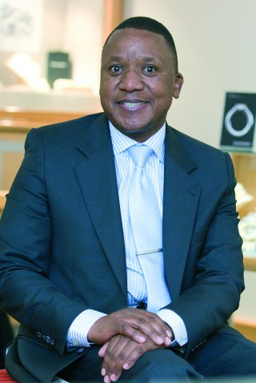
Former KP chairperson Abbey Chikane, of South Africa, who recently had an exclusive interview with Rough & Polished’s African Bureau Editor In Chief, Mathew Nyaungwa, said that although debate on the subject will continue this year, no sufficient evidence has been given to demonstrate the need for KP to re-define “conflict diamonds”.
He said in a veiled swipe at the U.S, which moved the motion that there was no need to “change what has worked just for the sake of it”.
Chikane also talked about fears that KP might be forced to review the statuses of the Central African Republic and the Democratic Republic of Congo due to the continued internecine fighting.
He also defended mining operations in Zimbabwe’s Marange, saying that operations and transactions that he witnessed during his tenure as the KP monitor for the African country were above board.
Below is the full text of the interview.
The Kimberley Process is coming back to where it started, as it celebrates its 10th year anniversary this year. What has the diamond trade watchdog achieved over the years?
I think founder participants and members of the Kimberley Process should take pride of the fact that they established an international certification scheme, which culminated into a global certification scheme of 70 to 74 countries that are currently compliant with the minimum requirements of KP, that have complied fully and benefited to their people and government in terms of revenue, you know tax and other forms of contribution to the economy.
The other thing is that I think there should be proud of the fact that the crisis in Sierra Leone and other parts of Africa where there was a crisis and wars supported by revenue that was generated from the sale of diamonds have since stopped.
As we speak now (former Liberian) president Taylor is incarcerated, which was [mainly] as a result of the Kimberley Process. So I think it is an event that is worth celebrating and one can say that it has been a resounding success for African countries.
Apart from the successes that you have highlighted, are there any outstanding challenges that KP faced during this period under scrutiny?
We, like any organisation, especially multi-lateral organisations, established a theme at the time when there was an urgency to deliver on our mandate as per the UN resolution and over that period we kept on improving the system, reviewing the system and making sure that it catches up with developments that were not necessarily anticipated. So, one can say that the challenge has always been change. Change is unfortunately something that we have to deal with because we live in a very changing world. So the challenges have always been about how much more we can do over and above what we have achieved so far. That continues to be the case.
Talking of change, I understand the previous KP chair, the U.S, pushed members to update the definition of “conflict diamonds”. What is your take?
I think as a matter of principle that dialogue and discourse need to continue because within the Kimberley Process decisions are taken by consensus and therefore we need to reach consensus on that. Having said that the principle is that or rather the fundamental of this debate and discourse is not whether or not we should remain doing what we are doing now within this narrow scope, which has worked for over a period of time and sometimes when you want change something that is working you need to seriously consider all other factors but in this case there seem to be no sufficient evidence to demonstrate that we need to go beyond what we are doing because the Kimberley Process has not completed its mission, I mean there are still wars, unfortunately in Africa. Look for instance in the Central African Republic, Mali and all these mining jurisdictions. Therefore we need to be careful that we don’t just change what we have, what has worked just for the sake of it and also we need not to change it for the sake of other matters that are outside Africa that may not necessarily add value to the current system. So without pre-empting what is likely going to come out of this debate, I think it is important that we need to stick to our mandate and make sure that it is in line with the United Nations resolutions.
There was also debate on the need to have a permanent KP secretariat. We also heard that the World Diamond Council volunteered to run this office. Do you espouse such a move?
In view of the permanent secretariat what was raised at the beginning of the negotiations for the establishment of the Kimberley Process was one of the reasons why we don’t have a permanent secretariat was simply because of no funds to fund such a permanent secretariat. The second reason was that some participants in the Kimberley Process were very concerned about the fact that a permanent secretariat may end up developing and building its own power. So the fact that the World Diamond Council has offered to act as the secretariat is a plus for participants and observers in the Kimberley Process but it is something that I think needs to be debated to its logical conclusion.
Let’s talk about Zimbabwe where you were monitoring their diamond mining. You gave operations in Marange a clean bill of health and even suggested that they were a model for many. However, this drew a lot of criticism, with some calling you ‘paranoid’. What is your reaction to such comments?
Am not sure, who exactly are you talking about, but suffice to say that over and above my own evaluation of the situation, a consensus … reached in November 2010 gave Zimbabwe clearance and it is on that basis not necessarily my recommendation that the Kimberley Process, 74 countries that participate, approved and endorsed that Zimbabwe should trade without any hindrance.
There are also allegations of misuse of diamond revenue in Zimbabwe to fund parallel government activities. As the former KP monitor for this southern African country, did you unearth such embezzlement of funds or this is purely hypothetical?
You know based on information at my disposal during my tenure as the KP monitor, of which am not one now, there is sufficient evidence that the largest chunk of revenue that was generated from mining activities in Zimbabwe was contributed to the government’s fiscus and that money had been used to develop and reconstruct their economy. I am aware of these allegations; I just think that if there are any such, one must produce evidence. So far and during my tenure there wasn’t such any evidence.
You said earlier that KP works with consensus. Is it really possible that you always have consensus from 70 plus member countries. Is there any other way that can be implemented for KP to make decisions without necessarily reaching a consensus?
You know in the 21st century, you have got a lot of stakeholders with various interests it does work and it has actually been demonstrated to be one of the instruments that have worked even for the United Nations Security Council, General Assembly, World Trade Organisation and other organisations around the world. Consensus solutions are more sustainable than if you have to vote. The problem with voting, which is just my personal opinion, is that it always depends on who is in control, who is in power, who has more representation and that does not necessarily reflect a consensus that we require. So it’s a matter of choice, we can either operate the way we have been and we have been successful or we can look at other options but am not sure if there is any evidence to that effect that those will work better than consensus based decision-making processes.
Can you say that KP is still relevant?
KP is very relevant, as I said the uncertainties and the war in the Central African Republic, which is a diamond producing country, Mali and even the Democratic Republic of Congo (DRC) are of serious concern. It does look like there is a concern that we may again act with conflict diamonds. At the moment, of course those countries are compliant with the Kimberley Process but there is a danger that we may be forced to go back and re-consider what the role of the Kimberley Process is in those countries.
What is the future of the KP like?
Now that South Africa is the chair to celebrate the 10th anniversary we need to look at how much more can KP do to be effective and efficient in dealing with conflicts in Africa and most importantly it has to be focused. Its success has always been as a result of the focus on its mandate rather than dealing with matters that may not be significant to the African agenda.
Do you anticipate South Africa introducing new issues now that it is the new KP chair or it will continue with what the United States started?
I am not sure of the vision or position of the current chair. I wouldn’t like to represent my views as the views of the chair. Suffice to say, South Africa has always had a holistic approach to the Kimberley Process. It was all about ensuring that diamond mines on the continent are not used to fund conflicts. Secondly that the South African government has always emphasised the issue of peace and security on the continent and thirdly, the whole concept of multilateralism and working together with not only African countries but our other partners outside Africa to ensure that there is peace and stability in Africa to attract investments. Lastly, that as a consequence of all of these, Africa should be able to improve the lives of the masses because unfortunately Africans are poor and suffer from all sorts of unnecessary calamities from health to lack of education. I think it is important that the agenda is captured within South Africa’s vision for the Kimberley Process in 2013.
Mathew Nyaungwa, Editor in Chief of the African Bureau, Rough & Polished
