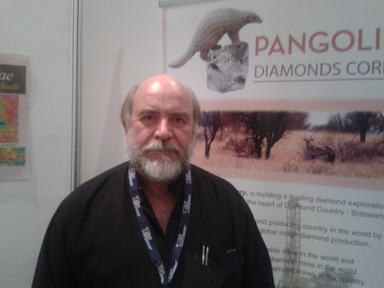
 Pangolin Diamonds, which recently discovered two kimberlites at its wholly-owned Tsabong North project, in Botswana said it will partner a diamond major if the kimberlites are declared economical.
Company chairperson Leon Daniels told Rough & Polished’s African Bureau Editor In Chief, Mathew Nyaungwa last month on the sidelines of the Botswana Resource Conference that the first kimberlite, which was recovered last May is over 20 hectares in size.
However, the interview was conducted a week before Pangolin announced the recovery of its second kimberlite at the Tsabong North project.
Daniels said two additional core drill holes intersecting at least 100 meters of kimberlite will be drilled on the Magi-01 kimberlite for kimberlite indicator mineral and micro diamond recovery.
He also said that it was too early to conclude that the 20ha kimberlite was a major find in Botswana.
Below is the full text of the interview.
You reported your first kimberlite recovery in Botswana last May; can you tell me more about it?
Yes, it was in our Tsabong north project area and it is called Magi-01 kimberlite, it is an aeromagnetic anomaly that we drilled. We have a number of cluster zones aeromagnetic anomalies and this is the first anomaly that we drilled in this particular cluster.
We intersected the kimberlite 33.5 metres down. It is a crater facies kimberlite, a sedimentary type…we think it is over 20 hectares in size. Currently, we are continuing with our drilling programme to drill the other anomalies in the area.
Once we finish drilling them we will come back to this kimberlite and drill at least two more holes into it with a minimum of 100 metres intersection and we will submit those samples to the laboratory to look at them … for possible micro-diamonds content.
What is your prognosis of this project area?
We think that this project area is geologically and tectonically very similar to the Orapa area and in Orapa there is over 80 kimberlites but the area has quite a high success rate of kimberlites that are economic.
So in this area we think that we will probably find not less than 20 kimberlites and under those circumstances we need 5 percent success rate of being commercially viable, which is significantly lower percentage than what we see in the Orapa area. So, we think the prospects are very good.
With this recovery of your first kimberlite, when will you start the development of the project?
I don’t know if we will get into mining ourselves in that area because we are looking at kimberlites that are generally more than 20 hectares in size and for a junior company that is a big apple to bite. So in that area we will probably invite a major partner to come and assist us in the evaluation and development of the project. But certainly if we find something that is smaller, that is between 5 and 10 hectares range we will certainly look at developing that ourselves. We have a management team that has experience, past experience to do that.
Have you received any offer from potential partners?
No, because we have not yet invited any offer, we think that it is too early to do that. We would like to make more discoveries so that we can go … and if we get an indication from the laboratory samples that the kimberlites are potentially economically viable at that point we will probably approach some of the majors and determine whether they have an interest or not.
Apart from the Tsabong North project, do you have any other projects that you are working on in Botswana?
Oh, yes we do. We have an area south of Jwaneng, which we are getting good encouraging results from. We [own Malatswae and Mmadinare projects]. They are all very important to us. We rate all those areas highly in terms of potential and we are certainly active in those areas as well.
Are you also operating in other African countries besides Botswana?
No, no, no! I have been exploring for diamonds for 33 years in this country and we are 100 percent focused on Botswana.
Why Botswana?
Because, it has the best combination of legal, fiscal and geological domains. The government is very supportive in terms of the mining industry. It is highly rated world-wide and I spent most of my adulthood here. I spent most of my adulthood here than I spent outside of Botswana and so to me its home. Why should I go anywhere else?
You really like the country?
(Laughes) Yes it has great potential but, you know on top of that, it is like home to me.
You had plans to elevate previously identified kimberlite targets in your project area. Can you briefly tell me about this?
You know large parts of Botswana have been explored and so with the exception of the Tsabong North project area, which had not been explored by anybody else before. In the general perspective areas of Botswana you are effectively at least the second or third explorer to look at that same area. So, we do have areas that some people have explored [but] we have a different interpretation of the results that have come out of that area that they may not realise the potential that we think there is and so we feel those are highlights that we need to go and develop further.
By and large what is the future of diamond mining in Botswana?
Well, the problem we have is that they haven’t been any new discoveries for quite a long time. Petra Diamonds discovered a kimberlite two years ago, which they were quite positive about, am not sure how big it is but I think it’s much more than six hectares. The thing is that it doesn’t really contribute much to the future reserves of the country and the problem is that every day they are mining the major mines of Botswana and the resource is getting smaller and smaller without any new additions. So we are focusing on +20 hectares kimberlite because we would like to contribute to increasing the future resource of the country and since we believe we will be successful we are quite positive about the future of diamond mining in the country.
So, can we safely conclude that this 20 ha kimberlite you are talking about will likely be a major find in Botswana?
No, that is too early to say. We still have to do a lot of work before we can say that.
Mathew Nyaungwa, Editor in Chief of the African Bureau, Rough&Polished
