 Last year, the World Federation of Diamond Bourses (WFDB) announced a new partnership initiative - the World Diamond Mark, a non-profit organization supposed to be the new marketing arm of the entire diamond and diamond jewellery sector, with the unique mission to ensure the health and future growth of the industry in the luxury segment.
According to WFDB, the World Diamond Mark signals the beginning of the largest accreditation and marketing programme in the history of the diamond sector, the “Authorised Diamond Dealer”.
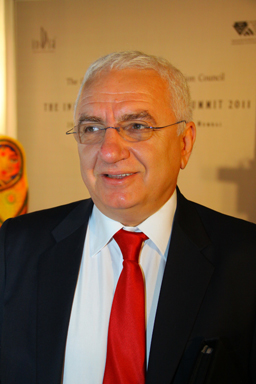
Alex Popov, recently elected Chairman of the World Diamond Mark Foundation (WDMF), gave this interview to Rough&Polished just before his departure to India for a series of talks with the top management of the Indian diamond, gem and jewellery industry and trade about the implementation of the World Diamond Mark programme.
As a member of the Executive Committee of the World Federation of Diamond Bourses you are promoting the program of the World Diamond Mark. Could you briefly describe the essence of this program?
As a member of the Executive Committee of the World Federation of Diamond Bourses (WFDB), I’ve been working together with my colleagues Suresh Hathiramani, President of Diamond Exchange of Singapore and Rami Baron, President of Diamond Club of Australia, on the World Diamond Mark program for the past three years. At the last WFDB Presidents’ meeting in Istanbul, I was elected as the Chairman of Board of the World Diamond Mark Foundation (WDMF) and currently, I devote most of my time to this program.
The World Diamond Mark (WDM) global objective is to ensure the health and future growth of the diamond and jewellery industry in the luxury market sector.
It is based on three fundamental principles:
1. Education of jewellery retailer about diamonds;
2. Confidence of the public with an accreditation program;
3. Generic marketing to promote diamonds and diamond jewellery based on the Authorized Diamond Dealer concept.
The Authorized Diamond Dealer concept is the cornerstone of the program. The international diamond business community, represented by the WFDB, will accredit jewellery retailers as Authorized Diamond Dealers. This will lead to greater and wider brand recognition of diamonds as a luxury product and to the increased visibility of diamonds in jewellery shops. Worldwide marketing campaigns will add to greater consumer confidence and enlarge the slice of diamonds in the luxury spending pie.
As far as is known, the World Diamond Mark was to be launched this year. Were you able to do it and for how long do you schedule this program?
We planned to launch the World Diamond Mark at the beginning of this year. The institution of the legal framework has taken more time than planned and therefore we are launching in the last quarter of 2013. Mind you, we are talking about a major change of thinking and a turnaround in the whole diamond industry worldwide. So a delay of nine months will not significantly alter our plans. The WDM program is not bound to a strict time frame and will last and develop as long as diamonds are sold in jewellery.
How will it be financed and implemented in practice?
The initial stage and preparation of the program are financed by the WFDB member bourses worldwide. They have provided initial seed capital. At this point of time, when the program enters the pilot stage, major industry stakeholders are prepared to take part in the second round of capitalization. Later on the program will be financed by Authorized Diamond Dealers’ yearly contribution and matching capital from all other industry participants – manufacturers, dealers and, eventually, mining companies.
In practice all the work is done by the World Diamond Company Limited in Hong Kong which develops the guidelines and seeks its implementation. In each country, we cooperate either with local WFDB member bourse, national jewellery association or another industry body, like, for example Gem and Jewellery Export Promotion Council in India.
This program is carried out under the auspices of the World Federation of Diamond Bourses. What is its role in this endeavor?
The WFDB has been the initiator and the owner of the concept since the beginning. The concept was first discussed at the 34th World Diamond Congress in Moscow in 2010. There the ad hoc working group was formed. Later on, at the Presidents’ Meeting in Dubai in 2011, the WFDB officially formed a WDM Committee that included Messrs. Hathiramani, Baron and myself.
This committee has developed the program up to the point where it is today and has established the legal framework for its implementation.
Six WFDB ExCo members are members of the WDM Board, including WFDB President Ernest Blom, who is my Vice-Chairman. The WDM Committee was strengthened by Anoop Mehta, President of Bharat Diamond Bourse; Julien Drybooms, President of Vrije Diamanthandel of Antwerp, and others.
To put the long story short – WFDB is the father and the mother of the WDM program. Today it is done and we are open to all industry bodies to join and support the initiative.
Do you feel any support from mining companies for this initiative?
We have not yet asked the mining companies for their support. From my private conversations with top people of all major mining companies I sense a lot of genuine interest. We are also getting requests for information from governments of African diamond producing countries. Apparently the miners, after the International Diamond Board (IDB) non-starter are waiting to see how it will develop further before they jump on the bandwagon. We welcome all such interest and are open to dialog with each and every mining company and/or government.
Each manufacturer of diamonds and jewelry is advertising its own brand in the market. Will they be interested also to take part in the program of generic advertising, which is the World Diamond Mark?
Indeed the branding aspect is very important. In today’s world, non-branded goods are perceived as being inferior to branded. We welcome all jewellery and diamond companies’ brand efforts and advertising. What the World Diamond Mark is about is branding of the diamond itself, regardless of the jewellery brand. While individual brands are competing with each other in same jewellery shop, we compete with other luxury items, like bags, fancy spas, shoes, clothes, cars, gadgets, travel, boats, etc. with the purpose to help increase the Authorized Diamond Dealer’s turnover and, therefore, increase the probability of sale of individual jewellery brands.
Recently, I had a conversation with a major jewellery retailer who spends more than 200 million on advertising every year. I asked him whether these millions have increased the diamond segment in their sales. The answer was: “Nobody knows!” In order to be effective and achieve the goals we need to be focused on generic diamond promotion.
Most diamond manufacturers understand the need of such promotion and are prepared to go to great lengths to ensure the health and growth of the diamond industry. As a matter of fact this week, the World Diamond Mark team is having serious talks with major Indian manufacturers who expressed their willingness to participate in the program.
What is the difference between the World Diamond Mark concept and the idea of the International Diamond Board virtually failed to work?
I’ve just mentioned the IDB non-starter. In my opinion IDB’s generic promotion project was excellently conceived. I’m familiar with the parties involved and we have exchanged a lot of thoughts together. I cannot pinpoint why IDB didn’t get off the ground as there’s multitude of such possible reasons. We have tried to learn from their experience.
The principal difference between the IDB and the WDM is that we have put the consumer as the main recipient of the Diamond advertising. The consumer gets its contact with diamonds at the jewellery store. Therefore the most important link in the diamond distribution chain is the retailer, who’s facing a consumer. Therefore, as we are concentrating our efforts at the end of the supply pipeline and not at its source, we have put the accent of the retailer’s education and attestation. After that, we can wholeheartedly recommend to consumers to prefer the Authorized Diamond Dealer when taking a decision to buy a diamond.
During economic downturns, manufacturers and trading companies in the diamond industry sometimes accuse diamond miners of inflating prices for rough diamonds, while the rate of diamond price increases lags behind that of other luxury goods. Do you think the World Diamond Mark will help raise prices for polished diamonds?
These accusations have their merit, but we live in the free market environment. Mining companies try to get maximum return on their investment and nobody can blame them for that. Their management reports to their shareholders and it is not their business to deal with the profitability of their clients. The prices of polished diamonds are too low for many reasons, one of which is the fear of losing clients to other luxury products. Look at prices of high-end watches – they rose more than 200% in last 10 years. Diamonds could do the same. The objective of the World Diamond Mark program is to help raise the price of diamonds and bring better profitability to manufacturers and dealers.
There is another problem. Diamonds are gradually giving way to other luxury goods in the market and not only to them - take, for example, electronic gadgets. What do you think should be done to reverse this process?
I’ve been talking about this issue at the beginning. This is the most challenging issue the industry faces. One cannot compare diamonds to electronic gadgets, but most young people don’t see this in the same way we do. We need to share our passion for diamond with other people, make them as enthusiastic about it as we do. It’s just not right to sell a Hermes bag for 20,000 Euro and a diamond for 10,000! Diamond should always be more expensive than wood, leather or any fabric, leave alone a China made gadget with cost price of 100 dollars selling for 800! The obvious answer is – the World Diamond Mark, supported by all the players in the industry supply pipeline.
What exactly has been done within the framework of this program and what are your plans till the end of 2013?
As I said, we’re nine months late, so we need to accomplish in three months what other people do in a year! What we’ve done by now is building the foundation. We realized that such a monumental task of changing the fortunes of the whole diamond industry cannot be built on the shoulders of few enthusiasts. We have finished the proper legal structure, put up the safeguards and established transparency procedures. We have assembled a team of first class professionals who have credibility and experience. Now we’re putting the last touches to Authorized Diamond Dealer accreditation criteria.
We have approached major labs and educational institutions to spread their knowledge to retailers in an organized bi-partisan manner.
Our goal is to start a pilot program in China and India this year. Then we are going to expand to Middle East, Russia and the CIS, and Far East Countries. Next – the rest of the world with USA and Europe leading the way. By the end of year 2016 we plan to have 50,000 Authorized Diamond Dealers selling diamond jewellery around the world.
By the same time the diamond segment in the luxury industry should regain it positions lost since 15 years ago.
Vladimir Malakhov, Rough&Polished
