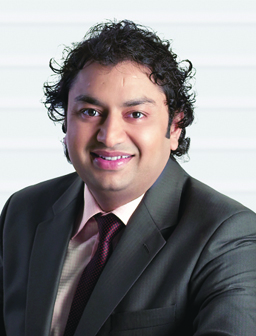
 KIRAN, the world’s largest manufacturer of polished diamonds, runs 138 factories employing a workforce of 31,000 skilled professionals annually turning out 1.61 million carats of white diamonds. The company is also engaged in jewelry production hatching over 1,000 jewelry businesses across the world, which makes it one of the top five jewellery vendors in the United States. Rajesh Lakhani, Vice President of Kiran Gems Private Limited (KGPL), interviewed by our correspondent in India Aruna Gaitonde told about the situation in diamond and jewelry manufacturing influenced by the rupee slide and layoffs, described the transformations going on in the Indian market and commented on jewelry branding and demand.
Can you give us an overview (profile) of your diamond (cutting and polishing) manufacturing unit and its output?
KIRAN Gems is India’s premier diamantaire with international reach and reputation. KIRAN has an enviable “state of the art” manufacturing strength. This ensures production of world class quality of diamonds that are stud in luxury watches, jewelleries and accessories. Given the pedigree and foundation of visionary leadership, Kiran Gems today holds the mantle of “The world’s largest manufacturer of white diamonds.”
KIRAN has 138 specialised production units, in Surat and Ahmedabad that processes over 5.7 million carats of rough to produce over 1.6 million carats of polished diamonds. A workforce of over 31,000 trained individuals makes the group the largest employment creator in the Indian diamond industry. Kiran owns 1,000,000 sq. ft. of factory space to manufacture polished diamonds.
Over the years KIRAN has received top export performance awards from Gems and Jewellery Export Promotion Council of India (Govt. of India body) for 5 consecutive years 2007-08, 2008-09, 2009-10, 2010-11 & 2011-12:
- The Highest Exporter of Cut & Polished Diamonds (DTC Category).
- The Highest Importer of Cut & Polished Diamonds in Belgium (Europe category).
- The Highest Exporter award for Export of studded Jewelry for the year 2011-12 and 2nd Highest Exporter 2009-10 and 2010-11.
IDCA has also awarded KIRAN Gems as the highest exporter from India for the year 2010-2011
Below are a few strengths of KIRAN:
1. The world’s largest group in terms of the number of specialized factories, counting over 138.
2. World’s largest user of advanced manufacturing equipment across all the factories.
3. KIRAN is recognised by all the major mining companies like DTC, ALROSA and is one of the largest and most credible buyers of rough in the world.
4. World’s largest rough diamond manufacturer using over 5.7 million carats annually.
5. World’s largest polished diamond producer, producing over 1.6 million carats annually.
6. World’s largest workforce of over 31,000 skilled professionals.
KIRAN is fully equipped to deliver products and services to customers which are proven to increase downstream efficiencies based on its unique strengths of production, custom assortment and marketing and distribution.
Apart from getting rough from DTC as a Sightholder, from where else do you source your requirements of rough diamond?
KIRAN makes its rough purchase from various miners globally, namely De Beers, De Beers Auctions, ALROSA and BHP.
How has the Rupee slide of recent days affected your rough procurements? How did you plan your production schedule, given the volatility of the present rough shortage scenario?
KIRAN is not affected any greatly with the rupee slide. Due to our global presence we are cushioned from these forms of volatility. Kiran’s production plans are as per schedule. Kiran has access to its requirement of rough due its credible rough supply partners.
News making the rounds of late that more than 25,000 workers have been rendered jobless in Surat due to Rupee fall and inability of small units to purchase roughs. Your comment.
Kiran has recently hired more workers for its various factories in Ahmedabad and Surat. It has also restructured the remuneration to match the expectation levels and attract more workers. There is a shortage of competent skilled workers.
Please, give a brief description of your jewellery unit and the markets you cater to.
KIRAN Jewels is uniquely positioned, possessing a robust procurement, manufacturing and distribution system to specialize in diamond jewellery using rounds, princess, tapered baguettes, marquise and pear shapes, and with a focused export program to the most important consumer markets in the world.
With manufacturing facilities using cutting edge technology, KIRAN Jewels has the capability to supply efficaciously, flexibly and with customisation for all customers. Our jewellery range encompasses product categories in Basics, Bridal and Fashion in gold and platinum.
1. Based on our product and marketing strength in jewellery we feature in the top 3 jewellery suppliers of US, in terms of volume.
2. Our superior quality of jewellery products enables us to service over 6000 major retailer doors worldwide.
3. The Highest Exporter Award for Export of Studded Jewelry for the year 2011-12 and 2nd Highest Exporter 2009-10 and 2010-11 from the Gems and Jewellery Export Promotion Council, the apex government body in industry.
Manufacturing Infrastructure (Diamond Jewellery)
- A 65,000 sq. ft. manufacturing facility situated in Sachin, Gujarat, India.
- Employing over 900 artisans crafting jewellery to exacting standards.
- In House Design Studio conceptualizing market specific products.
- Constant innovation in product design and manufacturing support to each customer.
- Servicing over 15,000 major retailers around the globe.
What transformations have you seen in the Indian domestic market over the years, in terms of diamond consumption (through your jewellery)? Does entry level jewellery with cheaper diamonds have a bigger market?
KIRAN believes there has been a major transformation in the Indian consumerism over the years that has percolated to tier 2 cities through the metros. Access to income at early age and information has driven this transformation. The knowledge and awareness about gold diamond jewellery has increased and so has the consumption.
Entry level diamond jewellery has a good market as it helps people try and upgrade to diamond jewellery.
How has the recent Rupee slide affected your business and smooth running of your units, given that the import costs have shot up drastically? And with the fluctuating Rupee, gold crisis etc., how do you manage to control your margins?
KIRAN has a well-balanced customer distribution globally which helps it to absorb such market aberrations. Besides, it is a temporary phenomenon and the market would adjust accordingly.
KIRAN has all its production units running as usual.
How successful do you think ‘jewellery brands’ been in the India market? Also, Indian brands don’t seem to have made much impact in overseas market. Your comment.
There are limited successful jewellery brands in India. This is due to traditional purchase behaviour. However, this is slowly changing and with focus marketing efforts from jewelers and corporate houses. As far as Indian brands making an impact on the overseas market, at B2B levels Indian manufacturing shares a great reputation. There are very few business houses, who are retailing globally. So, it is too early to comment.
What’s your take on a large section of Indian end-consumers’ preference for non-branded jewellery as against branded? Is it the price factor?
In India branded jewellery is relatively new. With high promotion and marketing of these brands people are slowly accepting and getting used to it.
Your comments on the current domestic market as far as diamond jewellery demand is concerned. And what is the trend, especially in quality/size of polished diamonds demand in today’s market?
The domestic diamond jewellery market has slowly grown over the years. With the introduction of diamonds in the fashion jewellery, buyers have access to more affordable and stylish jewellery for everyday use.
The quality, shape and size are highly region specific.
What is the current position in overseas demand for diamond jewellery? Like the USA, do you see any other countries becoming a big market for India-made jewellery?
There are stable demands from the overseas market. USA is one major big consumer of jewellery, currently there seems none of the country consuming to the tune of USA.
With gold crisis hitting jewellery sector, is ‘silver’ the ‘new gold’ now, at least in overseas markets where gold content in jewellery is not as important as to customers in Indian markets? Your views, please.
Indians have a very strong affinity towards gold. In near future it seems difficult to replace gold with any other metal. However, overseas market is open to experiment with designs and metals. However complete change of preference to Silver only time can reveal.
Aruna Gaitonde, Rough&Polished, Mumbai
