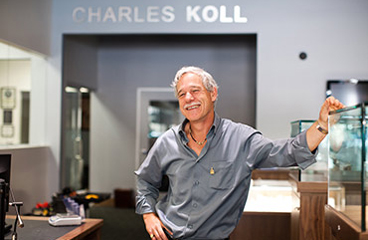
 The modern and creative jewelry store of Charles Koll Jewellers is located in San Diego, California. It features a jewelry manufacturing studio and a product gallery. A fully equipped manufacturing studio is separated from the jewelry store with transparent glass. Customers can observe and participate in the creation of their jewelry whilst enjoying coffee and mingling with the friendly staff. Named one of “America’s Coolest Stores” by InStoreMag.com, Charles Koll Jewellers is the jewelry store of the future. Malcolm Koll, CEO of Charles Koll Jewellers, answered questions from Rough&Polished in an exclusive interview.
Please tell us about your store. What makes Charles Koll Jewellers special?
The store as it is now changed two years ago and it became the model that we had visualized twenty two years ago which was to have a manufacturing facility in a retail environment.
Another point of differentiation - most of our jewelry is unique, one-of-a-kind pieces created for a specific person. If you are in a shopping mall, every jewelry store is just flogging jewelry that they buy elsewhere from the big brands like Tiffany, who are producing out of China, to Ben Bridge. Everybody is just importing, chasing price points and ignoring what the industry really is.
How did you come up with this idea to combine a retail space and on-site jewelry manufacturing studio?
I think it is driven by the fact that if at heart you are a manufacturing jeweler, then adapting the manufacturing environment to work inside a retail environment is a natural progression.
I understand that unlike most of the retailers, you do not buy jewelry from wholesalers and distributors. You are making your own pieces. How does it benefit your business?
We manufacture about seventy percent of what we sell. It unquestionably differentiates us from the competition. It does not present bigger margins because labor costs in the US are so much higher than everywhere else in the world. It is obviously a lot more cost effective to import jewelry that has made using inexpensive labor.
The big difference is that we make one piece at a time and we do not mass produce anything so every piece we make is made for someone.
How many pieces do you produce every month?
Full blown custom pieces, probably seventy five. A good percentage of what is on display in this store is also manufactured here.
What makes your jewelry unique and different?
It is the team. We are employing eighteen people who are continuously challenging each other. We run two full time CAD stations so the creative element is there. Everybody on the sales floor to the workshops are involved in the design process. Anybody can come up with a concept then it gets tweaked and pushed and pulled until it becomes something really unique.
What is the principle of “total transparency for customers”?
Every jewelry store you walk into tells you them will do custom work and you will explain what you want and they will send off their sketches to somebody else and they will hopefully do a model of it. Somebody else will cast it and somebody else will set it, you just totally lose control in that environment.
In terms of transparency, we actually itemize a custom job from the cost of originating the concept to the cost of building the model to the physical weight of metal and the elements that will be used. The value of the piece is derived by combining all those elements and that is done on the fly, with a customer in real time.
You once mentioned that you have customers who stayed with Charles Koll for many years, and the customers who used to buy for $3,000, now can afford to buy a $30,000 piece of jewelry from you. What is your best advice on how to retain customers and grow your business with them?
Deliver beyond their expectations. It is important to recognize that people do not buy jewelry in order to spend a lot of money. They buy jewelry in order to commemorate something that is very important in their lives. If very important in their lives is represented by a very small budget, it should be respected the same way as a person who is spending a lot more money.
How have your customers changed in terms of age, gender, demographics?
Until two years ago, our customers, like me, were getting older. My son Richard joined me two years ago and that brings a different dynamic to the business and a much better understanding of how you market a retail store in these times.
Speaking of marketing, do you think that the industry needs generic advertising for diamonds in the US?
The De Beer support went away 5-6 years ago in terms of advertising. I am sure that has had some impact. The movement without that support has shifted rapidly from the romance of diamonds to commoditization of diamonds. I think that is negative for the industry in the long term but it is a reality so you deal with it.
I am not obsessed with selling diamonds. I think there are lots of gemstones out there that are as pretty or prettier than a diamond. The reason that diamonds are the general choice is because of the durability above anything else. There is no other gemstone that is even close to as durable as a diamond. It is logical that for bridal jewelry or something that is worn every day, a diamond is appropriate.
Do you sell more bridal or fashion jewelry, color or diamonds in your store?
We are predominantly diamonds. That is the nature of the industry and of the diamond jewelry we sell, it is probably sixty percent bridal.
Hearts on Fire is probably the only diamond jewelry in your store that you do not manufacture yourself. Why them?
That is very high end. When the dust settles, the realization is that we are in a shopping mall and we are competing with, in our case, Tiffany’s and Neiman Marcus. For a client who is a Tiffany type customer, who is very brand conscious, carrying a recognized international brand is value for us.
Your store is located in the biggest shopping mall in San Diego. Are there any downsides of being in a shopping mall?
One of the first is the public perception that you are in a high rent district, therefore your prices must be much higher to compensate for that. I remind people that if I was in a five hundred dollar a month poor location, my volume will probably reflect the location. My rental never represents more than seven percent of my gross sales. I am in the correct location.
In your opinion, what is the state of the industry?
I think the industry is becoming polarized. The old US model was to have large chain stores like Zale’s or Kay’s who primarily were in the business of selling credit. It is fascinating to go into those stores and ask for a price on an item. You get a quote in terms of how much it will cost per a month as opposed to what the cost of the piece is.
That model is threatened by the abundance of credit cards on the market and the fact that credit card companies are getting a lot more realistic on the interest rate that they charge. I think that model is also threatened by companies like Costco or Wal-Mart who are selling a similar quality product at a much more competitive price.
That end of our industry is changing rapidly and it will probably go away. The high end is made up, in my opinion, of two different categories of people doing what we do, which is building one piece at a time for a specific person. Then there are the big brands like Tiffany, Cartier and Harry Winston who are essentially building their product and hoping that people will respond to it because it is their product.
What do you think about the Conflict Minerals Regulations, conflict gold in particular?
My opinion is that sanctions do not work. That invariably, they hurt the people that they are designed to help. I believe that there are much more efficient and effective ways of controlling production then sanctions.
How do you ensure that the gold and diamonds that you use come from responsible, conflict free sources?
To the extent that we can in the United States. Obviously, we have signed on to the Kimberley process and support that strongly but to the extent that I can only trust the person I am buying from to have the same ethical standards.
We are also a member of the American Gem Society, Jewelers of America, Society of North American Goldsmiths and other organizations.
What is your outlook for the upcoming holiday shopping season?
If you had asked me the question two months ago, it was hugely positive. The US government shutdown and the consequent drop in consumer confidence makes me a little bit less positive about it. The industry is projecting a thinner Christmas then we had last year. I am now projecting that we ought to hold or marginally increase on last year’s numbers.
Olga Patseva, Editor in Chief of the American Bureau, Rough&Polished
