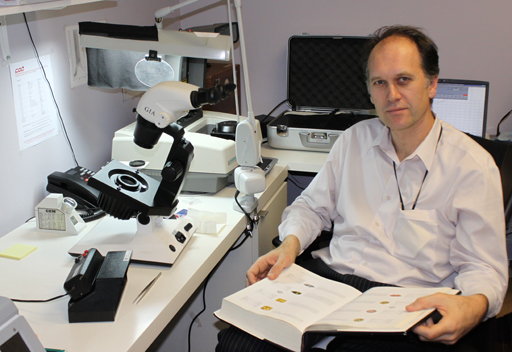
 Branko Deljanin, B.Sc., GG, FGA, DUG is head gemmologist and president of CGL (Canadian Gemological Laboratory) in Vancouver since 2009. He is a research gemmologist with extensive experience in advanced testing of gemstones. He is a Fellow of the Gemmological Association of Great Britain and was instructor of their FGA, DGA Programs. Since 1999, he has focused on the HPHT process for changing the colour of diamonds and is considered an international expert on identification of new diamond treatments and synthetic diamonds. In 2001 he earned his Advanced Gemology Diploma (DUG) on subject “Identification of HPHT treated diamonds” from University of Nantes, France. Branko has conducted on-site research on gems and coloured diamonds in Sri Lanka, Russia, Brazil and Australia, and has managed many projects on natural, treated and synthetic diamonds with international team of lab gemmologists.
Could you say a few words about the laboratory you are currently in charge of?
CGL-GRS Swiss Canadian Gemlab Inc. (former “Canadian Gemological Laboratory – CGL” founded in 2009) is a full service laboratory located in Vancouver, BC, Canada.
We offer a multitude of services to North American trade including:
- Testing and Certification of Diamonds, including Coloured and Synthetic Diamonds
- Grading and Lasering of Canadian Diamonds
- Identification and Certification of Gemstones and Pearls
- Professional Appraising of Gemstones and Jewelry
- Research and Education services on 5 continents
For more information on staff, gemological team, research papers and articles published by me and other researchers in gemological and trade magazines please visit the CGL website.
After CanadaMarkTM diamonds hit the market Canadian diamonds gained greater prominence. Are they really different from other diamonds mined around the world? And if they are, in what way gemologically?
Canadian diamonds are similar to diamonds to other countries and based on gemological properties it is not possible to separate them when they are polished, although we noticed that the majority of them do not fluoresce or have weak fluorescence. Coloured Canadian diamonds are extremely rare, most of them are near-colourless and colourless.
Do you think it is possible to distinguish diamonds mined in Canada from diamonds recovered in other parts of the world and is your lab able to do this?
When examined in rough state it is possible in some cases to separate rough diamonds coming from Canada from other sources based on different morphological characteristics. In the case of polished diamonds our lab cannot separate them gemologically with the instruments we have available.
What kind of other gems do you grade?
We grade only colourless, near-colorless and coloured diamonds (natural, treated and synthetic), but identify pearls and any gemstones, including their treatments, and determine natural or synthetic origin. We use standard and advanced instruments for testing like VIS-NIR and FTIR spectrometers (for example for Jade testing that is very popular in Vancouver because of large Asian community that appreciate jade).
Ekati and Diavik, launched in 1998 and 2003 respectively, are Canada’s major diamond mines which appear to be past their best days. Do you think the newer mines, such as Snap Lake or Gahcho Kué, will be able to reverse the situation?
Latest diamond mine Viсtor opened 2008 in Ontario by De Beers (the annual production is 600,000 carats a year in diamond grade) and Canada is now third largest producing country in the world (after Botswana and Russia) by value of diamond produced. 50% of world diamond exploration is done in Canada in last decade resulting in many kimberlites with diamonds and some of them could result in another mine if Stornoway Diamonds Inc. decide to go ahead with plans with their property at Otish mountains in Quebec.
Now that synthetic diamonds appear to be a threat to the market of natural diamonds, what kind of methods are used to identify them and what was the contribution of your laboratory in this regard?
As a director of Identification and Research at EGL USA I designed the FIRST certificate for Synthetic Diamonds in 2000 and co-authored book “Laboratory-Grown Diamonds” in 2007 that sold over 2,000 copies in English and over 500 copies in Portuguese (Russian version in preparation). I also co-authored a booklet “Identifying Diamond Types and Synthetic Diamonds with CPF (Cross Polarized Filters)” 3 years ago and teaching Advanced Diamond programs in North America, Europe and most BRIC countries (did at Gemological center at Moscow University in 2010). At CGL-GRS labs we use UV lamp and Cross Polarized Filters for screening of Diamond types and VIS-NIR, FTIR and PL spectrometers for final identification of Synthetic Diamonds. GRS and CGL-GRS labs just finished 2 research papers on “Identification of New Generation of Synthetic Diamonds: CVD-Grown Blue and Pink Diamonds” that are published in latest GRS “Contribution to Gemology” and GRS website.
Do you think the time when jewellers could use their loupes to identify natural diamonds passed?
YES, even in my 2007 book “Laboratory-grown Diamonds” I declared that examination with the loupe is not enough anymore because based on my 15 years of research and database, over 60% of synthetic diamonds are VS clarity or higher. More and more diamonds are grown by CVD technology that brings higher quality diamonds and makes it impossible to identify even with a good microscope.
Does all this mean that certification comes to the forefront in diamond trading?
Yes, not only larger 0.50 ct + diamonds need certification now but also smaller and melee diamonds that are tested and certified in parcels in gem labs. Coloured diamonds cannot be sold without certificates and more and more colourless diamonds of any size need accurate reports as well.
May it be that the synthetic threat will make people mostly focused on certificates accompanying diamonds, thus increasing competition between laboratories?
Gem labs around the world are competing in designing instruments and techniques for screening and testing large number of diamonds expecting to come for testing for natural or synthetic origin. GRS and CGL-GRS laboratories decided that these challenges need a strong answer and hence founded a network of 3 diamond research laboratories in Switzerland, Hong Kong and Canada to cooperate with the goal of becoming the premier task force for research and discovery of the latest arrivals of new diamond synthetics and treatments in the competing arena of major laboratories in the world.
However, legitimately traded synthetic diamonds are gaining their own niche in the jewelry market. What is the situation with grading such stones? And are they sold in Canada?
Yes, a new generation is more open to buying laboratory-grown diamonds as an alternative to natural diamonds because they like the idea of “conflict-free” and also more affordable diamonds. We regularly see synthetic diamonds coming to lab for certification, but still they are very small part of our lab business. One Canadian company is cutting HPHT-grown diamonds grown in Russia and CVD–grown diamonds made in USA and they can be found in jewellery stores in Canada. Canada is also home of AOTC (Advanced Optical Technology Corporation), which developed Russian based HPHT technology of growing diamonds in Netherlands and is selling coloured and colourless diamonds in North America and Europe. Their owner Alexei Zarakhani opened the FIRST Jewelry Store, which sells only laboratory grown diamonds in North Carolina under brand D.Nea.
What is your view of the jewelry market in Canada in 2014?
Canada is a very stable market for jewelry of all kinds, but Canadian diamond jewelry is doing very well. Special coloured stones are also sold with gem reports, but the majority of lower priced coloured stones are sold without gem reports and without disclosure of colour origin. Our lab also grades, tests and lasers Canadian Diamonds set in jewelry. In the beginning of 2014 we noticed a movement by some wholesalers and retail chains who have started to grade, laser and issue certification on their own Canadian Brands in order to save money by leaving independent labs out of picture. We have also noticed a higher interest in larger loose coloured diamonds (pink, yellow, orange, “cognac” and “champagne”) bought for investing purposes for their rarity of colour and clarity. Our lab specializes in coloured diamonds and we issue reports with or without values for private clients as well as retailers. Jewelers in Canada need more information on diamonds and gemstones, and that’s why I am a regular contributor on GEMMOLOGY column in Canadian “Business Jewellery” magazine. My latest article published last month, “A Closer Look: Screening Synthetic Diamonds with Standard Gem Instruments” is reflecting the current problem for the Canadian jewellery industry.
Vladimir Malakhov, Rough&Polished
