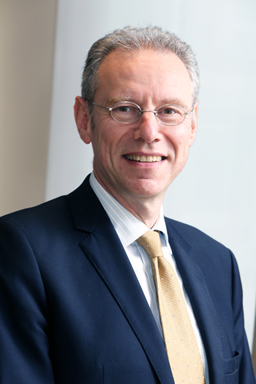
 Last Wednesday, the Antwerp World Diamond Centre (AWDC) launched an exclusive Antwerp Diamond Night hosted by the Belgian Embassy in Moscow and attended by a number of top managers fr om Gokhran of Russia, ALROSA and other stakeholders of the Russian diamond industry, as well by a whole gamut of Antwerp diamantaires, who used this opportunity to maintain their established ties and strike new partnerships. Stéphane Fischler, President of AWDC, who was on a visit to Moscow for this occasion, gave an interview to Rough&Polished speaking on the role played by ALROSA in the Antwerp diamond market, the AWDC’s activities this year, the Kimberley Process definition of ‘conflict diamonds’ and human rights, polished prices and the diamond trade in general.
Rough&Polished: The Antwerp World Diamond Centre (AWDC) has quite a busy calendar of events this year, one of them being the Antwerp Diamond Night in Moscow on March 12 in the presence of the ALROSA Executive Committee members. What is the immediate benefit of this event for its participants?
Stйphane Fischler: The aim of this meeting – it is its second edition as you know - is first of all to re-confirm the very close ties we have with the ALROSA Mining Company. ALROSA is, I would not hesitate to say, our main mining partner in Antwerp, with more than 65% of the mining output of ALROSA being distributed to sightholders and non-sightholders Antwerp-based companies. ALROSA being the largest miner in the world in terms of volume, you can easily understand how important this relationship is for us. The opportunity of this evening is really for the benefit of our Antwerp-based diamond companies. To give them an opportunity to meet the ALROSA management, to introduce some companies, which haven’t been in Moscow yet, giving them a chance to become second-tier customers and in the future maybe to become first-tier companies. That’s certainly the aim of this evening.
The AWDC business schedule also includes the AML & Compliance Seminar to offer an AML ‘best practices’ guide, tailor-made for the diamond industry. Does it have any relation to the recent FATF report on possible occurrence of money-laundering activities in the diamond sector?
It’s not the first such seminar. These seminars have been organized already for a long time. I believe around 200 companies have already been following those seminars and received the certificate of attendance. The current seminar and the future seminars are fully booked. So, it was done well before this FATF study.
On this FATF study it’s important to understand also that the perception around the study is a little bit skewed in a sense that people seem to think that the FATF study is a kind of general audit of the diamond industry in terms of compliance, which it is not. It’s a typology study. So, I think there’s a kind of confusion around this report. We do welcome the report, as any reader can determine that Antwerp has made tremendous efforts in general compliance with anti-money laundering. We do believe being well ahead of other centres, is not an ideal situation. We always look for a level playing field especially on compliance issues. And we believe it is essential for the business.
The Antwerp Diamond Manufacturers and Traders Fair “Antwerp Meets Antwerp” held at the start of this year may be an early and important probe into the state of the global diamond industry. In your view, what are the first indications?
Well, let’s look back a little at how this ‘Antwerp meets Antwerp’ initiative came into being. It is an initiative of the Diamond Bourses in discussion with some of us, at AWDC. The role and mission of the AWDC, representing the whole sector in Antwerp, is to support any value added initiative. We are happy to support the bourses’ initiatives, like the Antwerp Diamond Trade Fair, which this year was very successful. Also the regular fairs, in the trading halls for all Antwerp diamond dealers, are excellent events that we, at AWDC, are most happy to “power”.
What is your take on Belgium's resolution to the European Commission on the Kimberley Process calling to formulate a definition of ‘conflict diamonds’ addressing human rights?
Let me put this a little bit in a context. A few parliamentarians have made a recommendation to the Belgian Parliament. It’s a two-part recommendation. One part is in support of the Kimberley Process and the other part in support of the enlargement of the definition of the focus of the KP. So, that’s the context. It was not a recommendation by the Belgian Government. It was a recommendation by certain parliamentarians to the Belgian Parliament itself.
Now let’s talk about the idea of enlarging the KP definition. We have always said that the success of the KP was in large part due to its narrow focus. I think it’s important to understand that the focus of the KP is what has made the difference. We all remember the critical situation the people of Liberia, Angola and Sierra Leone were facing. It was a very tough situation. If you look at the history, the evolution and solutions that we brought on the ground, we are still the only commodity that has reacted as we did looking at these atrocities being committed in Africa fuelled by the profit of diamonds. So I think that as an industry we can and must be proud of these achievements.
Nevertheless, there is an ongoing debate to do more, and to specifically address human rights issues. We believe it’s important but in order to be successful there needs to be a balanced solution to address those issues. We do believe that the KP is not armed to take on this kind of broad human rights issues. We believe it is best served through a bottom-up approach. Meaning that the solutions must be devised on the ground, where the challenges are. We do not believe that the solutions must be only concocted in offices in New York, Antwerp or Mumbai. It’s in Africa, with governments partnering with mining communities and so on, wh ere the solutions must be found.
It is very important to understand that there are bodies today that are dealing with human rights, like the UN and others that have the necessary skills and resources and are in much better position to provide solutions. So, a bottom-up approach, not a top-down approach. That’s really what we are proposing.
But that seems to be a long way…
I agree. But it depends on how you see time yourself. If you look at other commodities and what they have achieved till now compared to what we have achieved, I believe it’s always too long when you deal with human rights issue. Let’s not forget also that the strength of the KP, and for some it is its weakness, is the vast number of member governments, with for example, Eastern and Western conceptions around human rights… So, a respectful dialog is essential. Understanding the various points of views without losing track of what we collectively try to achieve. We know that for example China and Europe have a different set of priorities around human rights. We hope to bring together those views and to put them into practice on the ground. The diamond industry and the NGO’s are observer parties but do have an important role to play. But it’s essentially through specialized bodies like the UN that we can find long term solutions.
According to media reports, Mr. Karl van den Bossche, Belgium’s Consul General in Mumbai, during a recent visit to Surat promised easy bank financing and tax relaxation to small and medium diamond traders from Surat in particular and Gujarat in general. Could you comment on this?
I wasn’t there, so I cannot really comment on what our diplomat said. I believe that the Consul General in Mumbai probably meant that there is a tax structure in Belgium that is currently being looked at and that hopefully will evolve into something more competitive and will hopefully interest new Indian companies to come to Antwerp. I think you have to see that within this context. In terms of giving particular incentives to particular groups – this is not part of our agenda.
That story had an echo in Luxembourg…
That is what I was told. Yes.
Do you think there is any possibility of emerging a new diamond centre in Europe, if similar tax benefits and easy bank financing will be offered to entice diamantaires?
Well, easier financing and taxation is only one part of a puzzle, which is called "infrastructure". To put a strong trading centre in place you have to build a very solid and huge infrastructure. The latest centre that has come up in the last 15 years is Dubai. Now, if they like to have the bill that Dubai footed… I don’t think Luxembourg is ready today to foot this kind of bill…To build a world class infrastructure like we have in Antwerp it takes many, many years and a lot of effort and commitment. So, it’s nice to hear that other parties in Europe are willing to invite diamond traders. As we have always said that diamond business is not a zero-sum game. We welcome any new initiative, any new trading centre that will contribute to the strength of the business.
It appears that in recent years the growth rate of polished prices is lagging behind that of other luxury goods. In your opinion, what should be done to realign polished prices with prices for other luxuries?
Well, it’s a question that comes up in every single interview. And you will probably receive the same answer that you got from my colleagues all over the world. There are two issues. Yes, there is a de-coupling between the prices of rough and the prices of polished, because the demand and supply dynamics are totally different. They should not be, but they are different, because the kind and number of players, the financial strength involved in both markets are different. That’s the first observation.
The second observation is that we do not have generic marketing as we used to have as when De Beers was “generously offering” it to the diamond industry to the tune of 200 million dollars a year. In support of their own interest of course…As you know, the most successful campaign ever for any product has come from De Beers. We still enjoy it to this day.
But yes, it’s a big gap in the demand equation, this is lack of generic marketing. There are initiatives like the World Diamond MarkTM trying to address this challenge. Of course, we welcome that. And hopefully, they will be successful.
But I think that this industry must come together most forcefully in terms of finding the strength to finance generic marketing, in one way or the other. It’s very frustrating for everyone that it hasn’t materialized yet. We haven’t lost hope, I think there may be new initiatives in the future that will come up, but that’s certainly part of the issue.
Another even more critical issue is, as one commentator put it, the "glass ceiling" that the industry has burdened itself with, the Rapaport Price List.
Now how to remove that from the equation is a very difficult issue indeed. It is also because, I believe, there is not enough independent, strong and objective data around. I hope this will change soon. We need to attract new financial models to the industry and without appropriate data you won’t. That is something we need to work on and are working on.
What is the general state of the Antwerp diamond market at the start of this year and, if possible, your forecast for the rest of 2014?
I believe the first time I gave an interview as president was with Rough&Polished. And I don’t know if you remember, I said “watch this space”.
I modestly believe, that we have made an impact in the last couple of years by the new initiatives we’ve taken. If you look at the numbers, more rough comes to Antwerp than even before. By and large, we are still the largest trading platform for rough diamonds. We have been able to strengthen that even more. On the polished side, there are the new initiatives, customers are finding their way to Antwerp once again thanks to the Bourse’s trade fairs. And we will continue to support these.
Yes, there is a good mood in Antwerp for the moment. And as you know the diamond market is sometimes, unfortunately, much, too much “short-term” in terms of how people look at it.
The Hong Kong show was positive. People sold, and hopefully better liquidity will be restored.
One of the biggest challenges to the industry is of course access to finance for the industry. We have to make sure that our current bankers view us with a better risk profile in the future. So, we have to work hard on this. I believe we have made progress in Antwerp. And yes, that’s really our ongoing mission.
Rough prices overall are strong, polished prices are stronger as well but not for all categories. How will the consumer markets behave in the next six months? America looks promising. Europe I wish I could say is promising, but we are still slowly, slowly emerging from the crisis. Judging from the results of the Hong Kong show, China, Eastern Asia, India are doing well, better than at the end of last year. So, more or less it’s an optimistic picture.
Now, the geopolitical situation in the world is challenging and not in our hands of course. It could seriously impact the financial markets and consumer behavior. We can only hope that dialogue and mutual respect will prevail and hopefully these crises will be resolved sooner than later.
Vladimir Malakhov, Rough&Polished, Moscow
