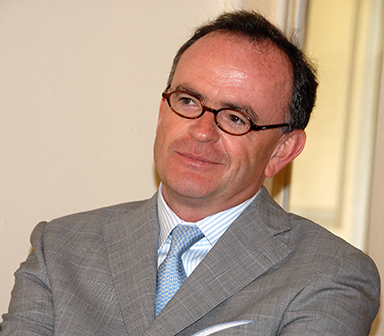
 The issue of investment diamonds has become particularly clamorous during recent years. While experts continue to debate whether it is possible to turn diamonds into a popular investment tool, Singapore launched the first Singapore Diamond Investment Exchange (SDiX), which is doing quite a brisk business. Its Executive Chairman and founder Alain Vandenborre gave this interview to Rough&Polished where he shared his vision of diamonds as an investor, described the work of the Exchange and told about the existing obstacles for and potential prospects of investment diamonds.
In your opinion, what makes diamonds a good investment idea?
Diamonds offer moderate to low volatility return compared to most other asset class and yet they represent a store of value as prices have historically been growing and will continue to do so in the long term due to an expected shortage of supply, while the demand for diamonds is increasing by a double digit in India, China and other emerging markets.
Please explain how investing in diamonds works with SDIX? Are we talking about physical investment, ETF or some sort of diamond derivatives?
We are talking about physical investment. We build up portfolios proposals for our clients where we simulate each stone and the total portfolio price behaviour fr om the past 10 years to the present time and we benchmark the portfolio with other assets classes like bonds, equities, real estate, gold, etc. By assembling stones of different size, color and clarity in a portfolio, we can simulate the pricing and volatility of that specific portfolio: moderate growth and low volatility or higher volatility and higher growth in value.
We also disclose fully our purchase price and our margin to our clients, something unheard of in the diamond market.
Once the clients has approved the composition of the portfolio, we finalize the negotiation of the portfolio usually resulting in improving the purchase price once we have secured the clients’ money to buy.
We then issue periodic valuation reports made by independent experts.
We are therefore NOT talking about ETF or derivatives, but portfolios of physical diamonds purchased by the investors
Can your customers take physical possession of the diamonds that they invest in?
Yes, absolutely but we also offer them the option to store them in a few Freeports and Free Trade Zones like Monaco Freeport, Geneva Freeport, Singapore Freeport, Hong Kong and Shanghai Free Trade Zone.
Stones are always stored with a specialized diamond logistic company like Malca-Amit, Brinks or Ferrari Logistics who act as a custodian for the clients. SDiX usually do not have access to the client’s diamonds unless the clients give us a proxy for practical reasons (remote geographic location of the client, for example).
What is the SDIX’s marketing strategy? How do you market diamonds as an alternative investment asset?
SDiX is a private diamond exchange offering the opportunity to financial investors to invest in portfolios of physical diamonds, a moderate to low volatility priced commodity by resolving the largest barriers for investing in diamonds:
(i) Access to buy and sell diamonds in the wholesale market
(ii) Pricing and margin transparency (this is unheard of in the diamond world)
(iii) Complexity of assessing and pricing each stone as well as valuation of portfolios in a reliable and independent way
(iv) Difficulty for resale: we are currently working on various liquidity mechanisms but usually advise our clients to hold on their portfolio for 3 years
(v) Providing full storage, door-to-door shipment and insurance
Unlike other diamond exchanges in the world, which are dedicated to diamond traders, SDiX offers its services to professional investors. As such, SDiX is not a member of the World Federation of Diamond Bourses but is monitored by IE Singapore, the Singapore Government Agency regulating the commodity market. For now, SDiX is exempted for being licensing as it deals only with accredited investors, i.e. investors having a minimum net worth of $2 million in liquid assets.
Diamonds are not a traditional commodity: each stone is different, which presents a significant difficulty in pricing diamonds. How do you overcome this challenge?
We have in-house diamond experts and pricing specialists. We also work with partners and existing database like Polishedprices.com to allow us to establish the pricing behaviour and volatility of each stones versus other asset class.
For example, we are capable of establishing the Beta coefficient of each type of stones versus its pairs or the diamond index. This give us a measure of the risk-return of specific stones versus the overall diamond market. SDiX is also developing mathematical models, which will allow us to navigate more intelligently into the wholesale market and detect pricing and supply or demand discontinuities.
Which grading authority are your diamonds graded by? Wh ere do you source them from?
We source stones exclusively graded by GIA and we work with a dozen of wholesale suppliers and sight-holders.
Are you or will you be in competition with the Rapaport Group that started to offer investment diamond services not long ago?
We are a two years start-up compared to a prestigious group like Rapaport to whom we are also a registered client to access their online inventory Rapnet. We are not aware of Rapaport offering investment services yet and if they do, it can only help us and the community of people who believe diamonds can be an investment commodity asset class.
I am a strong believer of open systems and open architecture. Everyone will win at the end of the day if we can persuade investors to come into this asset class. It will open a new distribution and sales channel that the diamond industry dearly needs to evolve.
Please tell us about the partnership between The Singapore Diamond Exchange and IDEX Online.
We have a working relationship with IDEX. At the beginning, we thought this would be a way to go but it turned out that all portfolios we have sold in the past 15 months are composed of large stones, which do not usually show enough on either of the known diamond inventory websites, so we had to build our own procurement and sourcing capability. However, IDEX is a tremendous source of information and we have commissioned several research works for us in the past.
Financial Action Task Force (FATF) recently released an international report on Money laundering and terrorist financing through trade in diamonds. In your view, what can be done by the diamond industry to eliminate or reduce risks of money laundering and terrorist financing? Are you required to implement Know Your Customer and Due Diligence policies?
I think this report was grossly inaccurate and has led to strong reaction from the Word Federation of Diamond Bourses and other diamond groups like Antwerp Diamond Center. We have always implemented KYC procedures for all our clients. This was not required by our regulator in Singapore but we have always done it voluntarily and because it only make sense if you are or want to become a professional exchange
What is your outlook for diamond investment demand this year and in the coming years?
Diamond Investment is a new topic. It has attracted public awareness in the last two years. It is difficult to predict yet how far it will grow. The annual market for polished diamonds is about USD 22 billion.
I do not believe the total amount of investment diamonds has reached or exceeds USD 1 billion today. A lot of people are working on ETFs (not SDiX however) and this could be a game changer. I think the biggest barrier to overcome for any investors remain price transparency and liquidity. The diamond industry has a long way to go to improve these two key factors but we hope to be one of the several vectors of change for the benefit of the industry.
Olga Patseva, Editor in Chief of the American Bureau, Rough&Polished
