 Ricardo Martinelli, President of the Republic of Panama, the leaders of the world diamond and jewelry industry, and about 200 members of the trade from Latin America and other parts of the world gathered in Panama City last March to celebrate the launch of the Panama Gem & Jewelry Center, which will be the first specialized platform for trading in diamonds, colored gemstones and jewelry in an area embracing South and Central America, Mexico and the Caribbean. The Panama Diamond Exchange will be its major organization.
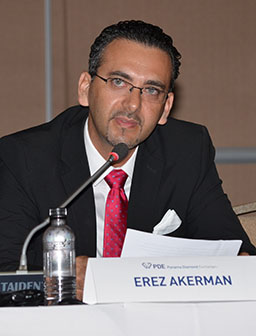
Erez Akerman, President of PDE, told about the Panama Gem & Jewelry Center in his interview to Rough&Polished.
Could you please introduce the Panama Diamond Exchange (PDE) to our readers?
The Panama Diamond Exchange was formally established in 2006, and in 2008 was accepted as the first and only member of the World Federation of Diamond Bourses (WFDB) from Latin America. This means that it is the only diamond exchange serving a region that covers South America, Central America, Mexico and the Caribbean. In setting up PDE, our mission was two-fold. First, we wanted to provide a secure and structured trading facility that would meet the specific requirements of the diamond, colored gemstone and jewelry sectors of Latin America, providing them with the range and volume of merchandise that over the years they have only have been able to obtain by traveling outside of the region, and a business friendly environment in which they are able to operate in the languages they are most familiar with.
Second, we wanted to offer an access point for dealers, traders and buyers from around the world to reach all of Latin America, which already is a jewelry market worth $8 billion a year, and is set to grow significantly in the coming years. At the end of last year, construction began on a complex located between Panama City and Tocumen International Airport called the Panama Gem & Jewelry Center. It will serve as the headquarters of PDE, and will be the only dedicated diamond, colored gemstone and jewelry trading facility in all of Latin America. The first stage, which will include a facility housing PDE, will be ready before the end of this year.
In your view, what are the prospects of Panama as a center of commerce and as a diamond center?
Panama already serves a trading hub for Latin America. Geographically it is strategically located, actually traversing the border between Central and South America, making it an ideal location for quick access to all the countries of the region. Panama’s financial and services sector accounts for more than three-quarters of the country’s GDP. The country is one of the region’s largest banking centers, one of the most important logistic centers, and, of course, it controls the most traveled waterway between the Atlantic and Pacific oceans. The Panama Canal presently serves more than 14,000 ships a year.
Panama’s government strongly supports our mission and has acted decisively to provide a legal and commercial environment in which the gem and jewelry business will flourish. This includes joining the Kimberley Process in 2012, and, significantly, passing legislation that will recognize the area of PDE and the Panama Gem & Jewelry Center as a Free Zone, which means that all business conducted within in its confines will be exempt from customs, duties and taxes, and corporations that are registered there will also be exempt from paying company tax.
I can confidently state that with the physical infrastructure that is being created, with our advantageous customs and tax status, with the already existing banking and financial services, and with the presence of the region’s only internationally recognized diamond bourse, Panama will undoubtedly serve as Latin America’s primary diamond center for many years to come.
Could you give some figures to show the scale of regional jewelry trade?
Current annual demand for jewelry and gemstones in Latin America is worth more than $8 billion. They sold through more than 11,500 jewelry stores across the region. Furthermore, there are more than 320 mining companies and almost 750 wholesalers of diamonds, precious stones and jewelry.
What are the mid-term and long-term prospects for the regional jewelry trade?
To understand this, I think we should look at some of the demographic data we have at our disposal. By 2020, Latin America’s middle class will represent the majority of consumers in the region, and as we all know the foundations of a developed consumer economy is based on the middle class.
What we are already seeing is that, as disposable income and purchasing power increase, Latin American consumers are become more discerning, discriminating and demanding in their tastes and expectations.
The region is home to a growing number of consumers with higher purchasing power. In terms of in luxury consumption, the Latin American market is forecast to see growth of 14 percent. To put that into perspective, it is just slightly below Asia’s growth rate of 16.5 percent.
Do you feel PDE has any competitors around? Who are your long-term partners and whom are you planning to attract?
As a diamond center in Latin America, Panama has no rivals, because there simply is not another recognized diamond exchange in the region, nor a dedicated facility like the one that is being established at the Panama Gem & Jewelry Center.
But it is important to point out we are not interested in competing in Latin America. On the contrary, our mission is to serve the Latin American markets, so that they may grow and develop. Panama is not and will not be one of Latin America’s leading jewelry consumer markets. The country’s population is too small for that. But we are committed to being the leading trading center, and the springboard for international companies into the region. This means we aim to attract all the participants in the Latin American industry, from mine to retailer, and all international companies wanting to do business in one the fastest growing markets in the world.
Do you have interest in diamonds from Russia?
Of course we do. As one of the world’s leading producers of rough diamonds and as a major diamond cutting center, it is imperative that Russia be involved in the Panamanian and Latin American markets. I would note that Russia was well represented at the official launch of the Panama Gem & Jewelry Center last month. Among the industry leaders attending were Maxim Shkadov, president of both the Russian Diamond Manufacturers Association and the International Diamond Manufacturers Association, and Alex Popov, President of the Moscow Diamond Bourse.
Do you have any problems, which should be solved by the world’s common efforts? What should we do together in the industry?
I firmly believe that common effort by the various centers around the world produces the best results, and it is for this reason that PDE is a member of the World Federation of Diamond Bourses, the World Diamond Council and CIBJO, the World Jewelry Confederation.
Our industry has been remarkably successful when it comes to joining together to tackle problems that cross borders, with the most notable example being the Kimberley Process. But there are other issues that require joint solutions, and these include synthetic diamonds, disclosure of treatments, precious metals and colored gemstones from conflict areas, and more.
To the degree that we can create our own structures together, the more likely it is that we will dissuade governments and other international organization to become directly involved, and at the same time enhance consumer confidence in our products and our business community.
What is your view of synthetic diamonds?
I believe that my view reflects the general opinion in the industry today. While synthetic diamonds are a legitimate product, a distinction between them and natural diamonds needs to be drawn. The two can live alongside each other, but as different categories. Most important, the consumer needs to understand this. Disclosure is critical. The situation in which consumers purchase synthetic diamonds without realizing that they were created in a factory, as opposed to being formed in nature millions of years ago, will undermine diamonds in general. We need to create international agreement that anyone who knowingly sells a synthetic diamond without clearly describing its true origins will be punished severely, including expulsion from the trade. This is something that we need to do together.
Alex Shishlo, Editor in Chief of the European Bureau, Rough&Polished
