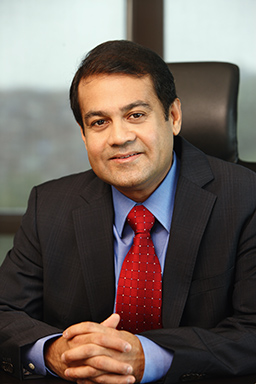
 Colin Shah is the Managing Director of Kama Schachter Jewelry Pvt. Ltd., a position he has held since inception. Colin established Kama Jewellery in the year 1996 and was responsible for the successful joint venture with Leo Schachter in 2007, to form the New Company Kama Schachter. Under Colin Shah’s leadership, the team at Kama took critical steps to drive profitability, gain global market share, improve product quality, customer care standards and consistently invest in technology.
In an interview with Rough&Polished, Colin expresses his confidence that India-made jewellery will establish a much stronger position in the global consuming markets in the future and that the local Indian market will grow by the day. And, does he think demand for diamonds in India will increase in future? ‘India’s appetite for diamonds will never dry’, he asserts...
Can you take us through Kama Jeweller, fr om the inception to its present status as Kama Schachter as a diamond /jewellery manufacturer and exporter and domestic retailer? Also, how is your company faring in the e-commerce space, given that it is crowded already?
Kama was established in 1996 and has been involved in manufacturing, marketing and distribution of diamond jewellery in all major markets for the past 17 years. Kama Schachter is amongst the top 10 diamond jewellery manufacturers in Asia. Our focus markets are the USA, India and China and we have successfully launched six private labels in India and the US. We are the recipient of several accolades, the most prominent being the ‘Largest Exporter of Diamond Jewellery’ out of SEEPZ for four years, ‘Emerging SME Award’ and ‘Udyog Ratna Award’.
What began as an entrepreneurial venture in a modest factory in the suburbs of Mumbai for manufacturing jewellery for local needs and for exporting jewellery to the Gulf, it has now grown multi-fold over the years. Today, Kama Schachter is a successful jewellery business model that operates three state-of-the-art large factories in India and China, a diamond sourcing office in Mumbai and seven offices globally, employing a strong multi-cultural workforce of 1000 employees.
In 2007, Kama Jeweller entered into a partnership with Leo Schachter Diamonds and became Kama Schachter. This collaboration helped our company to boost our equity to expand the existing manufacturing facility and also enabled further penetration, through wider distribution channels, at the global level. Years of innovation backed by our facilities for mass production with mechanization for precision, high standards in quality and a fully integrated ERP system have all helped us to supply superior products at competitive prices and customer friendly measures such as on-time delivery and efficient post-sales service.
With offices in India, USA, Japan and Hong Kong, we have a wide spread global distribution network in major markets. Bridal jewellery is our specialty. Our ‘private label’ brands, Love’s Embrace, One Love, Kama Love and Fiamma are being distributed through leading retail chains in the US, Europe, Russia, South Africa, Japan, Australia, India and the Middle East.
In the last 15 year, our company has built a reputation globally for innovation in design and technology and for producing high-class quality products out of India. Today, Kama Schachter is a name to reckon with, having global clientele and presence in all the major diamond jewellery markets. We have established a track record for supplying diamond studded gold and platinum jewellery in the USA, Europe, Japan, the Gulf and India.
We are a BPP compliant company, which ensures highest professional, ethical, legal, social, environmental, and safety standards. In India, we work with all leading jewellery retailers in top 20 cities. With the launch of our exclusive flagship ‘brick and mortar’ and ‘online store’ in Mumbai, the company ventured into the retail market in India in the year 2012. Our e-commerce store was launched in 2013 with about 1,000 pieces being retailed online. Today the web store attracts new customers every day and offers a choice of diamond jewellery in various categories.
Are the polished diamonds in Kama’s jewellery solely fr om Schachter or also sourced from India and elsewh ere too? How do you rate Schachter’s contribution to Kama’s success story?
Kama Schachter’s growth and progress over the years answers your question... However, Schachter’s contribution to the success of the company has been beyond faith. In the economically adverse times, when most in the jewellery sector were cutting costs to ensure survival, Kama recorded the highest growth figures. Despite the economic slowdown, Kama Schachter has recorded Y-o-Y increase in the annual sales turnover with an operating profit.
We source our diamonds from leading responsible miners globally as well as across India. Having said that, most of our diamonds used for the jewellery that we export to the US and China markets are sourced from Leo Schachter. As a responsible manufacturer, we also make sure that our diamonds are meticulously sel ected only after an exhaustive evaluation. We make sure that our diamonds not only come from conflict free sources but are also a force for good and benefit the countries and communities from which they originate.
It has always been a Kama Schachter imperative that the integrity of its precious metals stands beyond reproach and they are responsibly sourced in ways that meet the jewellery industry’s highest standards for environmental and social responsibility. We are committed to the best ideals and we reflect those ideals in our products, our people and our relationships with our customers and vendor partners.
Besides the countries wh ere Kama Schachter has its presence now, do you have any plans to cater to other consuming markets?
Our focus markets are India, the US and China. Our customer list features Alukkas, Amazon, Blue Nile, Chow Tai Fook, Christ, Damas, Dorotheum, Fred Meyer, Helzberg Diamonds, Luk Fook Jewellery, Malabar, Michael Hill, Primo, Prince, Riddles, Signet, Sterling, Tanishq, TBZ, Zale and other renowned names in jewellery business.
What about China... is it a threat or a potential market for Indian jewellery exporters? Which other untapped market/s do you think has/have more potential for India, as a jewellery supplier?
China is becoming the world’s largest jewellery consumer even overtaking India. The gems and jewellery industry of China is growing rapidly, the cutting and polishing industry is also on a fast growth pace, but I do not see it as a threat to established Indian players. Internal trade, human resource policies and lesser know-how manufacturing practices and a few such factors may be considered before treating China as a threat or a serious competition to the Indian exporters.
Our focus markets are India, the US and China.
Over the years, what transformations have you noticed in the global jewellery demand in terms of diamond, gold content, design, etc.? According to you, what should be the focal point to stress upon for Indian suppliers? What is the reason for Indian brands not making a mark for themselves in overseas markets? Your views?
I disagree that Indian brands are not making a mark for themselves in the overseas markets. If you look at the US, Europe and Middle East markets, Indian manufacturers and the brands are considered innovative and competitive. In these markets, the Indian brands have created an edge for themselves. All we need to do is probably be a little more alert and creative in our design and offerings and keep adding value to our products; none of the Indian manufacturers or exporters will need to worry about any competition from other countries.
GJEPC also plays a major role in promoting the Indian gems and jewellery industry, its players and Indian diamond jewellery designs. Apart from organizing various jewellery shows for international buyers in many regions, the Council also invests heavily in vocational training for jewellery designing. ‘Trend Forecasting Seminars’ conducted across is an example of this initiative. The Council has appointed approximately 13 international coordinators within key markets, such as the Commonwealth of Independent States (CIS), Europe, China, Iran, Russia, Australia, the Middle East and Japan. These coordinators are in close contact with the trade of their respective regions and actively promote the local shows and encourage buyers to visit the country’s manufacturing centres.
Has the gold import restrictions affected your manufacturing program? How important is the gold content in your jewellery meant for exports and will silver be a major substitute in the future, given that it is accepted in overseas markets?
At Kama we do not manufacture or export diamond jewellery in silver. Yes, silver is being accepted as jewellery overseas but we haven’t noticed a demand for diamond jewellery in silver among our esteemed customers. We do not foresee an opportunity to export diamond jewellery in silver anytime soon.
Restrictions on gold imports do affect the manufacturing planning especially when our order books are overbooked (normally the case before the buying season). The demand and supply scale of gold is not balanced. Gold as a metal is definitely important, however diamonds take the centre stage in our jewellery. All our jewellery is manufactured in 18KT–10KT gold, so the hike in the import duties does not have a major effect on our manufacturing program. We also plan and prepare our manufacturing calendar way in advance and accordingly stock raw material so we are able to meet the deadlines and complete orders and deliveries on time.
Where does Kama Schachter’s strength lay as a jewellery manufacturer ... a) high-end diamond couture jewellery or b) mass-produced diamond jewellery? What is the current position in overseas demand for diamond jewellery from India? Like the USA, do you see other countries becoming a big market for India-made jewellery?
Kama has unrivalled expertise in the art of designing, manufacturing, exporting and marketing of diamond jewellery for almost two decades now. Our strength lies in combining unparalleled craftsmanship, technical process and innovation in all creations. We cater to mass as well as high-end diamond jewellery customers. All our jewellery designs are exclusive creations, well researched and crafted meticulously by the finest of artisans. And while ensuring high quality of the products, we also adhere to the professional standards of certified jewellery, on-time delivery and timely customer support. Our prime focus is to deliver consistent quality of jewellery that the customer deserves.
No matter how many new markets the Indian manufacturers explore, the US will always be the most important market for all the Indian diamond jewellery manufacturers and exporters. The relationship that we share with the U.S. market is incomparable and irreplaceable. India’s manufacturers thoroughly understand the requirements of retailers or clients in the U.S. and have always advanced their capabilities to meet the requirements. This is nowhere more obvious than in their strong customer service component and robust information technology structure dedicated to logistics and finance.
Is diamond jewellery making a mark for itself in the gold-obsessed Indian market? What is the demand in quality/size of diamonds? Most Indian consumers prefer non-branded jewellery as against branded? Is it the price factor? Your take.
The Indian consumer has come a long way. The change in lifestyle, way of living, spending power, and disposable income play important role in the way purchases are made. Consumers, especially the younger generation are more aware of the changing trends, about brands and their advertising strategies.
Jewellers like us, also understand this and the jewellery offered today is more modernized and trendy. While India will always remain a gold loving country, the demand for diamond jewellery, precious and colour stone jewellery has seen a rise in the recent times and this trend will continue. India’s appetite for diamonds will never dry.
India is a huge market and preferences vary for different regions. Our customers in the North like to have their jewellery to have a big look. SI, I1, I2 and I3 are in more demand with North customers. Down South, customers like their diamonds and the demand for VVS, VS is high with that region. Eastern and Western regions see a demand of V and SI diamonds.
As an elected Convener of the GJEPC, your opinion on the Government’s step to curb gold imports. How has this affected the jewellery sector? How do you see this panning out in due course?
This move of the government has a huge impact on the industry and every manufacturer whether in export or domestic is affected by this. For a better industry outlook, ideally the import duty should be rolled back to an appropriate rate very soon. GJEPC has submitted requests to the ministry to ease the import duty and we are hoping that there will be one movement on this reform soon.
The current percentage of duty on imports of gold is resulting in many unethical practices being adopted to import gold into the country. The increased illegal smuggling of gold is continuing to malign the reputation of the industry. With the new government, we hope that the import duty is rolled back so that gold being brought in through smuggling is controlled. The sector will continue to languish if the decision is not made soon.
Despite the government taking steps, high polished imports seem to continue especially by SEZs and DTA importers. Your comments?
This is not entirely true. However, after the government has taken steps to control excessive import of polished diamonds, there had been a significant drop in the import of polished diamonds.
Are there any other ‘initiatives’ from GJEPC (in the lines of GGJF/Dubai) in the future?
GJEPC is organising the first ever Buyer Seller Meet in the US, which will hopefully become an annual event like the Dubai GGJF event.
After the success of the Trend Forecasting Seminar in Mumbai, we are also eagerly preparing and hoping for the success of the Trend Forecasting Seminar in the US.
Going forward, we are looking at organising more Buyer Seller Meets in more cities/countries.
Aruna Gaitonde, Rough&Polished, India
