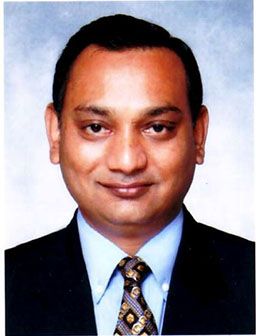
 I met Atul Jogani, President of the Indian-Thai Diamond and Color Stone Association at the Bangkok Gems & Jewelry Fair last February, when he spoke at the final press conference. In the ensuing interview to Rough&Polished, Mr. Jogani spoke about the work of his Association, which serves as a bridge between Indian and Thai jewelry and diamond industries and he also shared his view of prospects for cooperation between the two countries.
Please give us an overview of the Indian-Thai Diamond and Colorstone Association.
Before 1999, we had formed this as a club, Indian-Thai Diamond and Colorstone group. In 1999, we registered ourselves as an association. We now have more than 180 members. The founders and 90 percent of the members are of Indian origin. Our members represent the diamond industry, colorstone industry, and jewelry industry.
What role does your association play in the jewelry industry in Thailand?
Our association plays an important role in Thai gemstone and jewelry industry as a supplier, as an exporter, and as a jewelry manufacturer. Many our members supply colored gemstones and diamonds to the jewelry industry.
I have been a president of the association for the last 10 years. Under my leadership, we have been interacting with the Thai government on how to grow business in the supply chain. I was one of the first negotiators of the Free Trade Agreement between India and Thailand on behalf of the jewelry industry. We directly interact with the Department of Export Promotion of Thailand, and have very good relations with Thai industry and Thai government.
In your opinion, what was the most important goal achieved by your association?
We brought all the Indians, all the top people in our industry under one roof. Since we are foreigners living in this country [Thailand], and acting as a supply chain for the Thai jewelry industry, we wanted everybody to be under one roof, and have an efficient mechanism to solve any problems arising in our industry, as a unity.
What is the trade volume of diamonds, gems and jewelry between Thailand and India?
In 2013, Thailand’s polished diamond exports to India grew 97 percent year on year, from $110 million to $218 million.
Gems and jewelry exports from Thailand to India slipped by $9 million to $379 million last year from $388 million in 2012.
In 2013, Thailand’s imports of gems and jewelry from India totaled $530 million, down $148 million or 22 percent from $678 million in 2012. Indian diamond exports to Thailand declined 23 percent last year, from $630 million in 2012 to $485 million in 2013.
What is the status of the Free Trade Agreement between Thailand and India?
Ministers of Commerce of both countries signed the framework agreement in 2003.
The jewelry trade was one of 89 industries included in India-Thailand Free Trade Agreement (FTA). The business between two countries, I would say, has definitely grown.
There is a huge potential for colored gemstone jewelry in Indian market. Thailand can play a very important role in supplying jewelry to India because colored gemstones come from Thailand. This is a perfect combination because India is the world's leading hub for manufacturing diamonds, and Thailand is well known for its long tradition of exceptional craftsmanship in jewelry making and design.
Gold import in India saw a sharp decline last year followed by the 10% hike of gold import duty over the year. In your opinion, what would be a solution to this problem?
The Indian government has taken many steps to curb gold imports last year when overseas gold purchases undermined the rupee currency and pushed India’s current account deficit. Gold is the country’s second most expensive import after oil.
There is a strong call from the diamond and jewelry industry to reduce the gold import duty as Indian jewelry and diamond manufacturers suffer as a result of the record high duty. I think with the elections [R&P: the final phase of national elections ended on May 12, 2014] and new government in place, we can expect the gold import duty to go down gradually.
Would you say the recent Bangkok Gems & Jewelry Fair in February was successful for exhibitors and participants despite the political unrest in Thailand?
It was surprisingly successful for both the exhibitors and buyers. People who made it to the Bangkok Fair were the real buyers, and they came with an intention to place orders. So they did. According to our numbers and survey, it was a very decent show.
De Beers’ diamond brand Forevermark is planning to open a second Diamond Institute in India next year in anticipation of the growth it is expecting to see in the coming years. Do Indian consumers embrace the diamond trend? What is trending in India today?
For the last 50 to 70 years, Indian consumers have mostly seen only diamonds and gold jewelry. Diamonds – because India is the largest manufacturer of polished diamonds, and gold jewelry – because gold is part of India’s culture and tradition. Everybody in India sees gold as an investment. Colorstone jewelry is rather new to Indian market. There is a misconception of colored gemstones being cheap and made out of glass. Today, with a lot of marketing, press and media campaigns, the perception of colorstones is changing. Indians are looking for something new. They are looking to add more color to the jewelry.
The demand for diamonds in India will continue to grow as well. I think in the next five years India will consume more diamonds than we have to export.
How do you see the year of 2014 for diamond and jewelry trade?
The performance has been good in some countries, and in other countries it has been slow, like in Thailand as a result of the political unrest. China has been slowing down, as well. This year, the industry will be growing at a slower rate. India can expect the situation to improve after the elections. American economy is peaking up, which will help to boost exports from China. The demand for diamonds and jewelry in China and India will be stronger in the second half of 2014.
Olga Patseva, Editor in Chief of the American Bureau, Rough&Polished, from Bangkok
