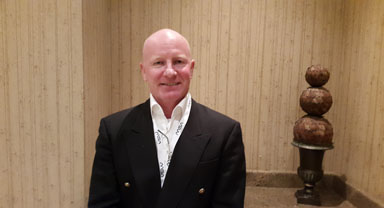
 Lucara Diamond, which wholly-owns Karowe Mine in Botswana through Boteti Mining, is undertaking a $50 million plant expansion at the mine located near Debswana’s Orapa mine.
Company chief operating officer Paul Day told Rough & Polished in an interview on the sidelines of this year’s edition of the Botswana Resource Sector Conference that the expansion would be commissioned at the end of the first quarter next year.
He said that the plant upgrade was designed at dealing with the ore the company encountered at depth, which have slightly different geological characteristics.
Day also said that Lucara would put a very large diamond recovery circuit to enhance their ability to recover large diamonds in an undamaged state.
Lucara, which commenced mining at Karowe in 2012, had as at end of May this year recovered 44 gem stones weighing over 100 carats and seven gem stones weighing over 200 carats.
The mine was expected to produce up to 420 000 carats this year and generate revenue of about $160 million.
Karowe mine was acquired fr om De Beers in November 2009 for $49 million.
Below are the excerpts.
Can you provide an overview of Lucara’s operations at Karowe since the company commenced production in 2012?
The operations at Karowe started processing ore in April 2012 and I would say pretty much the plant was stabilised in the last quarter 2012 and in 2013 we produced 440 000 carats of diamonds, which was exactly in line with expectations at the time.
During 2013, we started to recover a population of large stones, which were not previously predicted in the resource model. So we did a geological exercise, whereby we re-evaluated the historical size distribution fr om the areas we had mined and also the valuation of prices received for those stones and we also undertook a bulk sampling campaign, and the processing of areas where we had less data and we developed a new geological resource model, which indicated a significantly quarter size-fraction distribution and enhanced value per carat.
As we progressed into 2014, we have managed to continue surpassing our expectations both from a production and revenue perspective.
What is your projected output and revenue for 2014?
We expect to produce between 400 000 and 420 000 carats by year end. Currently our revenue fore-cast is $160 million for the year but we will release a new revenue forecast later this year, which will indicate enhanced revenue.
What was your revenue last year?
Last year’s revenue, I would have to check, I think it was in the order of $180 million.
So did the recovery of large stones come as a surprise to Lucara?
The recovery of large stones was outside of the prediction of the resource model; there had always been, I would say, a speculation that the AK6 ore-body contained large stones that were not picked up during the initial sampling undertaken by De Beers but we could not put a value on that at that stage. So it was proved basically that the process plant that Lucara put in place incorporated an AG mill which was, I would say, is gentler on the ore. It preserves diamond value and through that AG mill technology we definitely gave Ak6 the best chance of liberating large stones, which it has done.
Can you shed more light on the plant expansion you are currently undertaking at the mine?
At the moment we are undertaking a $50 million plant expansion which will occur through 2014 and will be commissioned at the end of the first quarter in 2015. That plant upgrade is designed at dealing with the ore that we encountered at depth, which have slightly different geological characteristics. Very excitingly, we will also put a very large diamond recovery circuit which will enhance our ability to recover large diamonds in an undamaged state.
Do you anticipate that the recovery of large diamonds will continue at Karowe?
All geological indications are that we will continue to recover large diamonds into the future of the life of the mine. I talked before about a specific sampling campaign wh ere we treated ore through the mill. Our ore-body is made up of three geological domains, which we call the north lobe, centre lobe and south lobe. The north lobe is quite small and it does not contain a significant population of large stones. The centre lobe is larger than the north lobe, but smaller than the south lobe and it does contain a population of large stones. The south lobe is the largest geological domain within the ore-body and [covers] probably the remaining 60 percent of the life of the mine, after we have mined the centre and the north lobes. We campaign treated that material to see whether there was a large stone population and what the value of that large stone population was and it was confirmed from geological perspective that large stone population exists, hence what follows that through, we predict that we will continue to recover large stones at high value as we progress.
What is the mine life of Karowe?
Currently Karowe runs through to 2026 so that’s a further 12 years from now. So with the increase in contained value per tonne, which comes from the large stone population and the value of those stones and incidentally we are currently surpassing the ore-body prediction. I think if one was to take the balance of production, year to date, one would come up with a contained value according to the resource model of between $380 and $400 per carat, in fact we have achieved well over $600 per carat. So, if one takes into account the enhanced contained value per tonne, I think there is definitely an opportunity for an underground operation at Karowe beyond 2026. Initially we were planning to undertake such a study in 2017 and 2018, but in fact we are looking at doing a conceptual study for underground development in the very near future. We are hoping that will come to fruition and if does indicate that then we will study further and inevitably that success will take the life of the mine well beyond 2026.
How do you market your stones?
Currently, we use Bonas-Couzyn a sales broker for our house stones. The stones are viewed in Gaborone by people whom Gaborone is a more appropriate destination, people in southern Africa but also we got a number of Indian clients coming over to view the stones here in Gaborone. We then ship the stones to Antwerp, wh ere there are viewed at the Bonas-Couzyn offices for people who find it easy to view the stones in Antwerp.
What are you doing to support the local diamond manufactures?
We will be transforming over to 100 percent Botswana viewings and sales in 2015. So our first initial step in terms of just beneficiation to the overall industry outside of mining is we have established a de-boiling facility, so we no longer have to send stones out of the country to de-boil them. So that’s our current first step.
Mathew Nyaungwa, Editor in Chief of the African Bureau, Rough&Polished
