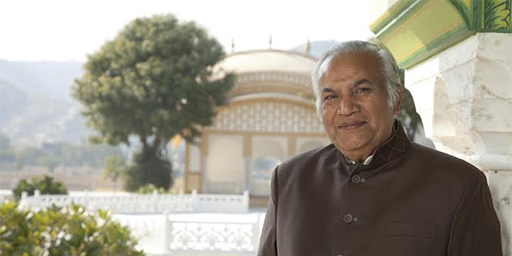
 A highly respected businessman held in high esteem in the Indian gems and jewellery industry, Mr. Navrattan Kothari, Chairman, KGK Group of India, has steered the conglomerate for over 50 years, with the Group now having grown into a world-class business empire. Under his guidance, the KGK Group, besides its underlying operations, funds many programs through a trust that looks into education of the underprivileged and provides healthcare facilities. Amongst his array of achievements, Maharaja Sawai Bhavani Singh award in 2008 tops the list, which was awarded to him for his much appreciated work in the field of heritage conservation that began with most talked about Jal Mahal restoration and revitalization of Mansagar Lake.
Mr. Kothari has been a member of the Managing Committee of the Gems and Jewellery Export Promotion Council (GJEPC) for 15 years; a member of the International Colored Gemstone Association – New York since the last 9 years; a member of the Managing Committee of the Bharat Diamond Bourse for 4 years, Chairman of the largest Cancer Hospital in Northern India, Bhagwan Mahaveer Cancer Hospital and Research Center, Jaipur; President of Subodh Shiksha Samiti, Jaipur, an educational trust imparting education to more than 22,000 students from elementary to post graduation courses; Chairman of the Indian Institute of Gems and Jewellery, Jaipur; member of KGK Wish Foundation, a group that has pledged to fulfill wishes of 100 children suffering from terminal diseases, and the list goes on…
Here, Mr. Kothari speaks to Rough&Polished about his initiation into the family business and his perception of the gem and jewellery business in India and all over the world as well.
KGK Group is easily the oldest Group engaged in gems and jewellery business in India. For the benefit of our readers, can you please give a backgrounder of KGK Group and how it all began more than a century ago?
The KGK Group was established in 1905 by our Kothari family from Jaipur (India). Now, it is a global corporation with fully integrated operations in the gems and jewellery industry, with presence across 12 countries. We are pioneers in the world of precious stones and have been sourcing, manufacturing and distributing colored stones, diamonds and jewellery for decades. From the business that only concentrated on trading colored gemstones, we took to manufacturing of nature’s most beautiful gemstones and today our Group has gemstone manufacturing units in India, China and Thailand, with marketing offices across the globe.
In the years 1972-73, we entered into diamond trading which proved to be a turning point in the history of KGK Group. Today, our Group is one of the few leaders in the diamond sector with diamond-manufacturing units in India, South Africa and Russia; and is a proud DTC sightholder, sourcing rough diamonds directly from DTC and other mining leaders like ALROSA in Russia.
Next we went vertical into jewellery manufacturing and established jewellery manufacturing units in India, Hong Kong and China. The foray into retailing was next natural thing on our agenda and our fine jewellery brand ‘Entice’ was born - our dream of completing the Group’s portfolio from mines to fingers was complete.
Please give us an insight into your life… childhood and youth; and the atmosphere you were raised. Was your decision to join your family business a conscious one or you just entered the business as it was the norm?
I am from a family which had a prosperous jewellery business when I was young, so it was natural for me also to follow the footsteps of my forefathers and join the family business. I started helping in the business at the age of 18, immediately after my education and from then on there was no looking back. I travelled to Rangoon in Burma, Hong Kong, Thailand and also lived in Madras for some time. I have been learning about our business since my early childhood and till date my learning has never ceased. Success encourages me to learn more and stretch my limits. Now that I am also a teacher, I love sharing all the knowledge, experience and guidance that my father has taught me.
What is the basis for the success of the KGK Group, especially because it is into varied businesses like colored gems, jewellery, diamond, manufacturing, exports, and retail – overseas as well as domestic, etc.?
Honesty and hard work are the basis of our business. All my family members have contributed in our business, some in larger roles and some in smaller but important roles. We have always treated our employees as family members and that’s one of the biggest reasons behind their hard work for our business and for our success.
As you have witnessed the changes and growth of the Indian gems and jewellery industry, what in your opinion are the challenges faced by the industry currently? What steps should be taken by the industry to remain stable as well as grow further?
Challenges come and go in every industry and ours is no exception. Raw material price is one of the biggest challenges at the moment. Still, business is good at the moment. Our business is all for women and till the time there are women on this planet, business will keep growing.
What are your views on overseas markets at present? Considering that the slowdown still persists in many countries around the world, which emerging markets should India focus on entering now?
It is true that some markets at the moment are slow but some emerging ones are showing good signs of being potential markets. At the moment, developing countries like the CIS countries & BRIC countries are good to focus on as they will emerge as stronger markets in future.
Do you perceive China as a threat or an opportunity for the Indian gems and jewellery industry? Your views on how these two fastest growing markets will eventually compete with each other.
I agree that India and China both are competitors but the jewellery made in both the countries is very different. What we make, they don’t have and what they make, we cannot make the same. It is all about the skills of the people in both countries. So therefore, there is no direct threat. Both countries will survive parallel.
Indian lending banks have become extra cautious and tight-fisted when financing clients of late. What steps should the industry players take to maintain a workable equation with lending banks?
We need to have more transparency in our businesses and follow rules and regulations very carefully. There have been a few black sheep and because of them, the whole industry is suffering. But slowly we need to build the confidence of the banks again.
Mostly due to stretching of receivables and sometimes due to wilful defaulting by borrowers to lending banks, it makes bad news. Such adverse news is spoiling the image of the Indian industry. Your comments.
It is sad that because of a handful of dishonest diamantaires, the whole industry’s reputation is on stake. But there are a few wrong-doers in every industry and our industry is no exception. A better transparency and good dealings with banks will increase trust on individual companies and slowly that should benefit the whole industry.
The Indian diamond industry has weathered many a storm. However, what plans should India chalk out to source ‘rough’ to feed its huge manufacturing facilities?
We need to be nearer and have close relations with bigger mining companies to get enough and timely rough supply. Indian mines have exhausted and therefore, we will have to depend on countries like Africa, Canada, Russia and Australia. It is a give and take relationship as they have the raw material and we have the skill.
As KGK sources rough from ALROSA, do you see India’s present arrangement for rough supply with Russia develop into a more organized direct supply system in the future?
We have very good relations with ALROSA and yes, over time we see that Russia will play a major role in rough diamond supply.
The Indian domestic market has grown many times in volume over the past years. How do you see it panning out in the future in terms of demand for diamond jewellery? And will gold jewellery reign forever in India?
Gold will always be gold; you cannot replace it with anything else. Customers have become aware about diamonds and have basic knowledge about their quality also. With price standardization through Rapaport and certificating agencies like IGI and GIA, they have started being sure of their investment in diamonds.
Your take on lab-grown diamonds vs. natural diamonds. What steps should be taken to retain consumer confidence in India, if large amounts of lab-grown gems are pushed into the market triggering misuse by unscrupulous jewellers?
Lab-grown diamonds are surely a big threat at the moment. We need proper machines and mechanisms to test lab-grown from natural diamonds and only then the customer will be 100% sure. Certificates help to a certain extent and even branded diamonds like Forevermark help to retain customers confidence but we need to have more testing machines at the retail level to make customers absolutely sure of their purchase.
Customers should also make sure that they buy from DTC sightholders and not from unscrupulous random jewellers. DTC sightholders are selected on the basis of best practice principles and nobody would want to lose such a prestigious sightholdership due to such ill practices.
Aruna Gaitonde, Rough&Polished, India
