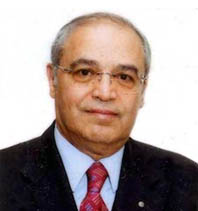
 Sians Mussa is President of the Italian Diamond Bourse. He began his career as diamond dealer in 1969. The Sians family has been active in the Diamond industry for 3 generations and has offices in Milan, Rome, Valenza, Tel Aviv and New York. President Sians currently works in his Italian office together with his two sons, David and Doni.
President Sians discussed with Rough&Polished the role of diamond bourses, what diamond represents in modern society, and the status of the Italian jewellery industry.
Could you please tell our readers about the history and role of the Italian Diamond Bourse?
The Italian Diamond Bourse was founded in Milan in 1926. It is currently based in Milan and it acts as a non-profit organization. It supports and harmonises the activity of its members so that their relations are positive, transparent and traceable.
What is the function of diamond bourses in today’s world, where prices are set on the Rapaport list and purchases are made through the Internet?
Diamond bourses have a leading role in the industry at a global scale. They monitor and control the credibility of their members and the respect of international regulations. Whoever does not comply with our regulations is expelled. Protecting and defending consumers, respecting the ethical code: this must be at the base of every single transaction.
Prices are not determined by price lists but rather by the market itself and any activity that takes place on the internet must also follow the rules. It has already happened that someone was expelled for violating these rules.
Talking about price lists: a few months ago, Stéphane Fischler, President of the AWDC, criticised the Rapaport List, defining it a “glass ceiling” which prevents a free development of diamond prices. Do you see this as a problem?
What you find online is price lists and offers based on stocks owned by companies which operate on the internet. Regarding President Fischler’s remarks, I have no particular comments to make.
Some recent researches highlighted how diamond prices are lagging behind those of other luxury goods. Do you fear diamonds might be trivialised, effectively being degraded from luxury to commodity?
Considering diamonds a commodity does not imply trivialising them. None of us can do without oil, iron or basic agricultural products. Just like these goods, diamonds are a gift from our earth. They have particular characteristics, which are exploited in the luxury industry because men were able to turn them into desire, emotion, dream and craftsmanship.
They might well be considered a commodity. So what? That would not be a problem at all.
What is the status of diamond jewellery in Italy today?
Demand for Italian jewellery is still strong in the world. But if you look at the internal market, that is also suffering from the national economic crisis.
In which direction should the Italian goldsmith industry proceed to maintain its competitiveness at the global level?
It should invest on commitment, research, innovation, and competitiveness.
Matteo Butera, Rough&Polished, from Italy
