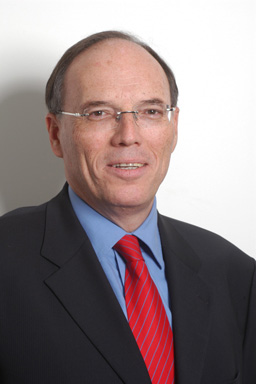
 The Israel Diamond Exchange (IDE) dates back to 1937 and is now the world’s largest diamond trading facility giving roof to approximately 3,500 members representing the whole gamut of businesses associated with the treasured mineral. Located in Ramat Gan, it dominates this city’s economy, and not only. Providing jobs for 55,000 people, the Israel diamond community accounts for a hefty share of total industrial exports generated by the country - $9,324 million vs. $48,200 in 2014. The recently signed Memorandum of Understanding between the IDE and Russia’s ALROSA at the International Diamond Week in Israel blessed by Israel's President Reuven Rivlin may ginger up the bilateral turnover adding value to the economies of both countries. Shmuel Schnitzer, President of IDE, in his interview to Rough&Polished told about the role of the Israel Diamond Exchange and shared the latest data on the performance of the diamond industry in his country.
The Israel Diamond Exchange is considered one of the largest in the world. What is its contribution to the economy of Israel?
The Israel Diamond Exchange is indeed the world's largest with more than 3,500 members. Our trading floor is the world's largest and also the most active. While our Israel Diamond Exchange complex of four buildings is not the largest anymore, it is the most efficient and most secure in the world.
For your convenience, I have attached a most recent presentation of our industry that gives you a lot of facts and figures of our industry's performance. To begin with, the total annual turnover of is about US $28 billion. Diamonds - polished and rough - constitute about 20 percent of Israel’s total industrial exports. Our annual exports - of rough and polished - stand at some $10 billion, with the major destinations of polished: USA 37 percent; Hong Kong about 29 percent, Belgium 27 percent, and others.
What were the results of the International Diamond Week held in Israel on February 8 – 12, 2015 in terms of trading volume and general mood?
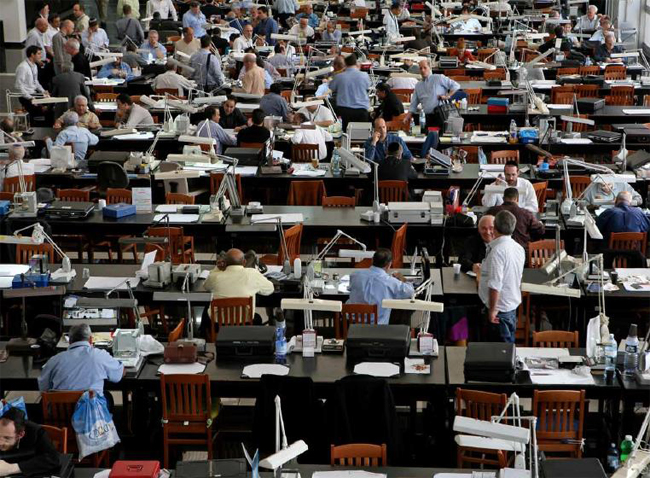
It was truly the best we ever had. I invite you to take a look at the video gallery and watch a number of the interviews and reports. Throughout the past three years, we have learned a lot and the current setup, layout of the hall, and the diversity of buyers was fantastic. We hosted a delegation of close of 40 diamond buyers from Turkey, and delegation of the partner bourses – the Diamond Dealers Club of New York and the Antwerp Diamond Bourse. In total, 450 buyers from 24 countries worldwide attended. As to sales, all participants – the 350-plus exhibiting members and the buyers reported back positively. Don’t forget that also for the local market – i.e. the Israeli diamond trading community - this is an important networking event. With the majority of diamond trading taking place in the 1200-plus offices in our complex, the floor was very busy as it is a wonderful opportunity to get an over overview of what their colleagues have to offer. The low cost model of the event – as all takes place on the existing trading floor- has proven a very effective marketing, networking and sales tool.
Could you give a percentage breakdown for polished diamonds traded at IDE in terms of carat weight and color last year?
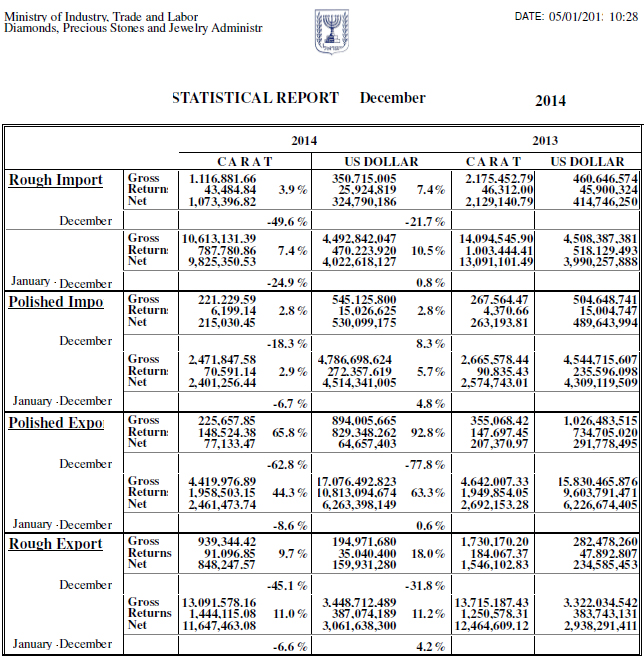
I refer you to the figures of the Ministry of Economy. Color is NOT measured or recorded. See below.
Now that ALROSA and Israel Diamond Exchange signed a Memorandum of Understanding, what will that mean for both parties in terms of rough supply in 2015?
The visit of the ALROSA delegation was of great importance to us, and we hope also to the ALROSA top managers themselves. They were duly impressed with what they saw on the floor during the IDW and they promised to be back to learn more about what our industry has to offer. The signing of the MoU opened the door to future talks and, of course, it is our wish to enter into talks about a model for rough supply from ALROSA to the Israeli industry. This is also a good opportunity to thank ALROSA for the delegation's visit and to invite them back for a follow-up visit.
It appears that the number of diamond bourses in the world is growing (with the Diamond Dubai Exchange and Panama Diamond Exchange joining the diamond community), while the supply of diamonds is said to be shrinking. What is your take of this countermovement?
You are correct to point out that natural diamonds are a finite product that the production of rough is therefore bound to what is mined during a calendar year. That said, there is definitely room for more centers that will contribute to the effective trading of diamonds, provided they contribute also to the efforts needed and implemented to get diamond into the hands of the consumers in the markets they cover, serve and seek to develop. All these efforts need to be directed at a single goal: to raise the desirability of diamonds and diamond-set jewellery in the consumer markets and by doing so, raise the profitability of diamonds manufactured, traded and sold down the supply pipeline.
Some of Israeli diamantaires are laboring to expand diamond manufacturing in Israel bringing it back to earlier levels. Do you think it is possible now on the backdrop of giant diamond cutting capacities in India and beneficiation programs pursued by African diamond mining countries?
We are realists. So we are not trying to bring back the industry of smaller stones that we lost to lower-wage manufacturing centers, such as India. We do however know our own strengths and therefore we are investing in enhancing and energizing the work force for those stones we can manufacture in a profitable manner here in Israel. Larger rounds, fancy shapes and fancy colored diamonds are deserving to be manufactured here in Israel as we have the top expertise and knowhow of such stones. The recent establishment of a new combined teaching center and diamond cutting services plant is just one of the many steps we are taking toward increasing our manufacturing output.
In your opinion, what kind of measures are to be taken to enthuse the interest of young generations towards diamond jewelry?
Promotion, promotion and promotion. The 'bandwidth' of luxury consumer products has increased tremendously during the past decades. We are competing with a wide range of fashion products and accessories, such as luxury watches, branded fashion, leather bags and shoes, as well as technology and communications products and gadgets, such as smartphones, tablets, and so forth. At the same time, we need to boost consumer confidence by presenting diamonds as a product that not only makes the consumer feel good about her or himself, but also as a luxury product that creates economic benefit for the countries and communities where they are mined and produced. And last but not least, we need to continue to assure that our product remains untainted and without controversy and it presented as what it is - a unique product, created millions of years ago in the crust of the earth, and that can be mined, cut and polished – not matter how small or large - only once!
Lately, the diamond industry appears to see no harm in synthetic diamonds if they are traded on a separate market. When do you think such a market will finally be established in terms of industry rules, regulations and overseeing authorities?
I've got news for you. The rules exist. We - i.e. the 30 bourses affiliated to the World Federation of Diamond Bourses (WFDB) follow the rules of the International Diamond Council that has set crystal clear rules for nomenclature of synthetic diamonds. As to oversight, each and every industry member –throughout the supply pipeline – carries his own responsibility of DISCLOSING the nature of synthetic stones. In Israel, at the Israel Diamond Exchange, we do not allow the trading of synthetic stones on our trading floor. Also, the special import and export mechanism that exists for natural diamonds is not applicable to synthetic stones. Synthetic diamonds, as well as synthetic colored gemstones, are from the point of view of Israel's Diamond Controller, who is the top representative of the ministry of Economy at our complex, a different product and must be imported and exported like any other consumer goods.
What is your outlook for the Israel diamond industry in 2015?
Whenever I am asked that question, I like to refer to what my late father, Moshe Schnitzer, who headed the Israel Diamond Exchange for no less than 25 years, used to say: "In the diamond business, you are best served with a good measure of optimism, a long term view and lots of hard work." I subscribe to that philosophy as well, and at the same time continue in his footsteps in working hard to create as much added value to the members of the Israel Diamond Exchange as we possibly can. The platform of the International Diamond Week in Israel has proven to be an important and successful tool and we’re looking forward to the next IDW, that will be held August 31 - September 4.
Vladimir Malakhov, Rough&Polished
