
 Besides diamond mining, The De Beers Group of Companies has been engaged in diamond research for many years and this kind of involvement is now paying back helping the global diamond industry to prevent its market from being eroded by synthetic diamonds. As part of De Beers Group, De Beers Technologies and the International Institute of Diamond Grading & Research (IIDGR) have been quite busy recently developing techniques and producing a range of easy-to-use equipment focused on detecting treated and synthetic diamonds. Simon Lawson, Head of De Beers Technologies UK (left) and Jamie Clark, Commercial Director for the IIDGR (right) described the latest know-how offered to the diamond industry in their interview to Rough&Polished.
Could you say a few words about your Institute and the research it is engaged in?
The International Institute of Diamond Grading & Research (IIDGR) is part of The De Beers Group of Companies and is uniquely positioned to work closely with some of the leading diamond research scientists from across the Group, principally De Beers Technologies which has been at the forefront of research into the detection of synthetic and treated diamonds for 30 years. Through close collaboration with Element 6, world leaders in the synthesis of diamond for industrial and technical applications, we are able to anticipate advances in synthesis and use this knowledge to invest in the development of techniques and equipment that can effectively address the challenges faced by the industry, both now and in the future.
Your Institute offers four basic types of verification instruments to examine diamonds. What kind of problems do they help to solve?
The DiamondSure and DiamondView instruments are designed to be used in sequence to respectively screen and identify polished synthetic diamonds.
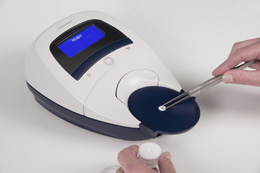 DiamondSure is a portable instrument which makes a fast and effective measurement and requires no user interpretation of results. Stones between 0.01 carats and greater than 10 carats in size are placed on a probe and within a couple of seconds the absorption spectrum of the stone is recorded and analysed and a result is displayed. Results averaged over hundreds of thousands of diamonds indicate that about 98% of natural diamonds give a ‘Pass’ result and require no further testing. All simulants and synthetic diamonds, together with about 2% of natural diamonds give a ‘Refer’ result and these stones need further testing in order to determine their origin. This testing may be carried out using the DiamondView instrument. It is of note that DiamondSure is not designed for use on brown diamonds where the referral rate for natural diamonds will be significantly higher than 2%. The probe design means that DiamondSure may also be used to test diamonds in a range of settings – the only requirement is that the probe is able to make direct contact with the table of each stone in the setting.
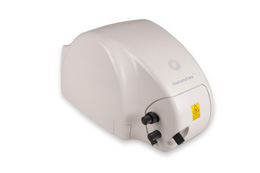 DiamondView uses a specially filtered UV source to generate a surface fluorescence image of the stones referred by DiamondSure. Synthetic diamonds show distinct growth sector patterns and other features which DiamondView is designed to reveal under these special lighting conditions. A user with relatively limited training and guided by example images is able to identify synthetic diamonds based on these growth sector patterns. Because this instrument does require some user interpretation and training, it tends to be used in a grading laboratory environment. An adaptor is provided to enable imaging of certain stones set in jewelry (typically solitaire rings and earrings).
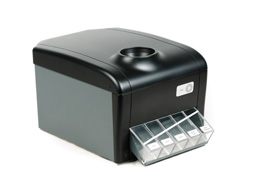 The automated melee screening (AMS) instrument is an automated version of DiamondSure with some additional functionality to enable the referral rate for stones in the 0.01 carats to 0.2 carats size range to be kept as low as possible. This compact instrument can receive up to 500 carats of loose melee size stones which are poured into a hopper and then automatically placed on the probe and dispensed into a relevant category at a rate of 360 stones per hour. This instrument is designed to make screening of melee diamonds more cost effective than would be the case for DiamondSure.
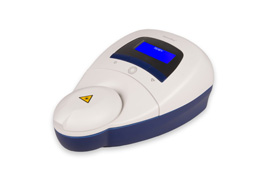 DiamondPLus is primarily designed to screen for HPHT treatments of natural type II diamonds – generally in a grading laboratory environment due to the requirement to immerse the stones in liquid nitrogen whilst the measurement is being made. These natural diamond treatments are typically applied to type II brown diamonds in order to remove the brown colour. Detection of such treatments is an involved process usually carried out in a gemmological laboratory. DiamondPLus is designed to simplify and speed-up this process by recording, analysing and displaying the results of high sensitivity laser fluorescence measurements with a measurement time of around 20 seconds per stone. The instrument gives a ‘Pass’ or ‘Refer’ result. Our tests show that this instrument reduces the number of referred stones that require more involved laboratory based testing by about 50%. The instrument also identifies a feature, which is commonly observed in current commercially produced CVD synthetic diamonds.
Further information on these instruments may be found at the following website: www.iidgr.com
Does it mean that the best way for a diamantaire is to have them all to be on the safe side? If not, what is the best combination in your opinion?
Most diamantaires would probably find the screening instruments DiamondSure or AMS (for automated melee screening) sufficient for their needs. Any referrals would then need to be sent to a grading laboratory for definitive identification of synthetic diamonds. It may be cost effective for some diamantaires to invest in DiamondView and an appropriately trained technician to interpret the DiamondView images and in this way remove the need for the referrals to be sent to a grading laboratory.
Even if you have them all, is there any chance you may get some referrals for further examination?
While DiamondSure and the AMS will refer a very small proportion of stones for further tests, the DiamondView instrument is designed so that a trained operator can identify any referrals that are synthetic based on an examination of their fluorescence images.
The Automated Melee Screening (AMS) Device is the most expensive instrument in your Institute’s technological line-up focused on the cheapest diamond goods in many cases produced by small-scale manufacturers. Is there any way for them to get AMS services without having the instrument?
The AMS is now offered for sale to any diamond business across most jurisdictions. Further to this, we have worked with leading industry bodies on establishing testing centres in key locations, such as Hong Kong, Shanghai and Shenzhen with the NGTC; Tel Aviv with the IDE; and Mumbai with the GII. We are currently in the process of planning the installation of a Referrals Service at our new IIDGR laboratory in Surat, India. We are of course always reassessing requirements to support the industry in meeting new challenges.
The AMS pass rate on natural diamonds is more than 98%, which is very high and virtually eliminates the problem of ‘peppering’ natural melee with synthetics. Still, if you get some referrals for further tests, which will prove economically unjustified, does it mean there will be a stock of such ‘pending’ stones in the market?
We identified this potential issue from the outset and our aim is to make referral testing as economic as possible. We have been working hard to enable a more economic referral testing service to be made available in our key markets, whether this be with partnerships we’ve established or with our own Referrals Service.
The De Beers Group of Companies announced that its International Institute of Diamond Grading & Research (IIDGR) was launching synthetic detection symposiums around India and that the IIDGR was also in the process of establishing a referrals centre at its Surat laboratory that would provide a lower cost option for testing stones referred by detection instruments. Could you elaborate on this?
IIDGR and the broader De Beers Group of Companies are leaders when it comes to knowledge, research capabilities and technical expertise on synthetics. The best way of using this expertise is in supporting the diamond industry by building awareness of synthetics, their growth methodologies, how they can be detected and the tools and services available. This all helps to support trade confidence and to prevent any misinformation spreading. The establishment of a Referrals Service at the IIDGR laboratory in Surat will complement the many instruments already in place in India and will support the trade more generally.
You offer diamond grading services for diamonds weighing at least 0.14 carat. Does it mean that to grade smaller stones is economically pointless or are there any other reasons?
IIDGR is currently focused on Forevermark grading, which has 4Cs requirements (with one of these being a minimum weight of 0.14 cts). Anything smaller than this usually means the table facet is not large enough to inscribe the Forevermark icon and unique serial number. However, IIDGR is currently running some generic grading pilots to assess the industry appetite for such a service.
Does your Institute plan to produce some other devices for the diamond industry in the nearest future?
We have a continuous improvement programme for our current range of instruments and we will be introducing added functionality to DiamondView from the second half of 2015, thereby further aiding the ease of identification of synthetics.
We are also developing enhancements to the current AMS units, which will enable the device to be used on certain fancy cuts of diamond. We hope to release this early next year.
Towards the end of this year we also plan to introduce an instrument for automated screening of yellow and brown melee.
For mounted jewellery, we are in the final stages of prototype testing a DiamondSure instrument especially tailored for this area.
Vladimir Malakhov, Rough&Polished
