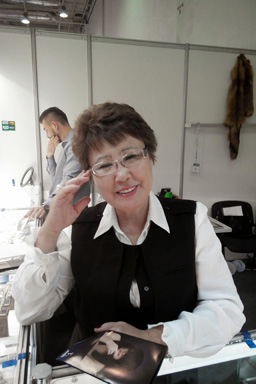
 Svetlana Maksimova, CEO of the Casting-House jewellery company (with the office in the Triumfalny trade centre, specializes in the designer items using high quality Yakutian diamonds with their origin being beyond any doubts and their cut flawless). She is a founder of the Yakutian polished diamonds trademark (Yakutskiye Brillianty).
She has graduated from the Yakutian State University and the Far-Eastern Institute of Psychology and Psychoanalysis.
She worked as a Senior Deputy Director General at the diamond cutting and polishing Tuimaada Diamond company, AK ALROSA (in the Centre for co-operation with cutting and jewellery companies) and also as a Director of the Almazny Dvor (Diamond House) trading and exhibition centre and a Director General of the Diamond Club of Russia.
Recently, you have taken part in the St. Petersburg JUNWEX, what are the results, have they met your expectations?
Despite some slowdown in the consumer activity, there is optimism on the jewellery market, which was felt quite well. The trade was rather lively, and both the effluents and mass buyers left the exhibition satisfied.
The participation in the JUNWEX in February was always special and ‘safe’ for our company. Although, this year is twice more difficult for running this exhibition. First, it was held at a new venue, and second, the crisis really makes us think about the reasonability of all the expenditures except the committed and necessary expenditures and forces us to cut the budget. Taking part in this exhibition is rather costly and it would be running a risk as the new venue is not popular and well known and is located somewhere on the fields where cabbage used to be grown. But we discussed it and decided to have a try, so we sent invitations to all of our regular customers and in fine, we are happy about the result.
Is there any ‘anticrisis’ range of products? On what customers do you place your stake on?
There is a classical version of an ‘anticrisis’ range of products: settings for small-size studs, designer pieces with a center diamond of 0.2 ct and higher. We place our stake on designer jewellery that maximizes the range of products: in St. Petersburg, as usually, we have exposed a fairly nice collection of diamond jewellery and even manufactured а ‘crisis’ version of a setting, bezel settings for small-size studs.
How one should act to remain successful in the recession times? Are there any changes in the marketing policy?
While trading gold and polished diamonds, we should maintain the promotion on the whole and the advertising of the stores at a certain level. It is very important to provide professional lighting for the display area and the whole shop. Taking the above into account, it is difficult and costly for us to quickly change our location and shift. So, one option remains: to overcome the crisis it is necessary to have a dialogue with the owners of the store areas, optimize all your expenses and hope that the government would not introduce any additional charges.
What is your opinion on the sales results early this year? What are your expectations about the polished diamond and jewellery sales, at least, for the year?
In the last December, when the dollar exchange rate started climbing up and the Central Bank – taking feverish decisions in an attempt to save the financial sector of the economy – arranged the special urgent overnight meetings and increased the bank rates, the government started to ‘tighten the screw’ and the people started to forestall market – electronics, cars and even food – then we also had fears that the deep crisis would not pass by the jewellery retail sector. The New Year sales compared to the previous years’ ones were weak, but as the first two months of this year showed the wealthier parts of the population, including our target consumers, at least, are not in slackjaw. Those who sell high-end goods have a seasonal business. Even in the non-recession years, sales drop markedly in summer that is why there are serious fears about this summer period.
Nevertheless, a great lot of stores shut down, the goods suppliers make their policy more stringent, many of them demand pre-payment. There is still a hope that the owners of trade centres watching the lenders leaving their store areas would decrease – at least, temporarily – their rents for their shopping space. The matter is that the jewellery stores – while equipping and decorating their stores – spend greater money than other luxury goods sellers, for example, fashion stores or stores selling furs, high-end houseware and tableware or household appliances because we need special-purpose and more expensive security and safety systems.
What is your take on the reasons of the weak development of the industry? Is anything being done to improve?
At present, there is much of unsold goods on the market. There are private, physical entities, that are offering the jewellery purchased earlier and there are companies and entrepreneurs that are shutting down their businesses and are ready to sell their inventories wholesale at a lower price. But, unfortunately, the polished diamond path is rather short, it is not freely circulating like, for example, gold. It means that it is not possible to deliver it somewhere and get money for it quickly. The are only pawnshops but their rates are extortionate. It was often in our country that the banks took credits in the Western banks abroad and gave loans here at a high rate. That's all. Now, maybe, due to sanctions they will start rendering other banking services, they will learn, in the long run, to work with rough and polished diamonds as the collaterals. But I doubt it, as there is no skilled personnel, nor statutory documents. In spite of the fact that one fourth of the global diamonds are produced in Russia and that the rough and polished diamonds are capital-intensive products, unfortunately, there is no any efficient diamond or gold exchange in Russia.
One fourth of the global diamonds over 270 tonnes of gold are mined in Russia and we rank first in the palladium production and produce over 40% of the world platinum. Here is the right place for the diamond or gold exchanges. The exchanges have been successfully functioning for a long time in many countries, even the ones mining no diamonds or gold. The Israeli Diamond Exchange alone, provides 55,000 places and its annual turnover is about $30 billion. Therefore, it makes a huge contribution to the country’s economy thanks to its value added. Even in China and the UAE, the exchanges are functioning. Everyone knows the procedure for establishing and organizing the operation of such entities and hundreds thousand people get jobs there. The goods can circulate freely, all the system of financial, legal, special insurance, customs and experts structures are set up around the exchanges. In general, it is an absolutely essential civilized development of the system for working with such goods like precious metals and gems. In early 2000-s, there was an attempt undertaken in Moscow to establish such an exchange, but the then existing legislative and taxation bases did not allow to address this issue closely. The only hope was for Russia’s joining the WTO. However, several years have passed since Russia joined the WTO, but nothing has changed in this issue. And we cannot expect any easing or preferences from the government in this area – it is good, at least, that the sales tax was not introduced. The drop in the purchasing power, higher dollar exchange rate and the social strain – all these create additional difficulties for our business.
What is your stand on the semi-precious gem segment?
This year we purchased a good parcel of chrome-diopsides and combined them with the polished diamonds to launch a new collection. It is dubbed ‘Tsarskaya’ (Imperial) and it uses much gold and diamonds. I like it and so do the customers. Provided that we should overcome the new crisis, my company is aimed at the promotion of the ‘Yakutskiye Brillianty’ (Yakutian Diamonds) trademark - we created it ten years ago – and remaining on the market of diamond jewellery and designer large-size diamond collections. These are jewellery pieces made by the Yakutian and Moscow factories, mainly, of classical designs and there is no possibility for much experimenting, although, we also manufacture a wide range of customized jewellery. Our customers, at large, are long-established clients, so we do our best to launch new collections.
Do the polished diamonds prove to be an investment tool?
Despite the rise in prices, consumers keep on buying jewellery and engagement rings, and order polished diamonds for jewellery. Probably, it is explained by the fact that the growth in rouble prices is not as high as that of the dollar exchange rate. People also got better understanding that the gold and diamonds are better to save their money invested than the home appliances or even cars. Moreover, I thinks that the sellers have become more flexible, it means, they have to offer discounts and preferences to their customers.
High-end jewellery is purchased as an investment: the customers pay attention at the polished diamonds characteristics, availability of certificates as it is the case elsewhere in the world. Nevertheless, any polished diamonds, even small-sized ones, are a correct investment in a tough time. Moreover, such investment makes you beautiful and happy.
Galina Semyonova for Rough&Polished
