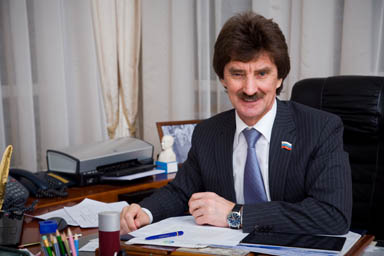
 Flun Gumerov is the President of Almaz-Holding, a jewelry company based and operating in Russia (it has been working in the Russian market since 1993 and is one of the leading firms in the country). He is also a member of the Kostroma Regional Duma (Parliament) and a member of Business Russia, which is an all-Russia social action organization. Being one of the participants of the Expert Council within the State Duma Committee on Natural Resources, Environmental Management and Ecology he combines this work with his activity as a member of the General Council of the Russian Jewelers Guild. Flun Gumerov was awarded the Honor Badge “150th Anniversary of Mikhail Perkhin” by the Commemorative Foundation of Karl Faberge for his outstanding contribution to the development of Russian jewelry art.
You are known as a business analyst and one of the commentators offering his views on the state of the precious metals and stones market in Russia. What are the major problems facing currently the jewelry trade here?
Today, the major problem is undoubtedly the washing-out of working assets, because de facto we now buy rough materials for U.S. dollars, selling then our finished goods for rubles. The drop in the ruble rate affected the amount of purchased rough materials for jewelry production. Conventionally speaking, if, for instance, you had 100 million rubles last December and could buy 30 kilos of gold at the rate of 30 rubles per one U.S. dollar, now you can by 15 kilos of gold at the rate of 60 rubles per one U.S. dollar. This results in lower production – on the balance sheets of materials, which is highly important. Right now, I happen to come across the fact that the jewelry industry has to deal with the ruble balance sheet and with the material balance sheet: if the first one remained as it was, the second one decreased two times – in terms of production and in terms of labor force – almost at all jewelry making companies. Automatically, the ruble value of produced goods went up if not two times, then at least one and a half time. This is happening on the background of a recession, which started in the Russian economy, and a drop in wages across all businesses, this in turn reducing purchasing power, while the value of our goods offered to the market increased. Of course, this was an extra burden to the development of our trade, which entered a rough phase of stagnation and crisis. One of the remedies to overcome this situation could be the introduction of a customs duty on gold exports – as it happened before 2000 - bringing it for example to 5%. This would decrease the value of gold inside Russia (conventionally speaking, by 5% below the London rate), which would permit to preserve working assets and give us some competitive advantage over our counterparts dealing in import goods. This question requires serious consideration, though I am sure that if some market players are losing certain amounts of money, they could get direct reimbursements from the customs duty due to the fact that gold could be channeled to recycling inside Russia, while the treasury could levy taxes and use them to offset its loss.
Are there any urgent measures taken to alleviate the fate of entrepreneurs?
As it happens, I am an inveterate opponent of any urgent actions – I think that we, on the contrary, should impose a moratorium on the initiation of laws. We should understand that nowhere else people adopt so many laws as we do it in Russia. This makes us to keep legions of lawyers and accountants – their number in the relative weight of employees is higher many times compared with their colleagues abroad: since our laws are permanently changing, we have to keep a whole army of lawyers and accountants. We told our President about the necessity of such a moratorium, because we need stability, at least in this field. We understand that people want boisterous action, but there should be experience discerning what laws are good and what laws are bad. My point of view is well known: our legal framework should predominantly be aimed at creating equal conditions for doing business to give impetus to fair and open competition – this is the major task of the State with regard to business. We should also take into consideration the experience of the world jewelry industry – for example, the experience of Thailand, where jewelry production developed very quickly; today all major businesses (take, for instance, Pandora) with a workforce of 6,000 people keep their jewelry operations in Thailand and in offshores and have marvelous sales of their goods in Russia expanding their operations and opening chain stores. We should study this experience to introduce it in this country. We should understand one thing: if the regulatory and lawmaking framework is not competitive – and this is business environment – then the goods produced within this environment will not be competitive either. In any area you should identify the reason and avoid mending the consequence.
You happen to take part in meetings convened by government officials and business community to discuss the problems of jewelry industry development in Russia. What is going on in the legislative field regarding the jewelry industry?
I am a member of the Presidium of the General Council of Business Russia, which is an all-Russia social action organization and has a section dealing with precious metals and precious stones, where we interact with the entire range of federal authorities on various problems, including the amendments to the 41st Federal Law on Precious Metals and Precious Stones, which were adopted in May. These amendments have their strengths and weaknesses: their strengths include among other things the rule that the silver jewelry pieces weighing up to 3 grams are to be hallmarked and there is some liberty of action regarding jewelry transporting. However, many problems remained unsolved. We failed to agree not to hallmark jewelry pieces to be exported – for example, the 585 hallmark for gold (people living abroad do not understand what it means). We failed to get a full list of requirements to business; however, we do hope that this work will be continued, but not in the way which may put lawyers into a flutter. We have to study the experience of the world market and adopt legislation corresponding to the conditions existing across the world. Besides the Thailand pattern, there are others, so we have to see the dynamics and what attracts investors. I know that Thailand attracts them, including Russian businesspeople, and they work there – for example, Formica was awarded the title of “The Best Innovative Enterprise” in Hong Kong two years ago. I communicate with them and understand that the relationship between the regulator and business there is quite different, they interact like partners; so far, we speak about this and our President mentions this, but everything is different at the grassroots level.
How Almaz-Holding, being one of the renowned leaders of the jewelry industry, is adapting to the current economic situation? What kind of anti-crisis program does it pursue?
I believe that all the talk about import substitution is a mistake. We should speak about how to create an export oriented economy. If we do not want to close, if we want to build an open economy, we have to take our bearings to export. One of these days we are going to open our store in Shandong, being somewhat late (since Sberbank did not allow us to transfer several tens of thousand dollars to repair the store building there and buy equipment we had to approach another bank). We have just returned from the United States from the Las Vegas Jewelry Show, where we signed four contracts of high readiness with Americans. So, the work is going on. Export should be real and meant not to launder money, not for the sake of grey schemes (like today you export your goods for the sake of VAT deductions and tomorrow you bring them back again). This is what was said by the deputy minister and the regulator, “In the course of one year export increased almost 10 times and the average weight of jewelry pieces increased to 40 grams from 2 grams.” It is clear that this is a scheme work regarding, for example, pieces without precious stones, and this is what casts a shadow on the entire industry. Understanding that it is very difficult to enter a tough export-oriented market offering wholesale supplies, we are now putting emphasis on establishing our own chain of stores abroad – in particular, in the Shandong Province of China.
We are taking all the anti-crisis measures and using all the methods accepted in the market, decreasing costs and ramping up online sales. However, making an emphasis on exports, we do not forget our domestic consumers, offering new services to wholesale suppliers and reducing production time on a give-and-take basis. We offer very comfortable terms and prices, as well as the best quality around and this made wholesalers come to us bringing their own metal, tens of kilos of it. All the jewelry networks have unmarketable goods in their inventories and they bring these to us for recycling (now under the new laws these goods have to go through refineries) and we created a special niche for them.
Which segment of the jewelry market enjoys the highest demand?
Today, the average ticket decreased two times: if before the New Year it was 10,000 to 15,000 rubles, now it is 5,000 to 8,000 rubles. This sets new tasks for marketing services. So far, we offer the same range of goods in the United States as we sell here: there is no sense to offer what they already have in their showcases. As for China, they have 1.5 billion people there and any jewelry piece may find its buyer; you have just to showcase it in the right place and offer for sale.
You don’t change your design. Is it because of the new conditions?
Our holding is operating across the entire spectrum – we are one of the largest producers of silver goods, including jewelry, tableware, corporate items, religious items and all the range of items from gold, silver and platinum. I am pleased that our Life Ring won the Gran Prix and the title of Champion of Champions in the International Jewellery Design Excellence Award-2015 contest in Hong Kong this year. It’s a pleasant thing: you may talk about export as much as you like, but if your designers have nothing to offer to the market, then you have nothing to do there.
What do you think about the prospects of the jewelry market in Russia in the near future?
There is nothing new here: the jewelry industry is a component part of the Russian economy and if everybody says that we haven’t yet touched the bottom, then it means that we are facing a very hard time ahead, but don’t lose your heart. We have been in the market for 22 years already and saw a lot and if we shall work, we shall survive: we have to establish the right kind of dialogue with the authorities, to streamline business processes within our company and communication with our employees, the very philosophy of business, as well as to start a new dialogue with consumers – whenever they are – inside Russia or abroad.
What is your recipe for success?
There is only one recipe and it is work. Add to this simplicity, understanding and patience. Do not make things too complicated: simplicity does not replace complexity, it just wins it. We have to understand what and how is done and why this or that is happening in policy or economy and where all this is moving to… You have to work patiently, because work will always bring you some result and joy to yourself and to consumers. I used to live in a village and I know that if I will not sow potatoes, there will be no potatoes for sure. But if I will sow potatoes, removing weeds, fertilizing and watering my plants, then, with God’s help, I will have some crop. Or I will not have it – everything may happen. But the probability to have it will be quite high. To achieve success you have to work, sowing wise, kind and eternal things…
We are doing business!
Galina Semyonova for Rough&Polished
