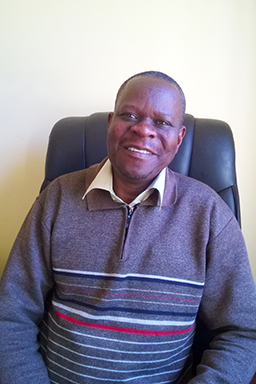
 DTZ-OZGEO discovered a diamond field in Chimanimani, Zimbabwe in 2010 where it is currently mining diamonds. After the superficial weathered rock was mined and processed, the company’s operation is now focused on the diamond-bearing conglomerate being developed by way of drilling and blasting. Bornwell Mupaya, Deputy Managing Director of DTZ-OZGEO is narrating about his company’s achievements during two decades of its existence in his interview to Rough & Polished.
Could you, please tell us about how your company was established?
DTZ-OZGEO was established in 1994 as a joint Russian-Zimbabwean venture initiated by Zimbabwe. The purpose of the company is to extend technical and financial assistance from Russia for the development of Zimbabwe. One of the main principles in the company’s organization is the participation of Zimbabweans as partners.
It is known that ALROSA has signed a technical cooperation agreement with DTZ-OZGEO. What is this cooperation about and how is it being implemented?
DTZ-OZGEO and the Geological Survey Service of ALROSA signed an agreement on technical cooperation for joint research to identify prospective areas to search for new diamond deposits in DTZ-OZGEO’S mining concessions and also assess the diamondiferous potential of the Republic of Zimbabwe.
How successful is your work in Zimbabwe?
The company's activities can be considered to be successful. As you know, you have to spend years of work and make rather huge investments to create a major mining company running as a stable business, as well as to replenish its mineral resources on a continuous basis. DTZ-OZGEO is slowly, but steadily increasing production and exploration throughout the whole period of its activities.
Can you describe the diamond field currently being developed by DTZ-OZGEO?
The economic diamond deposit in Chimanimani is part of the horizon of Proterozoic conglomerates of the Umkondo series (platform deposits). The productive horizon has been studied in detail for a strike of 1.5 km to a depth of 100 meters from the surface. It is not limited along the strike and in depth. We are carrying out exploration on the northern flank of the deposit probing the northern continuation of conglomerates. The horizon of conglomerates has monoclinal occurrence with a drop to the west at an angle of 20-30 degrees. The conglomerate rests on a thick bed of quartz sandstones and is overlain by a bed of siltstones. The productive pack is broken apart by a series of transverse and diagonal faults with keyboard-like upheavals ranging from tens of centimeters to several meters. Regionally, the productive unit is sandwiched between sill-like subconcordant bodies of gabbro-dolerites in the marginal parts of which there are highly hornfelsed sandstones and siltstones.
How different is this diamond field from the diamond fields in Marange?
The Chimanimani conglomerates are significantly different from the Marange conglomerates. The conglomerates in Chimanimani are located stratigraphically at a much higher level compared with the conglomerates in Marange, that overlie Archaean basement granite. The Archaean basement is not exposed in Chimanimani so we can only judge from the relative geological and stratigraphic position of diamondiferous conglomerates, but they are separated from the lower part of the Umkondo deposit section by a very thick (more than 200-250 meters) package of sandstones and aleurolite sands. There are differences in the material composition of the clastic conglomerates and in the particle size and quality of diamonds (and possibly in the composition and sources of diamonds).
How many people do you have in your company?
The company employs over 300 people. Prior to the suspension of the alluvial gold project, the company had more than 500 people.
What kind of equipment do you use for diamond mining?
For diamond mining, we use earth-moving equipment of world-renowned manufacturers, including Russian brands - Chetra, Kamaz, Hyundai, Caterpillar, Kamatsu and others. We also have a state of the art dense media separation plant with x-ray sorters for the final recovery of diamonds.
Are there any challenges the company is facing in the diamond mining operations in Chimanimani?
Chimanimani is located in the mountainous area with a highly dissected terrain. Therefore, the major difficulties for conducting the open-pit mining there are related to these mining and geological complications. The ore body outcrops on one side of the valley and then dips sharply at an angle of 20-30 degrees to the west, which dramatically increases the thickness of overburden, thus making the open-pit mining problematic. The dissected terrain and steep sides of the valley create great difficulties in the construction of tailings and settling dams for the processing plant.
Are you engaged in exploration work to find diamonds?
DTZ-OZGEO is engaged in systematic-based exploration and research. Of note is that the Chimanimani diamond field was discovered and developed by the company’s geologists. Currently, intensive exploration is underway on the northern and southern flanks of the deposit, as well as in prospective areas for diamonds within the large exploration concession of the company in Chimanimani. The company also has several promising exploration targets near the Chimanimani-Save area, where it is carrying out prospecting and exploration works.
Please, say a few words about the Penhalonga gold-mining operation of DTZ-OZGEO.
DTZ-OZGEO discovered the alluvial gold deposit in Penhalonga in 1996 and prior to its development, carried out exploration work for the assessment of gold resources in the whole valley of the Mutare River. Currently, gold mining in this field is not being conducted due to the government's decision to suspend mining activities in the river valleys across the country. We hope that this issue will be resolved in the near future.
Vladimir Malakhov, Rough&Polished
