 Pangolin Diamonds, which prides itself as one of the few exploration companies doing “real” diamond exploration, is optimistic of finding diamonds in Botswana, the world’s leading diamond producing country by value.
With 20 prospecting licenses for precious stones covering little over 10,000 square kilometres in the southern African country, the Toronto Stock Exchange (TSX)-listed company has every reason to be hopeful.
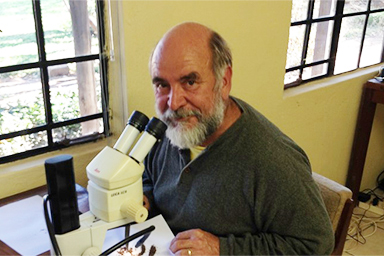
Company president and chief executive Dr. Leon Daniels told Rough & Polished’s Mathew Nyaungwa that current results in the Malatswae Project suggest they are close to discovery. He said the unusual number of diamonds Pangolin had found in a small area of the Malatswae Project strongly indicate that any discovery in the area would be diamondiferous. Daniels said his company should be a producer, not an explorer within the next five years. He also spoke about the company’s other projects in Botswana.
How many licenses are you currently exploring in Botswana?
We are exploring 20 prospecting licenses for precious stones covering little over 10,000 square kilometres. The prospecting licenses are broken down into seven different projects in different parts of Botswana. They are 100% owned by two Botswana registered subsidiaries of the TSX.V (PAN) listed Pangolin Diamonds Corp., that is Geocontracts Botswana and Pangolin Diamonds. We are currently focused on the Malatswae Project where we recovered four diamonds and numerous indicators, many of them have surface texture features that are considered proximal to source and hence we believe we are very close to discovering the source of these indicators and diamonds.
So how optimistic are you of finding the source?
We are very optimistic that we will find the source of the kimberlite indicator minerals in the Malatswae Project. The significantly high numbers of indicators per sample and the primary surface textures of the indicators suggest proximity to source. The recovery of diamonds from the soil samples is the best indicator that the kimberlites will be diamondiferous. We have embarked on an exploration programme that has at its core of design a basic philosophy, discovery. We use soil sampling as our primary tool for our exploration. The company is fortunate to have a small DMS plant that allows us to process our soil samples at least to the stage where we separate the high density concentrate from the bulk of the material to find the indicators. It is a very cost effective process and a distinct advantage to the company. It allows us to cost effectively both increase the number of samples and the size of the samples we collect and thereby increase the probability of discovery.
How difficult is it to get funding when you are conducting an exploration project?
In the present climate, it is difficult to obtain funding. We have a very good base of individuals and investment groups who are supporting us and have continued to support us over the last four years. However, the risk profile is quite high as for any junior resource company. The excellent regional geology for diamond discovery and well respected legal framework of Botswana does reduce the risk somewhat. The difficulty in raising working capital is also reflected in the size and frequencies of the finances. At Pangolin we try to minimize our general costs and try to focus expenditure on the ground where the discoveries are to be made.
At some point you announced that you had discovered what you called probably the largest ever kimberlite pipe in the world. Are you still seeing it that way?
The Magi discovery in our Tsabong North project has been modeled by independent geophysicists to be potentially the largest kimberlite in the world. All the drilling undertaken at the Magi to date has been consistent with that geophysical model. We have recovered 7 diamonds from 2 of the drill holes. In addition, we have recovered kimberlitic ilmenites and mantle-derived garnets and olivine from the drilled core. The material recovered from the core to date appears to be upper crater facies sediments. The geology of the crater facies sediments is quite complex as we believe that the sedimentation of the crater was contemporaneous with the deposition of the upper Karoo sediments. The crater facies material from the Magi is distinctly different to the crater facies material of the Cretaceous kimberlites in the main Tsabong kimberlite field further to the south, e.g. the 180 Ha M1 kimberlite discovered by Falconbridge. The crater facies sediments of those kimberlites contain upper Karoo sediments. The Precambrian kimberlites in the main Tsabong field, e.g. T45, do not contain Karoo sediments in the cretaceous facies material, similar to the Magi. The intrusive kimberlite phase of the Magi has not been intersected during the drilling campaign since the drills we used during the early exploration phase had limited depth capacity.
You previously submitted, I think, about 17 samples of Magi drill core (interrupted)
Magi is the discovery in the Tsabong North project. The drill core samples were submitted to two independent laboratories in Canada for the recovery of micro-diamonds. The two companies use different techniques to process the core for micro-diamond recovery. The core sent to the laboratory of the Saskatchewan Research council recovered four micro-diamonds and the three other diamonds were recovered from core at the laboratory of CF Mineral Research. The diamonds were recovered from DH 5 and DH 8. Core from DH 1 was submitted for kimberlite indicator mineral recovery. A number of indicator minerals were recovered. The results from the core confirm a kimberlitic and mantle intrusive association.
You were planning a further drilling on Magi…have you completed this drilling?
We haven’t been able to complete that drilling due to financial restrictions and also the very positive results are receiving from the Malatswae Project. The Magi programme as proposed internally would see us do a gravity programme followed by two drill holes to a depth which will allow for intersection of the intrusive kimberlite. The gravity surveys will be designed to model the Magi to depth and determine the appropriate depth to drill to.
How much funding are you looking at to enable you accomplish this project in terms of finance?
In terms of finance for the Magi programme as described above the required budget would be in the order of BWP 1 million. The programme will include a detailed gravity survey, drilling and submission of samples for micro-diamond recovery. Depending on the final depth of drilling the budget may be more than BWP1 million.
Tell me more about the Mmadinare project.
The Mmadinare project is a maturing project, we are in a second phase of license renewal. During the initial period of exploration we discovered a lamprophyric intrusion called SWS-21. It’s rather an interesting discovery. The intrusion has lower and upper mantle minerals like ilmenites, chromite and garnet. However, no micro-diamonds were recovered from the core. At present we are following up areas where kimberlite indicator minerals have been reported from with additional soil sampling. We are also reviewing the regional aeromagnetic data over the area to select specific anomalies for more detailed follow-up on the ground. The prospecting licenses are valid to 30 June 2016.
You indicated last year that the company wanted to embark on a major soil sample programme, did you accomplish this target?
We recently announced the progress of our soil sampling programme. We have conducted soil sampling programmes in all our project areas. We have serviced our DMS plant and it is in full production at present. The soil samples from the different projects are processed systematically through the DMS plant. As each batch of samples is completed, the concentrates are dispatched to an independent kimberlite indicator observer who has more than twenty years experience. We have also appointed an independent Qualified Person to monitor the entire exploration activity. In the field we have trebled our sampling capacity to accommodate both the regional sampling programmes as well as the detailed sampling programmes in the Malatswae Project. In the Malatswae Project the soil sampling is focused on areas where we have identified anomalous concentrations of kimberlite indicator minerals and four samples with diamonds. A number of the anomalous samples being followed up are proximal to aeromagnetic anomalies identified from regional aeromagnetic surveys.
Going forward where do you see Pangolin Diamonds in the next five years?
In the current financial climate five years is a long time and diamonds have not been in the spotlight for several years. However, we believe that Pangolin Diamonds is one of the very few exploration companies that do real diamond exploration and will be successful in discovery. The current results in the Malatswae Project suggest we are close to discovery. The unusual number of diamonds we have found in a small area of the Malatswae Project strongly indicate that any discovery in the area will be diamondiferous. The historical presence of diamonds in the Motloutse River Project is also a very positive indicator towards discovering diamondiferous kimberlites. We therefore expect that within the next five years Pangolin will not only be an explorer, but will have graduated to being a producer as well. Pangolin Diamonds has a well-balanced Board and highly experienced “boots on the ground” team to be successful in reaching this objective.
Mathew Nyaungwa, Editor in Chief of the African Bureau, Rough&Polished
